How Much Does It Cost to Build a Mobile App in Dubai in 2026
Real cost ranges in USD and AED for building a mobile app in Dubai in 2026 — broken down by platform, complexity, and developer type, with a guide to hidden fees.

This article may contain affiliate links. See our Disclaimer for details.
Building a mobile app in Dubai is a serious investment, and the numbers you find online are almost always too vague to be useful. "It depends on complexity" tells you nothing when you're trying to get a budget approved or pitch your idea to investors.
This article gives you real market rates for 2026 — in both USD and AED — so you can walk into any developer conversation knowing exactly what to expect.
The Short Answer: What Does a Mobile App Cost in Dubai?
For most apps commissioned in Dubai in 2026, here is where budgets land:
| App Type | USD | AED |
|---|---|---|
| Simple app (1–3 screens, basic features) | $8,000 – $20,000 | AED 29,000 – 73,000 |
| Standard app (5–10 screens, user accounts, API) | $25,000 – $60,000 | AED 92,000 – 220,000 |
| Complex app (custom logic, real-time, payments) | $60,000 – $150,000 | AED 220,000 – 550,000 |
| Enterprise app (integrations, compliance, scale) | $150,000+ | AED 550,000+ |
These are project totals, not monthly rates. We will break each tier down further below.
iOS, Android, or Both? How Platform Affects Price
Choosing your platform is the first decision that shapes your budget.
iOS only or Android only cuts your build time roughly in half. If your audience is clearly on one platform — for example, a luxury service targeting affluent Dubai residents skews heavily toward iOS — starting with a single platform is a smart way to reduce initial spend.
Both platforms (native) means two separate codebases. You are essentially building the app twice, which doubles engineering time and cost.
Cross-platform (React Native or Flutter) writes one codebase that runs on both iOS and Android. For most business apps, this cuts costs by 30–40% compared to building natively for both platforms. The trade-off is minor limitations in very hardware-specific features, which rarely matter for standard business apps.
For the majority of startups and SMEs in Dubai, React Native is the pragmatic choice. It is what I recommend and build with — you get near-native performance at a fraction of the cost.
Breaking Down Costs by Developer Type
Where you hire changes the numbers dramatically.
| Developer Type | Day Rate (USD) | Typical Project Cost |
|---|---|---|
| Dubai-based freelancer | $400 – $800/day | Mid-to-high range |
| Dubai/UAE agency | $600 – $1,200/day | High range, project management included |
| Remote senior developer (Europe/US timezone) | $300 – $600/day | Mid range |
| Offshore team (South Asia, Eastern Europe) | $80 – $200/day | Low range, higher coordination overhead |
A word of caution on offshore teams: the per-day rate is lower, but projects often take significantly longer, require more back-and-forth, and carry a higher risk of scope misalignment. Factor in your own time managing the relationship — that has a real cost too.
Hiring a single experienced developer or a tight two-person team (one developer, one designer) often outperforms a large agency for apps in the $25,000–$80,000 range. Agencies add overhead — account managers, internal reviews, margin — that you are paying for whether you need it or not.
What Each Budget Tier Actually Gets You
Under $20,000 (AED 73,000)
A simple utility or informational app: a few screens, basic navigation, perhaps a contact form or content feed. No user accounts, no payment processing, no backend complexity. Good for a proof of concept or a companion app to an existing service.
$25,000 – $60,000 (AED 92,000 – 220,000)
This is where most real business apps live. You get user authentication, a database backend, third-party integrations (maps, payments, notifications), and a polished UI across both iOS and Android. Think a service booking app, a customer portal, or a basic marketplace.
$60,000 – $150,000 (AED 220,000 – 550,000)
Real-time features (chat, live tracking, live updates), complex business logic, multiple user roles, payment processing with escrow or split payments, admin dashboards. If you are building a two-sided marketplace, a fintech tool, or a logistics platform, this is your tier.
$150,000+ (AED 550,000+)
Enterprise integrations with existing systems (ERP, CRM, legacy databases), compliance requirements (healthcare, finance), custom hardware integrations, or apps designed to serve tens of thousands of concurrent users from day one.
Hidden Costs Most Clients Miss
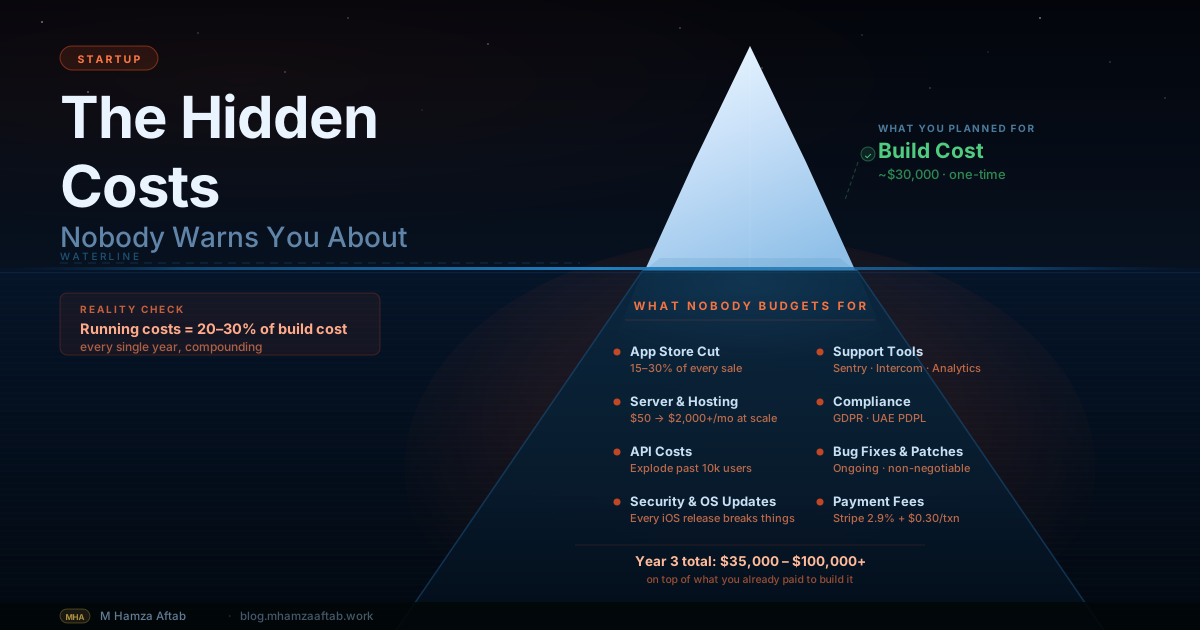
The build cost is only part of the story. These are the expenses that catch people off guard after launch.
App Store fees: Apple Developer Program costs $99/year. Google Play requires a one-time $25 registration fee. Both stores take a 15–30% cut of any in-app revenue.
Backend hosting: Your app needs servers to run on. For a standard app, AWS or Google Cloud typically costs $50–$300/month at launch, scaling upward as users grow.
Third-party services: Payment processing (Stripe, PayTabs, Telr), maps (Google Maps API), push notifications, authentication providers, and SMS gateways all carry monthly fees. Budget $100–$500/month for a standard stack.
Maintenance and updates: iOS and Android release major OS updates every year. Apps that are not actively maintained stop working, get removed from the store, or develop security vulnerabilities. A reasonable maintenance retainer for a standard app runs $1,000–$3,000/month, or you can budget for quarterly update sprints.
QA and testing: If your agency or developer is not including dedicated testing time, that is a red flag — and an additional cost. Good QA is 15–20% of the build cost.
How to Reduce Your Budget Without Cutting Corners
Choose cross-platform from the start. React Native gives you a single codebase for iOS and Android. Unless your app does something that genuinely requires native-only capabilities, there is no reason to build twice.
Build an MVP first. Ship the core feature that proves your concept — one problem, solved well. Get real users before adding the full feature list. An MVP at $25,000 that gets 500 paying users is infinitely more valuable than a $120,000 app built on assumptions. I cover this in depth in How Much Does It Cost to Build an MVP in 2026.
Reduce design scope. Custom illustrations, complex animations, and pixel-perfect design systems are expensive. A clean, functional UI with a solid component library costs a fraction of bespoke design.
Hire the right level of experience for each task. A senior developer should architect the system and write the complex logic. Simpler screens and admin panels can be handled by a mid-level developer at a lower rate.
Getting an Accurate Quote
Any developer or agency quoting a price without first understanding your full requirements is guessing. A useful quote comes after a discovery session where you walk through user flows, integrations, and edge cases together.
Before speaking to anyone, prepare three things:
- A list of every screen you think the app needs
- A description of who will use it and what problem it solves
- Any third-party services it needs to connect to (payment systems, maps, existing software)
That conversation will save you from ballpark quotes that turn into scope creep disasters later.
If you are planning a mobile app and want a straight answer on what your specific project would cost — no sales pitch, no hidden agenda — let's talk. I work with startups and businesses across Dubai and the UAE, and I'm happy to give you an honest assessment before you commit to anything.