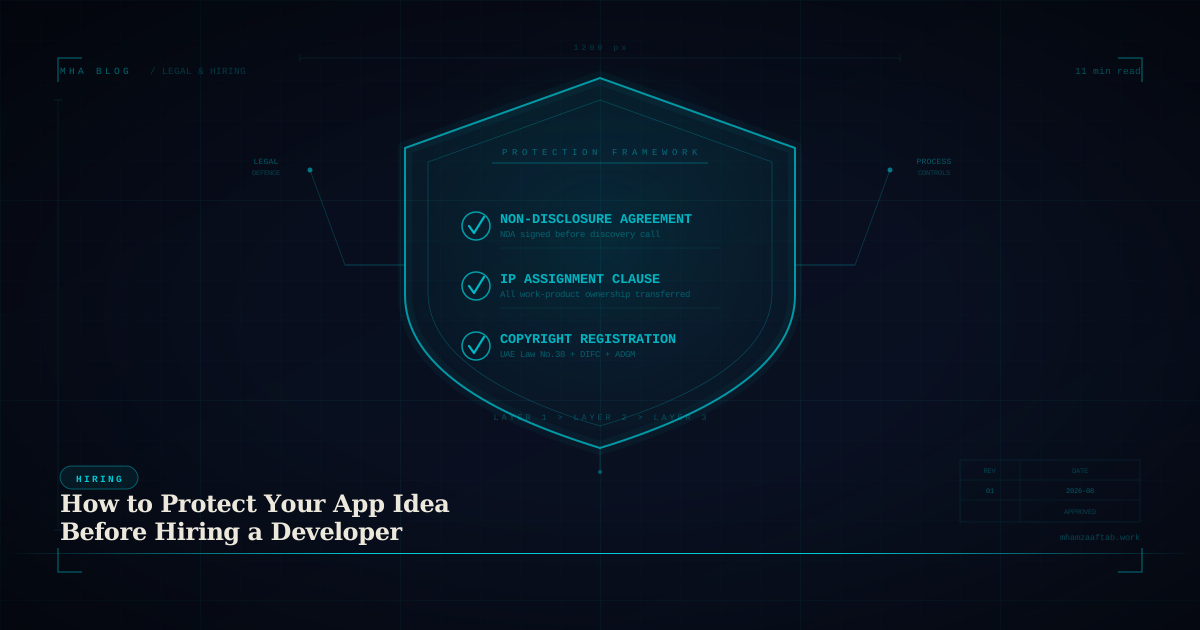
How to Protect Your App Idea Before Hiring a Developer
Worried a developer might steal your app idea? A senior full-stack developer explains what actually happens during discovery calls, what NDAs really cover, and the three documents you need before development starts.

This article may contain affiliate links. See our Disclaimer for details.
I've been on the developer side of this conversation hundreds of times. The founder is vague about what the app does, speaking in abstractions — "a platform that connects people" — and when I ask a direct scoping question, they pause before answering. Sometimes they say it outright: "I don't want to share too much until we have something signed."
The instinct makes sense. You've spent months developing an idea. You're about to explain it to a stranger. The anxiety is real and I don't dismiss it.
But most founders are protecting the wrong thing, at the wrong stage, with the wrong document. This is a practical guide to how to protect your app idea before hiring a developer — what the risks actually are (they're different from what you think), which legal instruments cover which threats, and what UAE-specific law means for your situation if you're building here.
The Fear Is Real — And Here Is What Actually Happens
There's a version of idea theft that founders imagine: the developer listens carefully, takes notes, builds your app over the following six months, and launches it before you do. This scenario is vanishingly rare. The realistic risks are different — and more addressable.
What a Developer Is Actually Thinking During Your First Call
When I'm in a discovery call, I'm running a specific mental checklist. Stealing the idea is not on it.
What I'm actually tracking:
Scope clarity. Do you know what you want to build, or is this a moving target? Vague scope at the discovery stage reliably produces scope creep later. Clients who can't describe the core use case in two sentences are a project risk.
Technical complexity. Is this a two-month build or a six-month build? Does it need real-time database sync, third-party API integrations, a complex permissions model, or AI features? The idea tells me almost nothing — the feature list tells me everything.
Client quality signals. Are you clear-headed and decisive? Do you communicate what you mean? Are your expectations anchored in reality? A difficult client costs more, in time and energy, than a technically complex project.
Budget fit. Is this a $15,000 project or a $150,000 project? A 45-minute call that ends with "our budget is $3,000" is time I've lost.
Project risk. Is there existing code I'd be inheriting? Compliance requirements I haven't worked with before?
The idea itself — the market insight, the problem you've spotted, the category — barely registers against these five things. An idea without execution is worth nothing to a developer. Executing someone else's idea while you sit on the sidelines is unattractive work at any hourly rate.
Why Developers Almost Never Steal App Ideas
Three reasons, all structural:
Reputation is everything. The developer market is smaller than it looks. Word travels through LinkedIn, referrals, and platform reviews. A developer known for taking client ideas and running doesn't get referred. Losing a reputation over one speculative project is a terrible trade — and experienced developers know it.
Execution is the hard part. An idea without a founding team, marketing budget, domain expertise, and 12–18 months of sustained work is worth nothing. A developer who built your app would then need to build an entire company around it: hire sales, acquire users, manage support, raise funding. Most developers went into development specifically to avoid that work. The gap between "I have this idea" and "I have a business" is one experienced developers understand precisely.
The time arbitrage doesn't work. A developer billing $80–$150/hour on real client projects doesn't have a rational incentive to spend evenings building a speculative copy of your app in a category where they have no users, no domain insight, and no traction.
None of this means you share your detailed business model on a cold call. But the risk is lower than most founders expect — before their first discovery call, the fear almost always outruns the reality.
What Information You Actually Need to Protect
Before you worry about mechanisms, clarify what you're protecting. The answer is more specific — and more limited — than most founders assume.
The Three Layers of What You Actually Own
An idea is not protectable. "A marketplace for freelance interior designers in Dubai" is a category description, not IP. What is protectable:
Layer 1 — Your business model specifics. Not "marketplace" — but your specific fee structure, proprietary sourcing relationships, go-to-market strategy, and pricing logic. These represent genuine competitive thinking worth protecting.
Layer 2 — Your UX and UI designs. Wireframes, design files, user flow diagrams, and prototypes. Once these exist, they're protectable as original creative works. They encode how you've decided to solve the problem — not just that you want to solve it.
Layer 3 — Your source code. Code is protected by copyright the moment it's written. Under UAE Federal Law No. 38 of 2021 on the Protection of Literary and Artistic Works, copyright vests automatically in the author — the person who created the work. If a developer writes your app code, they own it by default unless a written agreement transfers that ownership to you. This is the protection gap that actually harms founders.
What "IP Theft" Actually Looks Like in Practice vs. What You Fear
What founders imagine: a developer steals the idea during a call and launches a competing app six months later.
What actually happens (rarely, but it does): a developer retains your source code after the project ends and either uses it as a template for a similar future client, or continues developing the same concept because no assignment was ever signed.
The real threat is not idea disclosure during a discovery call. It's code ownership at the end of a project. Both are solvable — but they require different documents.
What to Share — and What to Hold Back — at Each Stage
The right sequence protects you without turning every developer conversation into a legal negotiation.
Stage 1 — Before Any Agreement (Discovery Call)
Share freely: the problem you're solving, your target user, the broad category of solution, and why existing products don't work for you. A developer needs this to assess scope and whether they're the right fit. Withholding it doesn't protect you — it just makes the call unproductive and makes you look difficult to work with.
Hold back: your specific monetisation model, proprietary data insights, detailed wireframes or flow diagrams, any existing code, and specific partnership arrangements that represent genuine competitive advantage.
Stage 2 — After NDA Is Signed
Share: business model specifics, wireframes and design concepts, existing market research, technical specifications, and any proprietary data that informs the build. The NDA protects what you share verbally and in documents. It does not protect what gets built — that's the development agreement's job.
Stage 3 — After Development Agreement Is Signed
Share: access to production systems, existing codebase, API keys, third-party accounts, and sensitive integrations. By this point, the IP assignment clause covers what's built, and the NDA covers what's discussed. Both documents together give you meaningful protection across the full engagement.
Do You Need an NDA Before a Discovery Call?
No — not for an initial discovery call where you're sharing the problem and broad vision. A post-meeting NDA signed before you share wireframes or business model details is sufficient for the vast majority of projects. Requiring a pre-meeting NDA before a first call filters out qualified developers who work at volume and won't sign legal paperwork for an exploratory conversation with someone they haven't met.
When You Should Require an NDA Before the First Meeting
There are three situations where that friction is worth it:
-
The idea involves a genuine trade secret. If your app's core value is a proprietary dataset, a unique algorithm, or a process you've developed — and even describing it risks meaningful disclosure — sign first.
-
You're in a heavily regulated sector. Healthcare, fintech, legal tech: if describing how the app works inherently reveals proprietary clinical, financial, or legal methodology, protect it before the call.
-
You've been burned before. If you have direct experience with IP misuse, requiring a pre-call NDA is a reasonable personal policy. You'll lose some candidates, but you'll feel better about the process.
When a Post-Meeting NDA Is Sufficient
For most app projects, an NDA signed after the discovery call but before you share wireframes or detailed specifications is the right balance. Both sides have assessed fit. The NDA then covers everything disclosed from that point forward — including what was discussed in the meeting, if the language explicitly reaches back to prior disclosures.
Ask your lawyer to confirm the backdating language if an initial conversation already happened without a signed agreement.
Platform Hiring vs. Direct Hire — NDA Differences
When you hire through Upwork or Toptal, the platform's Terms of Service include baseline IP provisions that provide some contractual protection by default. They're not as thorough as a purpose-built development agreement, but they cover the basics. Platform hiring adds contract protection that direct hire requires you to build yourself — which means with direct hire, your own NDA and development agreement carry the full weight of your protection.
What a Strong NDA for App Development Must Include
A generic NDA template from a legal document site covers the basics. A purpose-built NDA for app development covers five clauses that generic templates handle poorly.
Mutual vs. One-Way NDA
A one-way (unilateral) NDA protects information flowing from you to the developer. A mutual NDA protects both directions — you're also bound not to disclose information the developer shares about their processes, tools, or other clients.
For most engagements, mutual is the professional standard. One-way NDAs signal distrust upfront; experienced developers in the commercial market will often flag this. A one-way NDA is appropriate when you're sharing genuinely proprietary information and the developer has nothing material to share in return — rare in practice.
Definition of Confidential Information — The Critical Clause
The definition clause determines what's actually protected. A narrow definition — "any document marked CONFIDENTIAL" — leaves verbal disclosures, design mockups shared via Figma link, and phone conversations entirely unprotected.
A strong definition covers:
- All information disclosed verbally or in written form
- Technical designs, specifications, wireframes, and prototypes
- Business models, pricing strategies, and market research
- Source code, algorithms, and system architecture
- Information disclosed before the NDA was signed (explicitly included)
That last point matters. If you had a call three weeks ago and are now signing an NDA, everything said in that call is unprotected unless the definition clause explicitly reaches back.
Exclusions from Confidentiality
Standard exclusions protect the developer from being bound to treat publicly available information as confidential. A well-drafted NDA excludes:
- Information already publicly known at the time of disclosure
- Information the developer already possessed before your engagement
- Information they independently developed without reference to your disclosures
- Information required by law or court order to be disclosed
All four are standard. A developer's NDA with no exclusions at all is worth questioning — it usually means the template was never reviewed by a lawyer.
Term Length
For app development, a 2–5 year term is the standard range. Shorter than two years is too brief for early-stage startups whose IP may not become commercially valuable until year three. Longer than five years can face enforceability challenges — UAE courts give weight to proportionality and may not uphold obligations they consider unreasonably restrictive on trade.
Jurisdiction — Especially Critical for UAE
The jurisdiction clause determines which courts will hear a dispute. Most NDAs downloaded from US legal sites default to a US state. That's not useful if you're in Dubai contracting with a developer in Pakistan, India, or anywhere else.
For UAE-based founders, two practical options:
Dubai Mainland Courts apply UAE Civil Law. Proceedings are in Arabic. Well-suited for disputes between UAE-resident parties.
DIFC Courts apply English Common Law. Proceedings are in English. Preferred for contracts involving international parties or foreign developers — DIFC judgments enforce in over 170 jurisdictions through existing treaty arrangements. If your developer is not UAE-based, specifying DIFC jurisdiction is the more practical choice.
Don't leave jurisdiction to implication. Specify it before you sign.
Red Flags in Developer-Provided NDAs
When a developer sends their own NDA template:
- A jurisdiction clause specifying their home country (intentional or careless — enforcement shifts to their territory)
- Confidentiality defined as documentation-only or marked-documents-only
- No IP assignment clause (different from the NDA — its absence means the developer may retain code ownership)
- An indemnification clause exposing you to the developer's legal costs if a dispute finds in their favour
None of these necessarily make the developer dishonest. They usually mean the template wasn't built for commercial app development. Mark up the clauses and negotiate — don't reject the developer over a template.
IP Assignment — The Clause That Actually Matters More Than the NDA
An NDA protects what you say. An IP assignment clause protects what gets built. Most founders spend all their attention on the NDA and none on the assignment. This is backwards.
What an IP Assignment Clause Says in Plain English
An IP assignment clause in your development agreement establishes that all code, designs, documentation, and related work created during the project — and all intellectual property rights in those materials — transfer to you upon delivery and full payment.
Without it, you receive the code. But the developer retains the copyright. They can legally provide a near-identical codebase to another client, because ownership never transferred.
A well-drafted assignment clause covers:
- All work product: code, design assets, documentation, and third-party integrations developed specifically for your project
- Assignment effective upon full payment (not upon delivery — tie the IP transfer to payment milestones)
- The developer agrees to execute any further documents required to perfect the assignment
Subcontractor Coverage — The Overlooked Gap
Almost no protection guide covers this, so pay attention: if the developer you hire subcontracts any part of the work, the IP assignment in your agreement covers only their output — not the subcontractor's.
If the developer brings in a specialist to build a payment integration, a mobile front-end, or a backend service — and that subcontractor writes original code — they hold copyright in that code. Your assignment clause with the primary developer doesn't reach them.
The fix is explicit subcontractor language in your development agreement: the developer must ensure that any subcontractors they engage sign IP assignment agreements that flow upward to you. Some developers working at commercial scale already have these arrangements in place. Others haven't thought about it. Ask before you sign.
The type of developer you hire affects which protection documents apply — agencies typically have established subcontractor relationships with template assignments already in place; independent freelancers may not.
UAE Copyright Law and Why This Is Mandatory Here
Under UAE Federal Law No. 38 of 2021, copyright vests automatically in the author — the creator of the work. There is no work-for-hire doctrine in UAE law that automatically transfers copyright to a commissioning client when an independent contractor is engaged. This distinguishes UAE from some other jurisdictions, particularly the United States, where certain contractor-created works can qualify as works made for hire.
If you pay a developer AED 100,000 to build your app and no IP assignment clause exists, that developer legally owns the code. An explicit written assignment — signed by the developer and referencing the specific deliverables — is the only mechanism that transfers ownership. It is not optional.
If you have a development agreement in front of you and there is no explicit IP assignment clause — or if you're not sure whether the clause in your agreement actually transfers ownership — book a free 30-minute call before you sign. I'll review the agreement structure, identify what needs to change, and give you the language to add. No proposal deck, no sales process.
Protecting Your App Idea in Dubai and the UAE
Are NDAs Enforceable in the UAE?
Yes. NDAs are enforceable under the UAE Civil Code (Federal Law No. 5 of 1985), specifically Articles 246 and 247, which establish binding obligations from contracts and the principle of good faith in contract performance. Courts have upheld confidentiality agreements in commercial disputes. Practical enforceability depends on clarity of drafting, your ability to demonstrate a breach and quantify harm, and your choice of court — DIFC courts are generally more efficient for commercial IP matters.
Trademark Registration for Your App
Trademark registration protects your app name and logo — not the underlying code or functionality, but the brand identity. In the UAE, registration is through the Ministry of Economy's Trademark Registration system. A single-class trademark application (one category of goods or services) typically costs AED 8,000–15,000 including professional fees, with a standard timeline of 3–6 months for an unchallenged application.
UAE trademark rights go to the first filer, not the first user. A competitor who registers your app name before you do has legally enforceable rights — even if you've been operating under that name for months. File before you launch.
DIFC vs Mainland Courts for IP Disputes
In Dubai, which court you specify in the contract is not a formality.
Dubai Mainland Courts apply UAE Civil Law, conduct proceedings in Arabic, and are the natural forum for disputes between parties both resident in the UAE.
DIFC Courts are a different calculation: English Common Law, proceedings in English, and judgments enforceable across 170-plus jurisdictions through existing treaty arrangements. That last point matters when your developer is based outside the UAE. A DIFC judgment against a developer in India or Pakistan is actionable. A mainland judgment against the same party is considerably harder to pursue abroad. If your developer is international, specify DIFC. If they are UAE-based, mainland is the simpler choice.
Copyright Registration in the UAE
Copyright exists automatically upon creation — no registration is required to own it. Registration with the Ministry of Economy's Intellectual Property Department is optional but creates an officially dated record of ownership that is useful evidence in a dispute. Registration costs are modest: AED 1,000–3,000 for most software works. For serious commercial projects, registering the copyright in the delivered codebase and design assets after project completion is worth doing. A GitHub commit timestamp and an officially dated government record are not treated the same way in a courtroom.
Your Pre-Hire Protection Checklist
Before Your First Call
- Separate what's genuinely proprietary from what's just contextual — the problem statement and broad category are safe to share
- Validate core demand before sharing details with any developer — know what you're protecting before you protect it
- Understand what type of developer your project requires — the type of engagement shapes which protection documents apply
Before Sharing Proprietary Details
- NDA signed — explicitly covers verbal disclosures, wireframes, and business model specifics
- NDA backdates to cover any prior conversation if one has already taken place
- NDA jurisdiction is specified (DIFC if your developer is not UAE-based)
- Confidential information definition covers verbal and informal disclosures, not just marked documents
Before Signing the Development Agreement
- IP assignment clause confirmed — all work product, code, and design assets transfer to you upon full payment
- Subcontractor coverage clause confirmed — the developer is required to flow down assignment obligations to any third parties they engage
- Payment structure is milestone-based, with IP transfer explicitly tied to each payment milestone
- Governing law and jurisdiction explicitly stated in the agreement
- Use this checklist to vet the developer's technical ability and communication style once documents are in place
After Launch
- Register copyright in core app assets with the UAE Ministry of Economy (AED 1,000–3,000)
- File trademark application for app name and logo (AED 8,000–15,000 per class) — file before launch
- Confirm all final deliverables have transferred: code repository access, design source files, third-party platform accounts
If you're at the stage where this checklist applies — reviewing an agreement, about to brief a developer, or choosing between candidates — and you want to confirm the protection structure is complete before anything is signed, book a free 30-minute call. I'll go through the documents you have, tell you what's missing, and give you the specific language to add before the project starts. No proposal deck, no sales process.
Frequently Asked Questions
Do I need an NDA before talking to a developer for the first time?
No — not for an initial discovery call. Share the problem you're solving and the broad category of your solution freely; a developer needs this to assess scope and fit. An NDA becomes necessary before you share wireframes, your specific business model, or proprietary data. Requiring an NDA before a first exploratory call typically filters out strong candidates who work at commercial volume rather than protecting you from meaningful risk.
Can a developer steal your app idea?
Yes, but almost never in the way founders imagine. The realistic risk is not idea theft during a discovery call — it's a developer retaining your source code after a project ends because no IP assignment was signed, then reusing that codebase for a similar future project. The idea itself has minimal commercial value without execution. The code, designs, and systems built around it are what need legal protection. An IP assignment clause closes this gap; a general NDA alone does not.
What is the difference between an NDA and an IP assignment agreement?
An NDA governs information you share — verbally, in documents, or in designs — and prevents the developer from disclosing or using it outside the project. An IP assignment clause (part of your development agreement) transfers ownership of what gets built to you. You need both. An NDA without an IP assignment leaves code ownership with the developer. An IP assignment without an NDA leaves your pre-build disclosures unprotected. Neither document substitutes for the other.
Should my NDA cover the developer's subcontractors?
Yes, explicitly. If the developer subcontracts any component — a mobile front-end, a payment integration, a backend API — the subcontractor creates original code they own by default. Your NDA and IP assignment with the primary developer don't automatically extend to third parties the developer engages. Require a clause that obliges the developer to bind any subcontractors to matching confidentiality obligations and to obtain IP assignment from them before delivering work to you.
Are free NDA templates good enough for app development?
For a basic first call, a downloaded template is better than nothing. For a real development engagement, they're usually inadequate — specifically: the definition of confidential information is often too narrow (documentation-only), the jurisdiction defaults to a US state that is irrelevant in the UAE, and there is typically no subcontractor coverage or IP assignment language. Spending AED 500–1,500 on a local lawyer to adapt a template to UAE law and your specific project is a proportionate investment against a build that costs AED 50,000 or more.
What happens if a developer builds a competing app after our project ends?
Without a non-compete clause, nothing prevents it — legally. UAE courts enforce non-compete clauses in commercial contracts, but only when limited in scope (specific market segment), geography, and duration (typically 1–2 years maximum for enforceability). They're harder to enforce than IP assignment clauses and will be a negotiation point — experienced independent developers often push back on broad restrictions. A non-compete is a secondary protection; the IP assignment clause is the primary one. If the developer doesn't own your code, a competing app would have to be rebuilt from scratch, which is a meaningful practical barrier even without a contractual restriction.
What This Looks Like When You Work With Me
Before any project starts, I send every client three things without being asked: a mutual NDA, an IP assignment clause embedded in the development agreement, and a milestone-based payment structure where each milestone payment triggers the release of both the deliverables and the IP in those deliverables.
Discovery calls require no paperwork before we speak. Share the problem you're trying to solve, the users you're building for, and why existing solutions fall short — that's all I need to assess whether I'm the right fit. If we move forward, the NDA follows within 24 hours, before any further specifics are exchanged.
The subcontractor coverage clause is standard in my agreements. If the project scope requires specialist work I bring in, the assignment chain is already in place. You own everything delivered, end to end.
When you're ready to have that first conversation, here's how I work with founders at this stage. No legal paperwork before we've spoken, no proposal deck, no sales process.