The Hidden Costs of Running an App Nobody Warns You About
You budgeted for building. Did you budget for running? Here are every ongoing cost founders miss — server bills, App Store fees, API scaling, compliance, and more.

This article may contain affiliate links. See our Disclaimer for details.
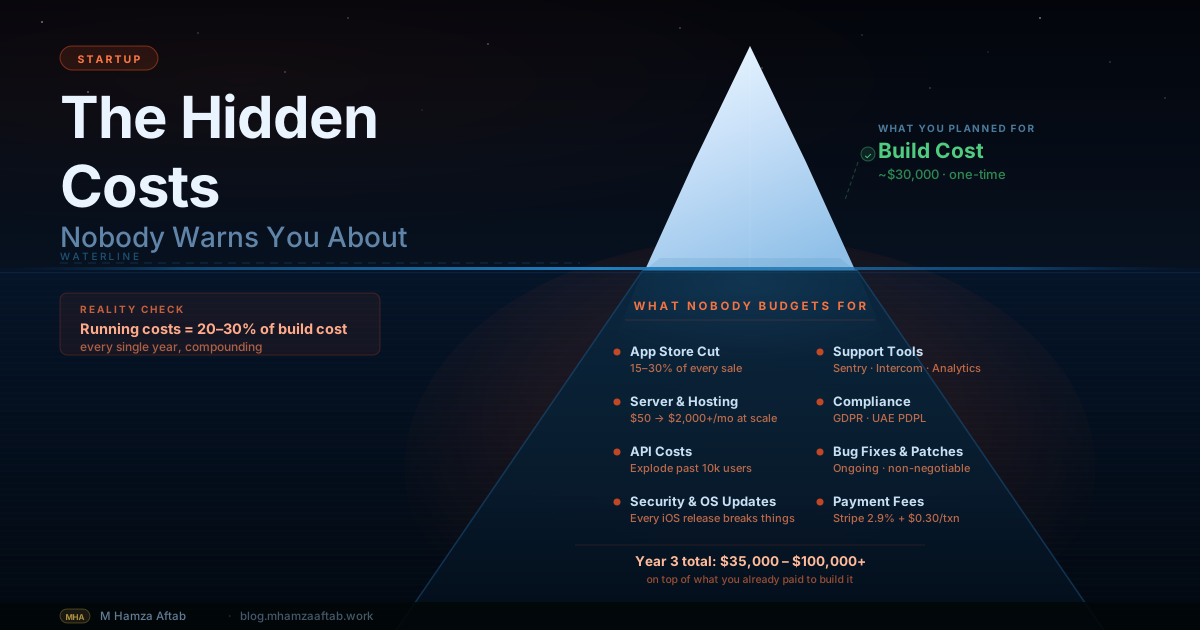
One of my clients budgeted $30,000 to build his app. The build came in on time and on budget. Four months after launch, he sent me a screenshot: a $2,100 AWS bill. His app had picked up traction — around 4,000 users — and the free tier had expired across three services simultaneously. He hadn't budgeted a cent for running costs.
It's not an unusual story. Most founders treat the build cost as the cost of their app. It isn't. The build is the down payment. Running the app is the mortgage — and unlike a mortgage, the payments go up as your product gets more popular.
This covers every recurring cost that hits after launch: App Store fees, infrastructure that scales with users, APIs that get expensive fast, security work you can't skip, compliance requirements, and the tooling stack that keeps everything manageable. Real dollar figures throughout, and a year-by-year cost table so you can actually plan for this.
If you haven't worked out your build cost yet, start with the mobile app cost breakdown first — this article picks up where that one leaves off.
If you are in the planning stage and your running costs are not yet in the financial model — book a free 30-minute call. I will go through your specific product and give you a realistic year-one and year-two running cost estimate before you commit to a stack or a pricing model. No pitch, just the numbers your plan needs.
The App Store Tax Nobody Budgets For
Every app distributed through Apple or Google is subject to platform fees. Non-negotiable, non-optimizable, and not going away.
Apple Developer Program: $99/year. A flat fee to keep your developer account active. Miss the renewal and Apple removes your app from the store within 30 days. It covers TestFlight, developer tools, and access to App Store Connect — but the primary reason you're paying is to keep your app live.
Google Play: $25 one-time. You pay once for lifetime publishing access on Android. One of the few examples of a platform being reasonable about developer fees.
The bigger cost is the revenue cut on in-app purchases and subscriptions.
Apple takes 30% of all in-app subscription revenue. That rate drops to 15% if your app earns less than $1 million annually through the App Store — Apple's Small Business Program, which most early-stage apps qualify for. Once you cross $1 million in App Store revenue, the 30% rate applies to everything above that.
Google Play charges 15% on the first $1 million in annual earnings, then 30% above that. Google cut its standard rate from 30% to 15% for the first million — a meaningful difference for smaller developers.
If your app earns $10,000 per month in subscriptions, Apple keeps between $1,500 and $3,000 of that before a cent reaches your account. Every month, indefinitely.
At $50,000 per month in subscription revenue, you're giving up $7,500–$15,000 per month in platform fees. This is not a cost you can negotiate down or route around for native in-app purchases. Plan for it before you set your pricing — it belongs in your unit economics from day one, not as an afterthought when you're calculating margins. If you're still deciding which revenue model to use, the app monetisation guide walks through how each model interacts with these platform cuts.
Server and Hosting Costs That Grow With You
Hosting is the cost every pitch deck treats as a small line item in year one — and the one that causes the most surprises by year three.
The free tier trap
Every major cloud platform offers a free tier. Vercel's Hobby plan, Railway's trial credits, Supabase's free tier, AWS Free Tier — these exist to help developers prototype and test. They are not designed for production apps with real users.
The problem isn't that free tiers are stingy. It's that the upgrade curve is steep and the transitions are abrupt. Vercel's Hobby plan gives you 100GB of bandwidth; their Pro plan starts at $20/month. Supabase's free tier gives you 500MB of database storage; their Pro plan is $25/month per project. A media-heavy app with 5,000 active users will exceed both limits.
When multiple services hit their limits in the same month — which they often do, since user growth drives all of them simultaneously — you get the $2,100 bill my client received.
What actually drives infrastructure costs
Database reads and writes. Every user action that touches your database costs something at scale. Apps with real-time features, activity feeds, or search-heavy interfaces accumulate database costs faster than simpler read-light applications.
File storage and CDN bandwidth. If your app stores photos, videos, or documents, storage compounds monthly. CDN bandwidth to deliver those assets globally adds another layer.
Compute time. Backend functions and server-side APIs cost per execution at scale. The jump from 100,000 API calls per month to 1 million is not a 10x increase in cost because of tier thresholds — sometimes it's closer to 15–20x.
Year 1 to Year 3 trajectory
| Category | Year 1 (0–2k MAU) | Year 2 (2k–15k MAU) | Year 3 (15k–50k+ MAU) |
|---|---|---|---|
| Hosting and compute | $300–$1,500/yr | $1,200–$4,800/yr | $6,000–$24,000/yr |
| Database (storage + operations) | $150–$600/yr | $600–$2,400/yr | $2,400–$9,600/yr |
| CDN and bandwidth | $0–$300/yr | $300–$1,200/yr | $1,200–$4,800/yr |
| Infrastructure subtotal | $450–$2,400/yr | $2,100–$8,400/yr | $9,600–$38,400/yr |
These ranges are based on a standard consumer app on a managed stack — Vercel plus Supabase or a comparable AWS setup. Real-time apps, video platforms, or two-sided marketplaces can run 2–5x higher at the same MAU count. If you're building a SaaS product rather than a consumer app, the SaaS product architecture guide covers the infrastructure decisions that have the most impact on this cost curve.
The API Cost Scaling Bomb
This is the section most cost guides skip. External APIs feel free during development because you're on free tiers hitting endpoints a few times per day. Then your app grows. You discover that "free" had a usage limit attached, and the paid tier pricing is built for enterprise customers.
| Service | 1,000 MAU | 10,000 MAU | 50,000 MAU |
|---|---|---|---|
| Google Maps (Places + Directions) | ~$20/mo | ~$200/mo | ~$1,000/mo |
| Push notifications (OneSignal) | $0 (free tier) | $0 (free tier) | $99/mo |
| Authentication (Clerk) | $0 (free under 10k MAU) | $25/mo | $200–$500/mo |
| SMS OTP verification (Twilio) | ~$7.50/mo (1k SMS) | ~$75/mo (10k SMS) | ~$375/mo (50k SMS) |
| Transactional email (SendGrid) | $0 (free tier) | $20/mo | $90/mo |
| Error monitoring (Sentry) | $0 (free tier) | $26/mo | $80/mo |
| Total monthly | ~$28/mo | ~$346/mo | ~$2,144/mo |
At 50,000 monthly active users, external APIs alone can cost over $2,100 per month — before you've paid a cent for servers.
Google Maps. If your app shows maps, calculates routes, or autocompletes addresses, you're consuming Google Maps API credits. A single "find nearby restaurants" action can trigger a Places Nearby call, a Place Details call, and a static map tile request — three billable events from one tap. Mapbox offers comparable functionality at lower per-request pricing and is worth evaluating at the architecture stage, not after you've received a $500 Maps bill.
SMS OTP. Every phone verification costs $0.0075 per SMS with Twilio on a US number, and more for international numbers. At 10,000 new sign-ups per month, verification alone costs $75 minimum — and that's before password resets, two-factor authentication prompts, or account recovery flows. Apps targeting markets with expensive SMS rates (parts of South Asia, some African markets) can see this cost run 3–5x higher per message.
Authentication services. Auth0 is free up to 7,500 monthly active users, then climbs steeply. Clerk is free up to 10,000 MAU, then $25/month with per-MAU charges above that. Neither will hurt you early. But both have pricing cliffs that hit at exactly the moment you're celebrating user growth — which is when the last thing you want is a surprise vendor bill.
Stripe. Every transaction costs 2.9% + $0.30. At $100,000 per month in payment volume, Stripe takes $2,900 off the top before any other cost. At $500,000 per month, you can negotiate enterprise rates — but below that threshold, you're on standard pricing. This is not a running cost you can optimise away; it's a cost of doing business that belongs in your pricing model before launch.
If that cost table maps closely to your product's planned feature set — book a free 30-minute call. I will model the API cost curve for your specific features, identify which services hit their pricing cliffs earliest at your target user count, and tell you which architecture decisions now prevent that $2,144/month figure from applying to your product. No proposal deck, no sales process.
Model these costs before you ship, not after the bills arrive. The APIs themselves aren't the problem — building pricing that assumes they're free is.
Security, Updates, and Compatibility Work
Shipping the app is not the end of the build. Every OS update, every newly discovered vulnerability, and every dependency that falls behind creates work — whether you've budgeted for it or not.
iOS and Android OS updates. Apple releases a major iOS version every September. Google releases major Android versions annually. Each can break native app features, deprecated APIs, or third-party SDK integrations. Keeping your app functional through new OS releases requires a developer to test against beta builds, fix incompatibilities, and push updates before the release date. Budget for 1–3 weeks of developer time per year, minimum, for a maintained app.
Dependency and security patches. A typical mobile or web app depends on dozens of npm packages, mobile SDKs, and third-party libraries. Each introduces potential vulnerabilities. The npm ecosystem in particular has a track record of supply chain attacks through compromised packages. If you are not actively maintaining dependencies, you accumulate security debt — and at some point a critical vulnerability forces an emergency update regardless of budget or timing. Emergency developer time is expensive.
SSL certificates. Let's Encrypt provides free SSL certificates, and most managed hosting platforms handle renewal automatically. If you're running a self-managed stack, managed certificates from AWS Certificate Manager or similar providers cost $50–$300/year. Not a major line item — but one that causes real incidents when it lapses and nobody caught the expiry reminder.
Penetration testing. For funded startups handling user data or payments, enterprise customers and investors will ask whether you've conducted security testing. A basic web and API penetration test costs $2,000–$5,000. A comprehensive mobile and web pen test with a full written report runs $5,000–$15,000. Once per year is the standard cadence. If budget is the real constraint in year one, skip it — but not in year two once you have paying customers.
The Support and Tooling Layer
Running an app without instrumentation is flying blind. You find out something is broken through a one-star review rather than an alert — by which point you've already lost the users who didn't bother leaving one. The tooling to observe what's happening, handle support requests, and understand usage patterns adds real monthly cost, but the alternative is worse.
Customer support. Every app with real users generates support requests. Crisp starts at $25/month for live chat and basic ticketing. Intercom's starter plan runs $39/month. Email-only support misses requests, creates slow response cycles, and gives you no visibility into recurring problems — so you ship the same bug twice. Worth paying for from launch.
Product analytics. You need to know which features users actually use and where they drop off. Mixpanel's free tier covers 20 million events per month — generous for early-stage apps. Amplitude's free tier handles 10 million. Once you exceed those limits, paid plans start at $20–$30/month and scale with volume. PostHog is worth evaluating if you want data under your own control: open-source, self-hosted, and you pay for infrastructure rather than a SaaS subscription.
Error monitoring. Sentry is the standard. Free tier handles 5,000 errors per month — enough for most early apps. Paid tier starts at $26/month for 50,000 errors. Set it up on day one, not because you'll have many errors, but because when you do you need to know before your users do.
Transactional email. Account confirmations, password resets, receipts, onboarding sequences. Resend's free tier handles 3,000 emails per month; SendGrid's covers the same. Both run $20–$30/month once you scale past those limits.
Compliance Costs: GDPR and UAE PDPL
If your app handles personal data — and nearly every app does — compliance is not optional. It's not free, either.
GDPR applies if any of your users are in the EU or UK. The requirements include an accurate privacy policy describing your data collection and processing, a cookie and consent management system, the ability for users to request their data be deleted, and signed data processing agreements with your third-party service providers.
- Privacy policy (lawyer-reviewed): $500–$2,000 one-time. Generic templates downloaded from the internet are not adequate for funded companies or apps handling sensitive data. A policy that actually reflects your data flows costs money to produce — and costs more to avoid when a regulator asks for it.
- Consent management platform: $0–$50/month. Cookiebot, Axeptio, and similar tools handle the consent banner and log user preferences. Most have free tiers that cover small apps.
- Data residency. If your compliance requirements mandate that EU users' data stays in EU-region infrastructure, you may need to provision EU instances of your cloud providers rather than defaulting to US regions. This restricts latency options and can add cost if you end up running parallel regional stacks.
UAE PDPL (Personal Data Protection Law) applies if you have users in the UAE. The law has been in effect since 2022 and covers any business processing the personal data of UAE residents. Key requirements include a privacy policy, defined data retention periods, user deletion mechanisms, and in some cases registration with the UAE Data Office. If you're building a consumer app targeting the Dubai market, factor a legal review of your data flows into your launch preparation — not as an ongoing running cost, but as a one-time compliance investment. The ongoing cost is the annual policy review and operational compliance work, which typically runs $200–$600/year once the initial documentation is in place.
In practice, this means a Dubai-market app storing user profiles and transaction history on a US-region cloud instance — with no privacy policy beyond a generic template and no working deletion mechanism — has measurable legal exposure as the UAE Data Office actively processes complaints. Fixing this retroactively after a complaint has been filed typically costs 3–5x the proactive version, plus the reputational cost with any enterprise customers who asked about your data practices during due diligence.
The Real Year-by-Year Running Cost
Stack all the categories together and the picture across three years looks like this:
| Category | Year 1 | Year 2 | Year 3 |
|---|---|---|---|
| App Store developer fees | $124/yr | $124/yr | $124/yr |
| Infrastructure (hosting, DB, CDN) | $450–$2,400/yr | $2,100–$8,400/yr | $9,600–$38,400/yr |
| External APIs (maps, auth, SMS, email) | $336–$1,200/yr | $2,400–$6,000/yr | $12,000–$30,000/yr |
| Support and monitoring tooling | $600–$1,800/yr | $900–$2,400/yr | $1,800–$5,000/yr |
| Security and maintenance work | $2,000–$5,000/yr | $2,000–$5,000/yr | $2,000–$7,000/yr |
| Compliance (policy, CMP, legal review) | $500–$2,000/yr | $200–$600/yr | $200–$600/yr |
| Total annual running cost | $4,010–$12,524/yr | $7,724–$22,524/yr | $25,724–$81,124/yr |
These figures assume:
- Year 1: 0–2,000 monthly active users
- Year 2: 2,000–15,000 MAU
- Year 3: 15,000–50,000+ MAU
In practical terms, by growth trajectory:
Low-traffic app (under 5,000 MAU through year three): $4,000–$12,000 per year.
Medium-traffic app (10,000–20,000 MAU by end of year three): $15,000–$35,000 per year.
High-traffic app (50,000+ MAU by end of year three): $50,000–$120,000 per year.
Budget 20–30% of your build cost as your annual running cost in year one, and expect that number to grow by 50–100% per year as your user base grows. If you spent $50,000 building your app, plan for $10,000–$15,000 per year in running costs at launch. If you're projecting 50,000 MAU within two years, the running cost at that point may exceed what you spent to build the app in the first place.
This math belongs in your financial model before you raise a round — not after you've launched and are working backwards to figure out whether the unit economics hold. If you're still in the pre-build stage, the MVP cost breakdown and the e-commerce app cost guide both include running cost considerations specific to their respective product types.
How to Keep Running Costs Under Control
Growing running costs are not fully avoidable, but the rate at which they grow is shaped by decisions made during the build — vendor choices, architecture patterns, and which services you commit to early.
Choose usage-based pricing over seat-based or project-based pricing. Services like Supabase, Railway, and Render charge based on actual consumption. Services priced per seat or per project become expensive as your team or product grows, regardless of actual usage. When evaluating tools, look at the pricing model at 10x your current scale — not just at what you're using today.
Prefer open-source alternatives where the operational overhead is manageable. Supabase over Firebase's paid tiers. Resend over SendGrid's paid plans. PostHog over Amplitude paid. Open-source doesn't mean zero cost — you're still paying for hosting — but the cost curve is more predictable and you're not locked into a vendor's pricing decisions when they raise rates. The no-code vs custom development guide covers this trade-off in more depth for teams evaluating where to draw the line between managed services and custom infrastructure.
Set billing alerts on every cloud provider from day one. AWS, GCP, Vercel, Supabase, and Twilio all support spend alerts. Set a notification at 50% and 80% of your expected monthly budget. The $2,100 AWS bill my client received was not inevitable — it happened because no alerts were configured when the free tier expired. That's a ten-minute setup.
Review your API usage quarterly. Pull usage reports from your maps, SMS, and authentication providers every three months. Usage patterns shift as features evolve — a feature shipped six months ago might be triggering 5x more API calls than you expected when you built it. Catching that early means you can optimise the code. Missing it means you're just paying the bill.
Frequently Asked Questions
How much does it cost to run a mobile app per month?
Running costs for a mobile app range from $340–$1,050 per month for a small app with under 2,000 active users, to $2,100–$6,750 per month for an app at 10,000–50,000 monthly active users. The biggest variables are infrastructure, external API usage (maps, authentication, SMS), and tooling. Costs grow non-linearly with user count — going from 1,000 to 10,000 MAU typically increases monthly running costs by 8–12x because multiple API tiers reset simultaneously. For a full breakdown of what drives the build cost before these running costs begin, see the mobile app development cost guide for the UAE market.
What are the ongoing costs of an app after launch?
The main categories: App Store fees ($99/year Apple, $25 one-time Google Play), hosting and database infrastructure that scales with users, external APIs — maps, SMS, authentication — support and monitoring tooling, annual security maintenance and OS compatibility work, and compliance. Most founders budget for the first two. The other four are where the surprise bills come from. If you are planning an MVP-first launch, the MVP development cost breakdown includes running cost projections specific to MVP-stage products.
Do I have to pay Apple every year to keep my app live?
Yes. Apple charges $99 per year for an active Apple Developer Program membership. If the fee is not renewed, Apple suspends the developer account and removes apps from the App Store within 30 days. The Google Play one-time registration fee of $25 does not recur — Android apps remain live without annual fees once published.
How much do server costs increase as my app grows?
Infrastructure costs roughly double for every 3–5x increase in monthly active users for a typical mobile app on a managed hosting stack. A Vercel plus Supabase setup costing $30/month at 1,000 MAU can cost $200–$400/month at 10,000 MAU and $1,500–$3,000/month at 50,000 MAU. Real-time features, media storage, and complex database queries steepen this curve. The largest jumps occur when multiple services hit their tier limits simultaneously — often within the same month of growth. If you are building on a SaaS model, the SaaS product architecture guide covers the infrastructure decisions that have the most direct impact on this cost curve.
What is the App Store fee for subscriptions?
Apple charges 30% of all subscription revenue processed through in-app purchases for standard accounts, or 15% if your app qualifies for the Apple Small Business Program — apps earning under $1 million per year through the App Store. Google Play charges 15% on the first $1 million in annual earnings and 30% above that. These cuts apply to every in-app subscription payment processed through the respective platform's native billing system and cannot be reduced below these rates for native in-app purchase flows. For a full breakdown of how each revenue model interacts with platform fees and what that means for your build scope, see the app monetisation guide.
You budgeted for the build. Now budget for what comes after. The founders who navigate running costs well are not the ones who got lucky — they are the ones who modelled them before launch and structured their infrastructure to stay manageable at 10x the initial user count.
The architecture decisions that keep costs under control at 20,000 MAU are not obvious on day one. Getting them right during the build saves multiples in running costs over the following two years. Getting them wrong means the bills you cannot explain to investors — and the ones that force a rebuild at the worst possible moment.
If you want to work through the numbers before you commit to a stack — book a free 30-minute call. I will tell you which services in your planned architecture have the steepest cost curves, where founders with your feature set typically get surprised at scale, and what can be deferred without increasing long-term cost. No proposal deck, no sales process.