Computer Science vs Software Engineering vs AI: What's the Difference — and Which Should You Hire?
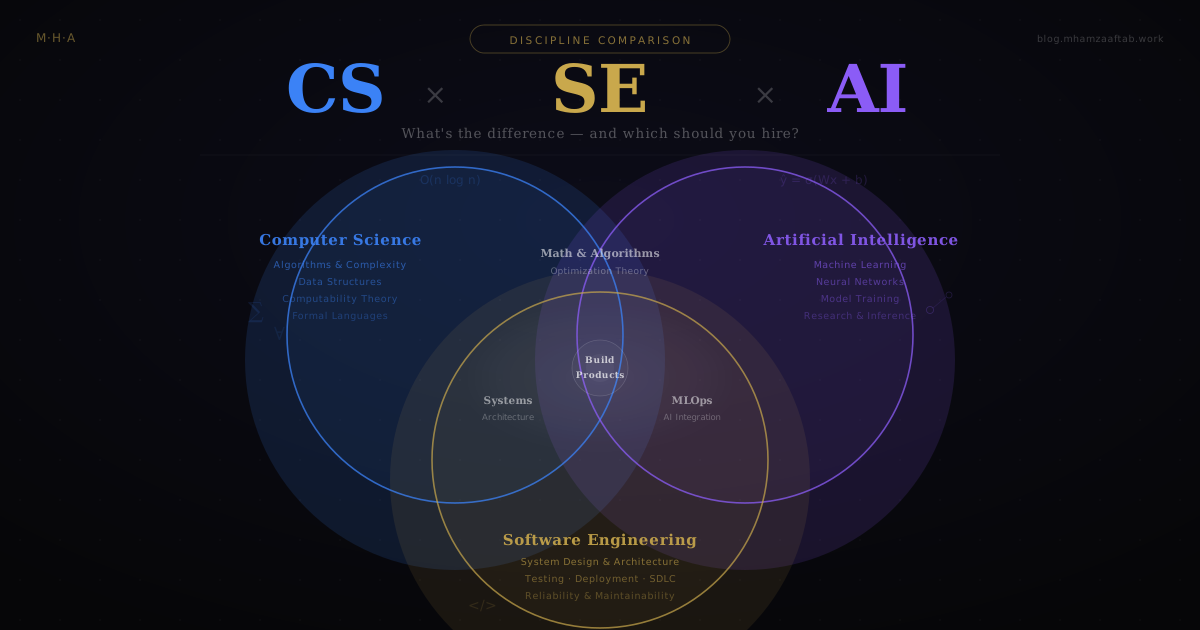
CS, SE, and AI: what's actually different and what overlaps. The honest breakdown for students choosing a degree and founders deciding who to hire.

This article may contain affiliate links. See our Disclaimer for details.
A founder I spoke with last year framed her hiring problem as a computer science vs software engineering vs AI question. She needed an "AI developer." Ten minutes of questions — what does the product do, where does the AI fit in, what does a successful feature look like — revealed the real answer: she needed a software engineer who could call the OpenAI API and wire the response into a clean UI. She had been about to post a job description asking for an AI researcher with deep learning experience. She was days away from paying frontier-lab rates for software engineering work.
This mix-up costs founders real money. For students, the parallel confusion — CS vs software engineering vs an AI degree — shapes decisions that affect years of career direction.
Students deciding between CS, software engineering, or an AI degree will find the relevant breakdown in the first half. Founders trying to hire will find the practical framework in the second half — though the context in the first half explains why those hiring decisions are so often miscalibrated. All three tracks produce people who write code. The differences are narrower than job titles suggest — but they're not zero.
What Computer Science Actually Is
Computer science is an academic discipline rooted in mathematics and formal logic. It asks foundational questions: what can be computed, how efficiently, and why do algorithms behave the way they do at a machine level?
The core curriculum — algorithms and data structures, formal languages and automata theory, operating systems, compilers, cryptography, computer architecture, discrete mathematics — is heavier on theory than most software engineering programmes. The emphasis isn't just writing code that works; it's understanding why it works, and what the hardware is actually doing when it runs.
The degree doesn't route graduates into one narrow job. CS graduates end up as software engineers — the same role SE graduates take, which matters — systems programmers, infrastructure engineers, research scientists, technical leads. Most of them write production software at companies that never look at the CS vs SE distinction at hiring time.
What CS Graduates Are Strong At
That mathematical foundation shows up in practice. CS graduates tend to spot inefficient approaches early, reason about time and space complexity without being prompted, and adapt to unfamiliar programming paradigms faster than people who learned primarily by building things. When they encounter ML mathematics later in a career, the linear algebra and statistics land differently than they do for someone encountering both the math and the software engineering simultaneously.
Systems-level intuition is the other genuine strength. A CS graduate who has built a compiler or written scheduler code understands memory management, cache behaviour, and concurrency in ways that don't always appear in SE curricula. For infrastructure, distributed systems, and performance-critical work, that foundation shows.
Where CS Graduates Often Start Slow
Software process knowledge is rarely taught. How to run an agile sprint, write a pull request that improves a colleague's code, structure a CI/CD pipeline, handle a production incident calmly — these aren't covered in most CS programmes. Neither is requirements engineering, stakeholder communication, or the discipline of writing software that other people can maintain and extend.
That gap isn't permanent — most CS graduates close it within 6 to 18 months in a professional engineering role. But it is real, and it explains why some very strong academic candidates take time to find their footing in a product team.
What Software Engineering Actually Is
Software engineering emerged from engineering practice. The question it tries to answer is how to reliably build, test, deploy, and maintain software at scale. The IEEE defines it as "the application of a systematic, disciplined, quantifiable approach to the development, operation, and maintenance of software" — positioning it as closer to civil or mechanical engineering than to pure mathematics.
The curriculum is built around what it actually takes to ship software in a team: design patterns, software development lifecycle, testing and QA methodologies, requirements engineering, project management, system architecture, version control, DevOps practice. Some programmes treat agile and Scrum as first-semester engineering competencies, not afterthoughts. The design assumption is that building software for other people to use is a team activity with process requirements that have to be learned deliberately.
Where SE graduates end up looks nearly identical to where CS graduates end up — software engineer, full-stack developer, DevOps engineer, QA engineer. The CS vs software engineering label rarely appears in a job description.
What SE Graduates Are Strong At
Shipping software in a team environment, reliably and on a reasonable schedule. SE graduates tend to arrive with stronger instincts around testing coverage, maintainable architecture, and readable code than day-one CS graduates — not because they're more capable, but because their curriculum was designed around those specific outcomes.
They're also typically more comfortable in the messy middle of a project: ambiguous requirements, legacy codebases, stakeholders who can't agree on what the product should do. Software engineering programmes teach that managing complexity is part of the job, not a sign that something has gone wrong.
The Honest Admission
In most companies, CS and SE graduates are hired into the same "software engineer" role and evaluated against identical criteria. The Stack Overflow Developer Survey 2025 consistently shows that the majority of professional developers identify by what they do — "full-stack developer", "back-end developer" — not by their degree background.
Within two or three years of a career, degree background becomes largely invisible to employers. By year five, it is irrelevant. The gap between a strong CS graduate and a strong SE graduate is far smaller than the gap between a strong and a weak candidate from either background. The degree distinction matters most in years one and two — after that, what you've shipped and who can vouch for your work matters far more.
What "AI Developer" Actually Means (It Depends Who You Ask)
"AI developer" is not a single job. It's three completely different roles that happen to share a title. Conflating them is the most expensive hiring mistake I see founders make — and the most avoidable.
Type 1: AI / ML Researcher
This person invents algorithms. They publish papers, run experiments on novel architectures, and work at organisations like DeepMind, OpenAI, Anthropic, or university research labs. A PhD is almost always required. Their day-to-day work involves mathematical proof-writing, academic literature review, and running training experiments at a compute scale most companies can't afford.
Almost no startup needs one of these. If you're wondering whether you need an AI researcher: you don't. Their work produces the models and methods the rest of the industry builds on — you consume that output, you don't hire the person generating it.
Total compensation at frontier labs reflects this scarcity. Packages of $500,000 and above are not unusual at the top organisations. If you see that salary band in a startup job post, the role has been incorrectly scoped.
Type 2: Machine Learning Engineer
This person takes ML research and turns it into production systems. They train models, fine-tune pre-trained ones on proprietary data, evaluate model performance rigorously, and build the infrastructure that serves predictions reliably at scale. A CS or SE degree plus meaningful ML specialisation is the typical background.
When does a startup actually need one? When the trained model itself is the core product — not a feature, but the thing the company sells. Medical imaging diagnosis. Document classification at scale on proprietary training data. A recommendation engine trained specifically on your user behaviour. In those cases, the company's intellectual value lives in the model's performance, and you need someone who can train and evaluate it properly.
In the UAE market, ML engineers command AED 25,000–50,000 per month at mid-to-senior level. They're not as rare as AI researchers, but they're not abundant — and hiring the wrong profile is an expensive mistake when what you actually needed was someone to call an API.
Type 3: AI-Enabled Developer (What Most Startups Actually Need)
Type 3 is what most startups actually need: a software engineer who works with LLM APIs (OpenAI, Anthropic, Cohere), embeddings, vector databases, RAG pipelines, and structured output parsing. They don't train models. They use models — and they know how to use them well enough to build reliable production features.
Building a document chatbot, a customer support assistant that knows your product, AI-powered content suggestions inside a SaaS product? All Type 3. The ai engineer vs software engineer distinction here is narrow: a Type 3 developer is a software engineer who has learned the AI integration stack. If you can describe the AI feature you want built and it doesn't involve training a custom model on proprietary data, this is the profile you need.
Misidentifying them as "AI researchers" in your job posting is why that role stays vacant for six months. For a practical breakdown of what these integrations actually involve, how to add AI to your business is worth reading first. If you're wondering whether AI tools can replace a developer entirely, can AI build my app covers that directly.
UAE salary range for Type 3: AED 15,000–35,000 per month depending on seniority. These developers exist in the market. They're also the most frequently misidentified.
| AI Researcher | ML Engineer | AI-Enabled Developer | |
|---|---|---|---|
| Primary skill | Algorithm invention, mathematical proofs | Model training, ML infrastructure, evaluation | LLM API integration, RAG pipelines, prompt engineering |
| Degree signal | PhD typically required | CS/SE + ML specialisation | CS, SE, or self-taught with a portfolio |
| What they build | Novel models and research papers | Production ML pipelines, trained model services | AI-powered features using existing model APIs |
| When to hire | Almost never (for startups) | Core product IS a trained model on proprietary data | Any product with AI features built on existing models |
| Salary (UAE) | N/A (frontier lab rates; not hired in early-stage) | AED 25,000–50,000/month | AED 15,000–35,000/month |
If you've read that table and still aren't sure which column describes your product, that's the normal position for a founder who hasn't staffed a technical team before. The type you hire shapes your budget, your architecture decisions, and your first four weeks of build. Getting it wrong costs months. A short scoping conversation is usually enough to answer it — see how I work with founders.
The Overlap Is Bigger Than the Differences
About 80% of the competency across all three tracks is identical. Python and JavaScript are common to all three; TypeScript increasingly so in modern product engineering. Git, code review, relational and document databases, REST API design, debugging, systems architecture, and cloud infrastructure — these are table stakes everywhere. No one gets hired without them, regardless of degree.
The 20% that diverges: CS gives you a head start in algorithm design and systems programming. SE gives it in process discipline, testing coverage, and team delivery. ML engineers need proficiency in linear algebra, statistics, and tooling specific to model management (PyTorch, scikit-learn, Weights & Biases). AI-enabled developers need API fluency and enough practical understanding of model behaviour to build features that don't hallucinate at the wrong moment.
The career reality, which the Stack Overflow Developer Survey 2025 bears out, is that experienced developers cross-train constantly. A software engineer who has spent a year building LLM-powered products has more practical AI development skill than a recent CS PhD who hasn't shipped a product. The cs vs software engineering degree debate, in that sense, matters far less than what someone has actually built and maintained in production.
By year five of a career, the degree label on a CV tells you very little about what someone can build.
Choosing a Degree — The Student's Decision
If You Want to Build Products and Apps
Either CS or SE works. SE is more directly applicable in the first two to three years — the curriculum aligns with what a junior role at a product company looks like on day one. CS gives theoretical depth that pays dividends at senior and specialist level, particularly for infrastructure, distributed systems, and performance-critical work.
What matters more than the degree choice is what you build during it. A portfolio of shipped projects, meaningful open-source contributions, and evidence of working in a team matters more than degree choice in almost every hiring conversation I've had. If you're evaluating specific SE programmes, check for IEEE-CS or ABET accreditation — these are quality signals for the programme's rigour and how it's perceived by employers.
If You Want to Work in Machine Learning or AI
CS is the stronger foundation, primarily because of the mathematics. Linear algebra, calculus, probability, and statistics are not optional extras in ML work — they are the subject matter. CS programmes tend to treat these with more rigour than SE programmes, which prioritise applied engineering practice.
A dedicated AI/ML specialisation within a CS programme, or a joint CS/Mathematics degree, is the most direct route into ML engineering. Transitioning into ML from an SE background is possible, but the mathematics gap requires deliberate, sustained effort — most people find it slower to close than they expect, especially when working full time simultaneously.
For the applied Type 3 track — building products with AI APIs — an SE degree is completely sufficient. You won't be training models. You need solid software fundamentals and the ability to learn new API ecosystems quickly. SE produces that reliably.
If You Are Unsure
CS gives the most optionality. From a CS degree you can pivot into SE-track roles (the vast majority of software engineering jobs), ML engineering with additional study, data science, security, or compilers and systems work. The generalist mathematical foundation is valuable precisely because it doesn't commit you to one track early.
SE is more focused — excellent for product-building careers, and by no means a lesser choice if that's where your interests point. But if you're genuinely undecided and want maximum future flexibility, CS is the safer starting point.
On compensation: the Bureau of Labor Statistics puts the median annual salary for software developers in the US at around $132,000. UAE salaries for software engineers run AED 12,000–45,000 per month depending on seniority and specialisation. ML engineers earn a 20–40% premium above SE rates at mid-to-senior level. AI researchers at frontier labs earn significantly more, but they represent a tiny fraction of total roles and work for a very small number of organisations globally. For most software development careers, the CS vs SE salary difference at the degree level is minimal — both route to identical job titles at similar pay.
The Founder's Guide — Which Type Do You Actually Need to Hire?
For 90% of startups at the product-building stage, the answer is a software engineer. The 10% where that changes is worth understanding.
For an MVP, Web App, or Mobile App
Hire a software engineer with relevant stack experience and a portfolio of shipped products. Whether their degree says CS or SE is irrelevant. What matters: working software they've built that handled real users and real data, clean API architecture they can explain in plain language, and honest communication about trade-offs.
The hiring a developer in Dubai checklist covers the full vetting process — the questions to ask in the first call, red flags to watch for in portfolios, and the contract clauses that protect you. Once you've identified the right type, freelance developer vs agency covers the engagement model decision.
If you've already done that groundwork and want a direct read on your product's scope — realistic timeline, tech choices, and a cost range before you commit — get in touch here. Most founders leave that first call knowing exactly what to build and in what order.
For a Product with AI Features (Chatbot, Document Processing, Recommendations)
You need a Type 3 AI-enabled developer, not a researcher or a pure ML engineer. The skills to look for: demonstrated experience with OpenAI or Anthropic APIs (not just personal use of ChatGPT), familiarity with vector databases such as Pinecone, Weaviate, or pgvector, RAG pipeline construction, prompt engineering in production contexts, and either Python or TypeScript as a primary language.
Ask to see an AI feature they've shipped. Ask how they handle retrieval quality, hallucination rate, and latency in an LLM integration. Those questions separate developers with real integration experience from those who've added "AI" to their CV because it's fashionable this year. For the technical scope of what these integrations involve, how to add AI to your business in 2026 is worth reading before your first candidate call.
For Data-Heavy or Algorithmic Work
If the intellectual property of your product is a trained predictive model — the model's output is what you're selling, and you have proprietary training data that provides a competitive moat — then you need a Type 2 ML engineer. Signs you're in this category: you have a labelled dataset that competitors don't have, the product's value proposition is the model's accuracy compared to generic alternatives, and calling a third-party model API is not sufficient to match that accuracy.
This describes a small subset of startups. If you're not sure whether you're in this category, you're probably not. The products that genuinely require custom-trained ML are less common than the current market hype suggests.
Red Flags in "AI Developer" Job Postings
The most common pattern I see: a founder posts a job description asking for "deep learning experience, model architecture knowledge, PhD preferred" when the actual role is integrating GPT-4 into a customer support interface. The result: six months with the role vacant, a handful of wildly overqualified candidates who aren't interested in the work, and salary expectations that make the hire feel impossible.
The fix is simpler than it sounds. Describe the product features you need built, name the tools and APIs the role will actually use, and let the required skills derive from the work rather than from job title templates found online. If the feature is "a document Q&A system using our internal knowledge base," the skills required are LLM APIs, vector search, and backend development — not a PhD in machine learning.
In the UAE market specifically, ML engineers are genuinely scarce and expensive when you find one. For early-stage products, a well-sourced Type 3 AI-enabled developer is more available, better suited to the actual work, and meaningfully cheaper. Reserve the ML engineering hire for when you have evidence that custom model performance is what's actually limiting your product.
Frequently Asked Questions
Is computer science harder than software engineering?
Neither is objectively harder — they emphasise different kinds of difficulty. CS programmes tend to be more mathematically intensive: formal proofs, algorithm analysis, and theory-heavy coursework that tests abstract reasoning. SE programmes require more sustained practical discipline: managing complex software projects, coordinating team work, and building reliable delivery habits over time. Both produce competent developers. Which feels harder depends entirely on whether you find mathematical rigour or applied project complexity more challenging.
Can a software engineer work in AI?
Yes, and many do. A software engineer who builds fluency in LLM APIs, vector databases, and RAG architecture can build AI-powered products without any formal ML training — this is the Type 3 profile described above. For ML engineering or AI research roles that involve training or fine-tuning models, the mathematical foundations (linear algebra, statistics, calculus) need deliberate study beyond a standard SE curriculum. That gap is closable, but it takes consistent effort over time, not a weekend course.
Which pays more: CS or software engineering?
At entry level, the salary difference between CS and SE graduates entering software engineering roles is small or zero — both route into the same job title at similar pay bands. ML engineers at mid-to-senior level earn a 20–40% premium above standard software engineering rates. AI researchers at frontier labs earn significantly more, but they represent a tiny fraction of total roles. For most software careers, degree background has no measurable effect on salary after the first three to five years. Performance, seniority, and specialisation determine earnings far more than what the degree says.
Do I need someone with a CS degree to build my app?
No. What matters is demonstrated ability: shipped products, strong system design decisions, and relevant technical experience with the tools your product needs. Many excellent developers are self-taught or completed coding bootcamps and are indistinguishable from degree-holding counterparts in production work. A degree is a signal — it suggests a certain foundation was laid — but it's not a prerequisite. Focus your vetting on what the candidate has built and how they explain the decisions they made, not on formal credentials.
What is the difference between an AI engineer and an ML engineer?
"AI engineer" is loosely used and means three different things depending on who's writing the job description — which is exactly the problem. An ML engineer is a more precisely defined role: someone with statistical knowledge, hands-on model training experience, and familiarity with production ML infrastructure like feature stores, model registries, and evaluation frameworks. "AI engineer" in most startup job postings actually means Type 3 — an SE who integrates AI APIs. Always ask what the role builds, what data it touches, and what APIs it uses before accepting either title at face value. The description tells you far more than the title.
Not Sure Which Type of Developer Your Project Needs?
The computer science vs software engineering vs AI debate matters far less than the specific problem you're trying to solve. For 90% of early-stage products, the answer is a software engineer — someone who ships well, communicates trade-offs clearly, and has built things similar to what you're planning. If you need AI features built on existing models, you want a Type 3 AI-enabled developer with real integration experience, not a researcher or someone who has only used ChatGPT as a consumer.
If you're considering a role where the product's value sits in a custom-trained model, that's a more involved conversation — and a significantly more expensive hire. I can tell you in a single call whether an ML engineering hire makes sense at your current stage, or whether a well-scoped API integration gets you to the same outcome for a fraction of the cost and time.
If you're still working out whether to build at all, how to validate your app idea is worth reading before you get to the hiring decision.
The clearest next step: take a look at what I build, then reach out. I'll tell you which developer type fits your product, what that engagement looks like, and what it realistically costs to ship a working first version.