Freelance Developer vs Agency: Which Is Right for Your Project
Agency or freelancer for your next project? Get an honest cost breakdown, risk comparison, and a clear decision framework — with Dubai market rates included.

This article may contain affiliate links. See our Disclaimer for details.
Most of the advice on this topic comes from people with a financial interest in your answer. Agencies write blog posts telling you why agencies are safer. Freelance platforms publish guides explaining why freelancers are better value. Neither source is lying exactly — they are just omitting the parts that work against them.
Here is the version without that filter: the real cost difference between hiring a freelance developer vs an agency, the decision factors that actually matter, and a third option that most of these guides do not mention at all. Whether you are building your first product or scaling an existing one, this breakdown gives you a clearer basis for the call you are about to make.
The Core Difference (And Why It Matters More Than You Think)
The surface-level difference is obvious — one is a company, one is a person. But the operational difference runs deeper than headcount.
When you hire an agency, you are buying a system: project management, design, development, QA, and account management packaged together. The agency coordinates internally so you do not have to. You get one point of contact, and work moves through a defined process.
When you hire a freelancer, you are buying direct access to a skilled individual. No project manager sits between you and the person writing your code. That directness is both the main advantage and the main risk.
Here is why it matters more than most people think: the right choice is not about which model is objectively better. It is about what your specific project needs and what you are actually capable of managing. A startup founder who wants to stay close to technical decisions and move fast will find agency overhead frustrating. An enterprise team that needs contractual accountability and parallel workstreams will find a solo freelancer insufficient.
What You Actually Pay — A Real Cost Comparison
A freelancer typically costs 30–50% less than an agency for the same project. The gap comes from agency overhead — account management, internal reviews, and margin. For a $40,000 build, that difference can be $10,000–$20,000. The trade-off is accountability: an agency has contractual obligations a solo freelancer may not.
Freelancer rates and project costs in 2026
Rates vary significantly by geography, seniority, and platform. Here is the realistic range you will encounter:
| Seniority | Global (hourly) | Dubai / UAE (hourly) | Typical project cost |
|---|---|---|---|
| Junior (1–3 years) | $25–$55 | $35–$65 | $5,000–$15,000 |
| Mid-level (3–6 years) | $55–$100 | $65–$120 | $15,000–$45,000 |
| Senior (6+ years) | $100–$175 | $120–$200 | $40,000–$100,000+ |
These are full-stack web and mobile rates. Specialist roles — AI/ML engineering, blockchain, native mobile — push 20–40% higher. Platform-sourced freelancers (Upwork, Toptal) typically carry a 10–20% platform fee that either comes out of the developer's margin or gets passed to you in the rate.
For context on what these numbers look like in practice, the mobile app development costs in Dubai breakdown I published earlier this year covers complexity tiers in detail.
What an agency charges — and what that price includes
A mid-tier agency in the UAE or UK will typically price the same project at 1.5–2.5x a freelancer's quote. On a $40,000 freelancer project, that means $60,000–$100,000 with an agency.
What justifies the premium:
- Project management: someone whose job it is to keep everything on track
- Design–dev integration: designers and developers working from the same process, not emailing files back and forth
- Internal QA: bugs caught before they reach you
- Contractual SLAs: defined deliverables, timelines, and remedies if they are not met
- Business continuity: if one person gets sick or leaves, the project does not stall
What the premium does not always include, despite the impression:
- A senior developer actually writing your code (junior developers execute most agency work at most mid-tier firms)
- Fast turnaround — coordination layers add time, not subtract it
- Post-launch ownership — many agencies hand off and charge separately for maintenance
Agency pricing in Dubai and the wider UAE market has its own dynamics. The market here includes international agencies with offices in the region (pricing anchored to London or New York rates), local boutique agencies, and a growing number of hybrid studios. Expect AED 150,000–400,000 ($40,000–$110,000) for a mid-complexity web or mobile product from a reputable local agency.
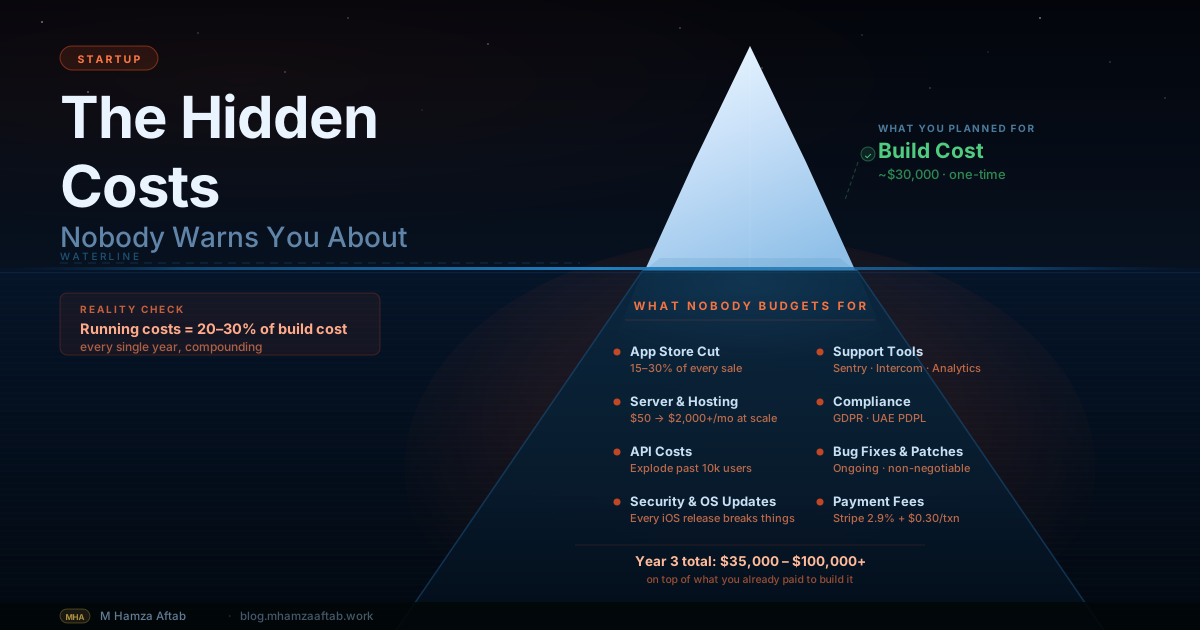
The hidden costs that never appear in the quote
Both hiring models carry costs that do not show up in the initial proposal. Worth accounting for before you compare numbers.
With a freelancer:
- Your time spent managing the project — expect 3–5 hours per week for a medium-complexity build
- Rework when scope is misunderstood (freelancers have less process to catch this early)
- Gaps in capability — a full-stack freelancer is rarely equally strong on design, backend, and infrastructure
- Availability risk — a solo developer's emergency becomes your project's delay
With an agency:
- Change order costs — scope changes at agencies are almost always charged separately, and at premium rates
- Communication lag — decisions that should take hours can take days when routed through account management
- Handoff friction at the end — getting clean code, documentation, and access credentials from agencies ranges from smooth to painful
- Ongoing retainer lock-in — some agencies structure projects to require ongoing engagement for even minor updates
Factor these into your actual budget and timeline, not after they surface mid-project.
The Five Questions That Decide It
Answer these honestly. The right model usually becomes clear.
| Question | If your answer is... | Lean toward |
|---|---|---|
| How complex is the project? | Single product, defined scope, under $80k | Freelancer or Senior Consultant |
| Multi-product, parallel workstreams, $150k+ | Agency | |
| How much can you manage directly? | Comfortable with daily technical oversight | Freelancer |
| Need the vendor to self-manage | Agency | |
| How tight is your budget? | Every dollar counts, MVP stage | Freelancer or Senior Consultant |
| Budget for predictability and reduced risk | Agency | |
| How important is post-launch support? | Need ongoing feature work and maintenance | Agency or long-term freelancer retainer |
| One-time build, in-house team takes over | Freelancer | |
| What happens if the relationship fails midway? | Can absorb a reset with a new hire | Freelancer |
| Need contractual guarantees and handoff continuity | Agency |
If you are still in the planning stage and are not sure how much your project should cost at all, the breakdown of how much an MVP actually costs is a useful baseline before you start collecting quotes.
Already know your project type but unsure which hiring model fits? Feel free to run your requirements past me — I will give you an honest read on scope, timeline, and whether the quotes you have received make sense.
When a Freelancer Is the Right Call
Freelancers win on four criteria: cost, speed to start, communication directness, and access to highly specialized talent.
If you are building an MVP — a focused first version with a tight scope and limited budget — a senior freelancer will typically get you further for the same money than an agency. You are paying for execution, not process overhead.
Agencies hire for breadth. If you need a specific skill their generalist pool does not have — a developer with deep Next.js and edge computing experience, or someone who knows your specific industry stack — the freelance market is where specialists live.
Then there is the direct communication angle. Some founders find it indispensable to talk to the person actually writing their code rather than routing feedback through an account manager. Feedback loops are shorter, context does not get lost in translation, and you build a working relationship with the builder rather than the salesperson.
The project profile that suits a freelancer well: a well-defined MVP or product feature, a founder or CTO who can give clear direction and feedback, a budget in the $10,000–$60,000 range, a preference for speed over process.
When you go the freelance route: vet portfolio work that matches your product type (not just pretty screenshots), use milestone-based payment rather than hourly for any project over $5,000, and establish communication expectations in writing before work starts.
When an Agency Is Worth the Premium
Agencies justify their cost when the project genuinely needs what they offer: coordinated multi-discipline work, contractual accountability, or a team structure that can absorb personnel changes without the project stalling.
The project types where agencies tend to add real value: enterprise web platforms with separate design, backend, and infrastructure workstreams; products with strict compliance or security requirements; projects where the client organization has limited technical capacity to manage a freelancer directly; and situations where procurement requires a legal entity with insurance and SLAs.
Stakes matter too. If a freelancer goes dark two months in, your recourse is limited. With a reputable agency and a well-structured contract, you have defined remedies — and that is worth something when the cost of a failed engagement is high.
The project profile that suits an agency well: larger scope with parallel workstreams, an organization that cannot dedicate management time to daily developer oversight, a budget above $80,000, a requirement for formal contracts with deliverable guarantees.
One practical check before signing with any agency: ask to meet the developers who will actually work on your project. The pitch team and the build team are often different people. The agency's seniority and the assigned developer's seniority are two separate questions.
The Option Most Guides Skip — Senior Independent Consultant
There is a third model that most "freelancer vs agency" comparisons omit entirely, which is convenient for both agencies and freelance platforms: the senior independent consultant.
This is a developer with 8–15 years of experience who works independently but is not on a platform, does not take commodity work, and operates more like a fractional technical partner than a hired pair of hands. They typically work on a project or retainer basis, charge rates comparable to mid-tier agencies, and bring senior judgment rather than just execution.
The practical difference from a standard freelancer: they tend to push back on scope, ask the uncomfortable questions about what you actually need, and catch problems before they become expensive. The difference from an agency: no overhead, no junior developer doing the work while a senior developer does the sales call, no change order process.
The trade-off is availability. Senior independent consultants are selective about projects, often booked weeks or months out, and not the right fit for high-volume production work that needs a full team.
Where they fit best: technically complex products where senior judgment matters; founder-led startups that want an experienced technical perspective without the agency markup; situations where you want a long-term relationship with someone who knows your codebase rather than a rotating team.
Side-by-Side Comparison
| Factor | Freelancer | Agency | Senior Independent |
|---|---|---|---|
| Cost | Lowest ($25–$175/hr) | Highest (1.5–2.5x freelancer) | Mid-high ($120–$250/hr) |
| Accountability | Varies; depends on contract | Contractual SLAs, legal entity | Strong; reputation-based |
| Communication | Direct with the builder | Via account manager | Direct with decision-maker |
| Speed to start | Fast (days to 1–2 weeks) | Slow (2–6 weeks for onboarding) | Moderate (1–3 weeks) |
| Post-launch support | Varies; often informal | Structured retainer available | Usually available, selective |
| Best fit: budget | $5k–$60k | $80k–$500k+ | $40k–$150k |
| Best fit: project type | Defined MVP or feature build | Multi-discipline, enterprise, compliance-heavy | Complex product, founder-led, needs senior judgment |
Each row represents a different trade-off profile — there is no uniformly better column.
The Bottom Line — Which Should You Choose?
The freelance developer vs agency decision comes down to three variables: project complexity, your capacity to manage, and your tolerance for risk vs cost.
The mistake most founders make is treating this as a binary choice and defaulting to the option that feels safer rather than the one that actually fits. An agency does not automatically mean more reliable. A freelancer does not automatically mean cheaper in total cost. Both are only as good as the specific people involved.
If you have a well-scoped product, can stay close to the work, and want to maximize what your budget buys, a strong senior freelancer will likely serve you better than an agency. If you need coordinated multi-discipline execution, contractual protection, and a team that self-manages, an agency is worth the premium. If you want senior technical judgment without agency overhead, look for an independent consultant with a track record on products like yours.
Most founders who end up in a failed or over-budget engagement made the wrong hiring call at the start — not because they lacked information, but because they made the decision in isolation. The model you choose sets the terms for everything that follows: communication cadence, risk exposure, cost structure, and how fast you can correct course when requirements change.
If your scope is still forming, the MVP cost breakdown will give you the numbers to sense-check your budget before you start collecting quotes.
I work as a senior independent consultant based in Dubai — not an agency with layers of overhead, and not an anonymous platform freelancer. I take on a small number of projects at a time, which means you work directly with me: the same person who scoped the project is the one writing the code.
If you have a product to build and want a straight conversation about approach, timeline, and what your budget actually gets you, let's talk. No proposal deck, no sales process — just a clear answer on whether and how I can help.
FAQ
Is a freelancer cheaper than an agency?
Yes, in almost every case. A freelancer typically costs 30–50% less than an agency for equivalent work. The difference comes from agency overhead: account management, internal reviews, project coordination, and margin. On a $40,000 project, that gap can range from $10,000 to $20,000. Whether the savings are worth the trade-offs depends on your project's complexity and how much direct management you can provide.
What are the risks of hiring a freelance developer?
The main risks are availability (a solo developer's personal emergency becomes your project's delay), capability gaps (full-stack generalists are rarely equally strong across all disciplines), and limited contractual accountability compared to an agency. Mitigating these is straightforward: vet thoroughly, use milestone-based payment, and choose someone with demonstrable experience on projects similar to yours.
When should a startup use an agency instead of a freelancer?
When the project has parallel workstreams that genuinely require a team, when your organization lacks the technical capacity to manage a freelancer directly, or when contractual accountability is non-negotiable. Budget matters too — below $60,000, an agency's overhead frequently produces worse value than a senior freelancer at the same price point.
How much do freelance developers charge in Dubai?
In Dubai and the wider UAE market, mid-level freelance developers charge AED 200–450 per hour ($55–$120). Senior developers and specialists range from AED 450–750 per hour ($120–$200). Project-based rates for a standard web or mobile MVP typically fall between AED 55,000 and AED 180,000 ($15,000–$50,000) depending on scope and seniority.
What is a senior independent consultant and how is it different from a freelancer?
A senior independent consultant is an experienced developer (typically 8+ years) who works independently but outside the commodity freelance market. The practical difference: they bring strategic judgment alongside technical execution, tend to work on longer engagements rather than one-off tasks, and operate closer to a fractional CTO than a hired developer. Rates are higher than standard freelancers, but lower than agencies, and the absence of overhead means a larger proportion of the budget reaches senior-level work.
Can I switch from a freelancer to an agency mid-project?
Technically yes, but it is disruptive and expensive. Handoffs mid-project involve onboarding a new team, reconstructing context, and often reworking code to fit the new team's conventions. If you anticipate needing an agency's capabilities, structure the project that way from the start. If a freelancer relationship breaks down, the cleanest path is usually a new freelancer or consultant with a clean scope and documented handoff — not a mid-project agency transfer.