How to Validate Your App Idea Before Spending a Dirham
Before you hire a developer, validate your app idea. Here are the exact methods — free and low-cost — that tell you if your app is worth building.

This article may contain affiliate links. See our Disclaimer for details.
A founder I spoke with last year had spent AED 180,000 building a logistics app for small retailers in Dubai. Twelve months of development. A full backend, a driver app, an admin panel. He launched it, reached out to 40 retailers, and heard the same thing from most of them: they were already using WhatsApp and a spreadsheet, and that worked fine.
The problem was not the app. The problem was that he had never asked those retailers whether they had a problem worth solving before he started building. A single early conversation with an experienced developer — someone who has seen this pattern before — would have raised that question in week one, not month twelve.
So here is how to avoid that outcome. The core process takes 7 days, not 12 months:
- Run competitor research to confirm the market exists (2–4 hours, free)
- Interview 15–20 potential users who do not know you personally (1–2 weeks, free)
- Build a one-page landing page with email capture (1–2 weeks, AED 0–500)
- Run a small paid traffic test to confirm demand at scale (AED 500–2,000)
- Collect pre-sales or letters of intent from real prospects (2–4 weeks)
- Score your signals against a go/no-go rubric before committing to build
- If green, talk to a developer about what building it actually involves
Why Validation Comes Before Development (Not After)
Building an app costs between AED 30,000 and AED 500,000 depending on what you are building and who you hire. That is the range between a stripped-down MVP and a fully featured product. Most founders reach the end of that range — or beyond it — before they find out whether anyone actually wants what they built.
Validation does not guarantee success. It does guarantee you are not spending six figures on a guess.
The deeper issue is that asking the wrong people the wrong questions feels like validation but is not. Most founders ask friends, colleagues, or LinkedIn connections whether the idea is good. Those people say yes. The founder proceeds. That is not validation — that is encouragement.
What Counts as Real Validation?
Real validation requires someone to do something — not just say something. Here is what that looks like in practice:
- Signed letters of intent or pre-orders. A business agrees in writing to use your product once it is built, ideally with some financial commitment attached.
- 20 or more qualified user interviews with unprompted pain confirmation. You ask about the problem, not the solution, and the person describes the pain without being prompted. They bring up the frustration themselves.
- A landing page converting cold traffic at 3% or higher. Strangers who have never heard of you visit a page describing your product and give you their email address.
- A waitlist where people signed up without being asked twice. They found the page, understood the proposition, and opted in.
What Does NOT Count as Validation?
- Friends and family saying the idea is great. They are not your market — they are your supporters.
- Survey responses where people tick "yes, I would use this." Saying yes on a survey costs nothing and predicts very little.
- LinkedIn poll likes or positive comments on a post describing your idea.
- Your own conviction that this is a gap in the market. That conviction matters — but it is a starting point, not evidence.
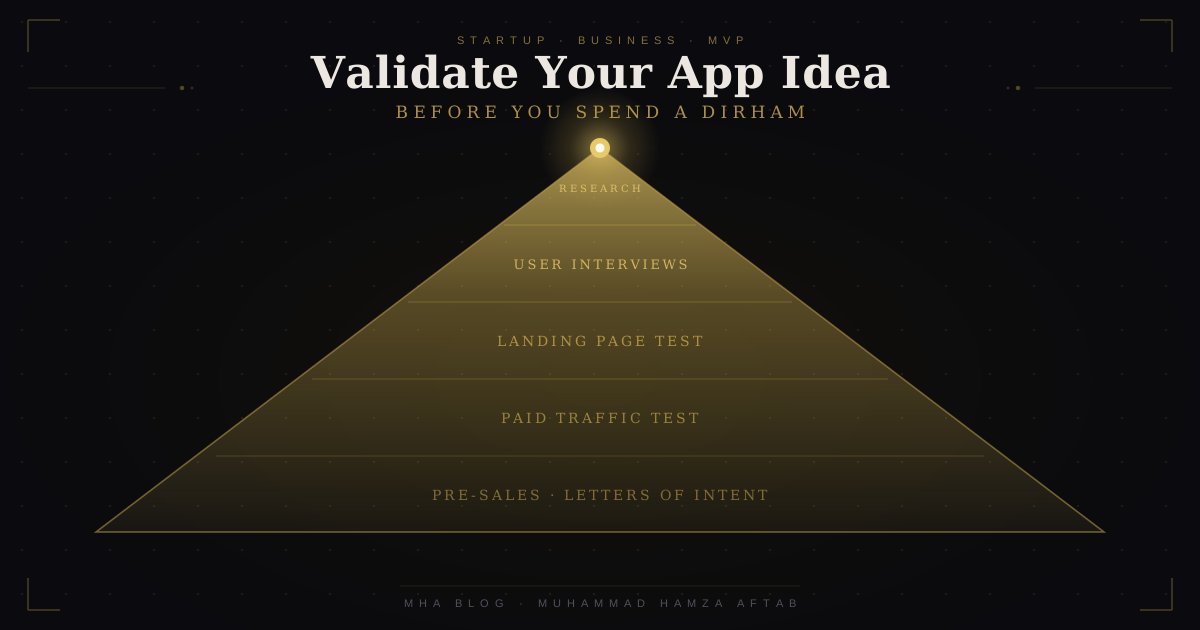
The Validation Pyramid — From Free to High-Confidence
Think of validation as a pyramid with five levels. Each level costs more and takes longer than the one below it, but gives you stronger evidence. You run them in sequence and stop when you have enough signal to make a decision — or when the signal tells you to stop entirely.
Level 1 — Competitor Research (Free, 2–4 hours)
Before you talk to anyone, spend a few hours understanding whether similar products already exist. Use Google, the App Store, Google Trends, G2, Capterra, and Product Hunt.
You are looking for three things: direct competitors (same product, same audience), indirect competitors (different product solving the same problem), and how those competitors are positioned and reviewed.
Founders consistently misread an empty market as a good sign. It usually means one of three things — the market is too small, the problem is not painful enough to pay to solve, or others have already tried and failed. A market with successful competitors means real demand exists. Your job is to find the gap — what they are not doing well — not to find a space no one has touched.
Read the one-star and two-star reviews on competitor apps. That is your product brief. Every complaint is a problem you could solve better.
Level 2 — Problem Interviews (Free, 1–2 weeks)
Once you know the competitive landscape, you need to talk to the people who would use your product. Not to pitch the idea — to understand the problem.
A five-question framework that works:
- Tell me about how you currently handle [the problem area].
- What is the most frustrating part of that process?
- How often does that frustration come up?
- What have you tried to fix it?
- What would the ideal version of this look like?
None of those questions mention your app. You are mapping pain, not selling a solution. If the person does not bring up the problem you are trying to solve — without being prompted — that is important data.
Who to talk to: People who do not know you. Friends and colleagues will soften their feedback. You need strangers or near-strangers who have no reason to protect your feelings.
In the UAE, LinkedIn outreach is underused and surprisingly effective. A short, direct message — "I am researching how [industry] professionals handle [specific problem], and I would value 20 minutes of your time" — gets responses more often than you would expect. WhatsApp group recruitment also works well here. Dubai startup communities, industry groups, and professional networks on WhatsApp are active and receptive to research conversations if the ask is short and respectful.
Goal: 15–20 interviews. At that volume, patterns become obvious. If you are hearing the same phrases unprompted across 12 of your 18 conversations, the problem is real.
Level 3 — Landing Page Test (AED 0–500, 1–2 weeks)
A landing page is a single webpage that describes your product as if it already exists — what it does, who it is for, and what the outcome is. At the bottom, an email capture: "Join the waitlist" or "Get early access."
You do not need to build anything to do this. Carrd (free plan works), Notion, or Typedream — an hour of setup is enough.
The traffic source matters. Do not send your LinkedIn followers — they already know you. Send cold traffic:
- Facebook and Instagram groups for Dubai entrepreneurs and startup founders
- Dubai-based WhatsApp communities (AstroLabs, In5, Dtec networks all have these)
- Reddit threads relevant to the problem you are solving
- Cold outreach to your interview participants asking them to share
What to measure: Email signups and waitlist clicks — not page views. Views tell you nothing. A 3–5% email opt-in rate from people who did not know you beforehand is a strong demand signal. If you get 200 views and 2 email signups, the proposition is not landing.
Level 4 — Paid Traffic Test (AED 500–2,000, 1–2 weeks)
Once your landing page converts organic traffic, you can test it with paid traffic to measure demand at scale and compare value propositions.
Run two or three ad variants with different angles — different headlines, different pain points, different outcomes. Send them all to your landing page and see which angle drives the most signups at the lowest cost.
For consumer apps targeting the Gulf market, Instagram and TikTok consistently outperform Meta newsfeed and Google display. If you are targeting B2B — businesses, managers, procurement — LinkedIn ads are worth the higher cost-per-click.
A rough signal for a consumer app in the Dubai market: a cost-per-lead (email signup) under AED 30 suggests genuine demand. Above AED 80, the proposition needs work or the market is narrower than you thought.
Level 5 — Pre-Sales or Letters of Intent (Free to facilitated, 2–4 weeks)
This is the strongest validation possible. You ask someone to pay — or commit — before anything is built.
For B2B products, a letter of intent (LOI) is a document where a business agrees they would purchase your product once it is ready, sometimes at a specified price. Three signed LOIs from qualified businesses you found through cold outreach — not through your network — is enough to proceed with development. That is real signal.
For consumer products, the equivalent threshold is a waitlist of 500 or more people in your target market, built from cold traffic rather than personal connections.
Pre-selling is uncomfortable for most founders. That discomfort is worth something — it forces you to articulate your value proposition clearly enough that a stranger will commit to it.
Your 7-Day Validation Sprint
Here is what validation looks like in practice, compressed into one week using Levels 1 through 3:
Day 1 — Competitor mapping (3 hours, free) Search Google, the App Store, Product Hunt, G2, and Capterra. List every direct and indirect competitor you find. Read 20 reviews on the top two or three. Note the most common complaints. This is your content brief and your differentiation opportunity.
Day 2–3 — Interview prep and outreach (2–3 hours) Write your five-question interview script. Identify 30 potential interviewees — LinkedIn searches, WhatsApp group members, online community members in your target sector. Send outreach messages asking for 20 minutes of their time. Aim for 30 contacts to land 15–20 conversations.
Day 4–5 — Conduct 10+ interviews (1–2 hours each) Run the conversations. Record them (with permission) or take detailed notes. After each one, note the exact phrases people used to describe the problem — unprompted phrases are the most valuable. Look for repetition across conversations.
Day 6 — Build a one-page landing page (2 hours, free) Create a page on Carrd's free plan. One headline, three bullet points on what the product does, one email capture field. The headline should describe the outcome, not the features. "Manage your Dubai rental portfolio without spreadsheets" beats "Property management software for landlords."
Day 7 — Drive traffic and measure (1 hour setup, then passive) Share the page in five relevant communities — startup WhatsApp groups, Facebook groups, LinkedIn posts targeted to your audience. Do not ask people to "check it out." Frame it as: "We are building a tool for [specific problem] and we are looking for early users."
By the end of Day 7, you have competitor data, 10 or more pain confirmations from real conversations, and live traffic data on your landing page. Total cost: AED 0–200, depending on whether you use any paid tools. Total time: roughly 15–20 hours.
Validation Methods — At a Glance
| Method | Cost (AED) | Time Required | Signal Strength | Best For |
|---|---|---|---|---|
| Competitor research | 0 | 2–4 hours | Low | First filter |
| Problem interviews | 0 | 1–2 weeks | Medium | Pain confirmation |
| Landing page test | 0–500 | 1–2 weeks | Medium-High | Demand signal |
| Paid ad test | 500–2,000 | 1–2 weeks | High | Value prop testing |
| Pre-sales / LOI | 0 | 2–4 weeks | Very High | Final confirmation |
How to Know You Have Enough Validation to Proceed
Positive signals do not mean much in isolation. What matters is the pattern and the source.
Green signals — proceed:
- 15 or more problem interviews with unprompted pain confirmation from people outside your personal network
- Landing page converting at 3% or above from cold traffic
- At least one person outside your network offered to pay or signed a letter of intent when directly asked
- A successful competitor exists, and your differentiation is clear and specific — not just "we do it better"
Yellow signals — validate more before building:
- All positive signals came from people who know you personally
- No one offered to pay or commit when you asked directly
- The landing page had views but near-zero email signups
- The competitive landscape is completely empty with no explanation for why
Red signals — rethink or pivot:
- Every interview respondent described the problem differently, suggesting there is no consistent, addressable pain
- Landing page bounce rate above 85%, no signups despite decent traffic
- The only people who showed genuine interest are in your immediate personal network
- Three or more competitors tried the same thing and shut down
Yellow does not mean stop. It means do not spend money yet. Run one more level of the pyramid before committing to a developer.
If you are already hitting green signals and want a grounded second opinion before you move forward — book a free 30-minute call. No pitch, no proposal. Just a conversation about what to build first and what it realistically involves.
Validating an App Idea in Dubai — What's Different
Dubai is not San Francisco, and the validation process here has real structural differences that generic startup advice glosses over.
Market size matters more than you think. Dubai has roughly 3.5 million residents; the UAE as a whole is around 10 million. I build for this market — and the smaller addressable audience means your validation thresholds need to be sharper. A 2% conversion rate that might be acceptable in the US needs to be 3–4% here before you have the same confidence. The margin for error is tighter.
Arabic-language segment. If your app targets Arabic-speaking users, validate specifically with that demographic. English-language landing pages and English-language interviews will not tell you whether Arabic-speaking users have the same problem or will respond to the same proposition. These are often different products, even if the underlying idea is identical.
Where to find early adopters in the UAE. The startup and innovation communities here are concentrated and accessible: AstroLabs Dubai, In5 Tech (Innovation Hub, Dubai Internet City), Dtec (Dubai Technology Entrepreneur Campus), Hub71 in Abu Dhabi, DIFC Fintech Hive for fintech products, and Dubai Chamber of Commerce networks. GITEX contacts — if you attended or know people who did — are a warm audience for B2B apps. These communities actively support founders in research mode; reaching out respectfully gets results.
B2B cycles are long here. In the Gulf, procurement often involves multiple stakeholders and trial periods that stretch for months. Three signed LOIs from qualified Gulf businesses means more than 300 B2C consumer signups — B2B revenue in this market is stickier, the ACV is higher, and the relationship matters more than anywhere I have worked.
WhatsApp runs everything. Cold email gets ignored. WhatsApp outreach — done respectfully, with a clear ask — consistently gets responses for interview recruitment, landing page sharing, and follow-up. People check WhatsApp far more than email here. If you are treating it as a fallback, you are slowing yourself down.
What Comes After Validation
If your signals are green, the next step is not to start building immediately. It is to understand what building actually involves.
Three questions most founders need answered before they talk to a developer:
What will it cost? Before you get quotes from agencies or freelancers, understand the realistic range. Read what building an MVP actually costs to get grounded on cost by product type and complexity before anyone gives you a number.
What does the build process look like? If you have not built software before, understanding the phases, timelines, and what you as a founder need to contribute is essential. What an MVP is and how to build one covers this end to end.
Do you need a custom developer, or can no-code tools handle your use case? For some apps, especially in the early stages, no-code platforms get you to validation faster and cheaper. Read through whether no-code tools can handle your use case to make that call before you hire anyone.
FAQ
How do you know if an app idea is good?
An app idea is worth pursuing when real people — not your network — confirm the problem is painful and current solutions are inadequate, and at least some of them demonstrate willingness to pay. "Good" is not really about the idea itself. It is about whether the market exists and whether you can reach it efficiently enough to build a business on top of it.
Can you validate an app idea for free?
Yes. Competitor research costs nothing. Problem interviews cost nothing beyond your time. A landing page on Carrd's free plan costs AED 0. The only levels of the validation pyramid that cost money are the paid ad test (AED 500–2,000) and pre-sales facilitation, which is optional for many products.
How long does it take to validate an app idea?
The core validation process — Levels 1 through 3 — takes 7 to 21 days and costs very little. Adding paid traffic testing extends this by 1–2 weeks. Pre-sales and LOI collection can take up to 4–6 weeks for B2B products, where decision cycles are longer. Most founders who move quickly through the sprint have enough signal to make a go/no-go call within two weeks.
Do I need to show a prototype to validate my idea?
No. The most important validation happens before any prototype exists. A conversation and a landing page are enough to confirm whether the problem is real and whether people want a solution. Building a prototype before validating is how founders end up spending AED 50,000 on something no one uses.
What is the difference between validating an idea and building an MVP?
Validation confirms that a real problem exists and that a defined group of people wants a solution badly enough to pay for it or commit to it. An MVP is the smallest working product you build after that confirmation — the first version that real users can interact with. Validation is a research activity. An MVP is a build activity. They happen in sequence, not simultaneously. Conflating the two is one of the more expensive mistakes I see.
How many user interviews do I need to validate an app idea?
15 to 20 interviews with people outside your personal network is enough to identify consistent patterns. Below 10, individual variance is too high to draw conclusions. Above 20, the signal rarely changes significantly — you are just confirming what you already know. The quality of the interviews matters more than the number: strangers who have no reason to spare your feelings are worth more than 30 supportive friends.
Ready to Build? Here's Your Next Step
If your validation is pointing green — problem confirmed, demand signal live, at least one person outside your network ready to commit — the next conversation to have is with someone who has actually built apps in this market before you get formal quotes, scope documents, or proposals from agencies.
Not ready to build yet? That is fine. Most founders I speak with are still in the yellow zone when they first reach out. The call is not a sales pitch — it is a scoping conversation. We look at what you have validated, what questions are still open, and what the build would actually involve if you decided to proceed. You leave with a clear picture, not a proposal.
What a 30-minute call covers:
- Whether your validation signals are strong enough to proceed or whether one more step would materially reduce your risk
- What a realistic build timeline and AED cost range looks like for your specific product — not a generic range, but a grounded estimate based on what you have described
- What the first version needs to do versus what can wait for version two
- Whether your idea needs a custom developer, a no-code tool, or something in between
There is no commitment on your side. If you decide not to build after the call, you will still leave knowing more than when you came in.
Book a free 30-minute discovery call — no pitch, no proposal