Why Apps Fail: The Real Reasons 90% Never Make It
90% of apps fail — and the cause is rarely what founders expect. Here are the five real reasons, with honest analysis from a developer who has seen them firsthand.

This article may contain affiliate links. See our Disclaimer for details.
Ninety percent of apps fail. That number is everywhere — pitch decks, investor panels, developer forum threads. What almost nobody talks about is why.
Talk to founders who have been through it and you'll hear the same explanations: the market wasn't ready, the timing was off, the team had issues. These are real. But they're usually symptoms, not causes. In my experience building apps for startups across the UAE and internationally, the actual cause is almost always traceable to one of five things — and most of them could have been caught before the first line of code was written.
First, what doesn't kill apps — because founders spend enormous energy worrying about the wrong things.
The Three Myths Everyone Blames First
Myth 1: The Idea Was Bad
Airbnb pitched renting an air mattress in a stranger's apartment. Uber asked people to get into a car driven by someone they'd never met. Instagram launched a photo-filter app in 2010 when Facebook already owned social photos. None of these ideas looked good on paper. All three became defining companies of their era.
The idea is almost never the problem. Most app concepts are workable enough to succeed if they reach the right users and retain them. Bad ideas do exist, but they're rarer than founders assume — and when they fail, it's usually for distribution reasons, not conceptual ones.
Myth 2: The Code Wasn't Good Enough
WhatsApp's backend was built on Erlang, a language most developers have never touched. Twitter ran on Ruby on Rails long after reaching a scale it was supposedly never designed for. Instagram had 13 employees when Facebook acquired it for $1 billion — the codebase was imperfect, the architecture was stretched, and the product handled 30 million users.
Code quality matters for long-term sustainability. It rarely determines whether an app lives or dies in the first two years. Founders who spend months choosing between frameworks and tech stacks before validating anything are optimising the wrong constraint — the question of web app versus mobile app matters far less than whether anyone wants what you're building.
Myth 3: The Market Was Wrong
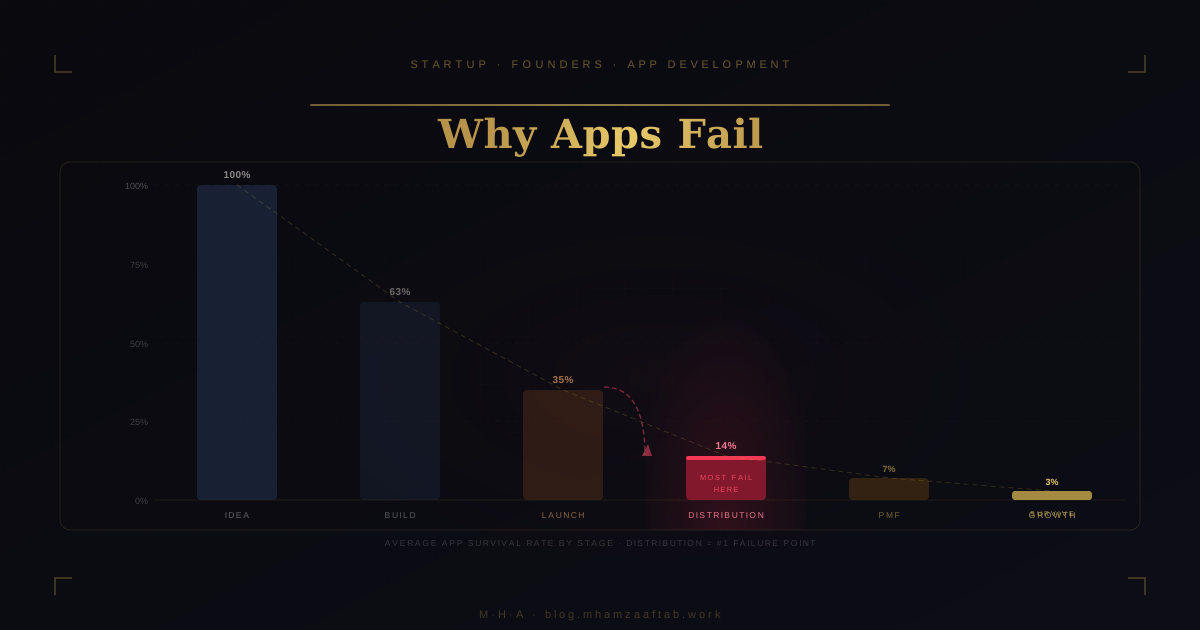
If a market is large enough to justify building at all, the market itself usually isn't the problem. The problem is reaching it. "Wrong market" is almost always a misdiagnosis for a distribution failure — and that brings us to what actually kills apps.
The Real Reasons Apps Fail
1. No Distribution Plan (The Actual #1 Killer)
There are currently over 1.8 million apps in the App Store and another 2.5 million on Google Play. The average app is downloaded fewer than 1,000 times in its entire commercial lifetime. Organic app store discovery — the idea that someone will search a category and stumble on your app — is functionally dead unless you're already prominent enough that you don't need it.
Most founders have some version of the same plan: build the product, launch it, and rely on word-of-mouth and the app stores to bring users in. That is not a distribution plan. That is hope.
A real distribution plan means knowing, before you write a single line of code, how you'll reach your first 100 users, what it costs to acquire a paying user (your customer acquisition cost), and whether that number works against your expected customer lifetime value. In most consumer app categories, CAC runs $30–$80 per user. For subscription apps, that math has to resolve against an LTV that typically takes six months to materialise. Most founders have not done this calculation, and most discover the problem only after the launch budget is gone.
The apps that survive invest in owned distribution before they launch — SEO, content, email lists, communities, direct outreach. They treat user acquisition as a product problem solved at the architecture stage, not a marketing afterthought assigned to someone in month four.
2. Building What Founders Want, Not What Users Need
This failure is subtle because it feels like you're doing everything right. You identify a problem you've experienced personally. You design a solution. You build it.
The error is assuming your experience generalises. It usually doesn't, or at least not in the form you imagined. The productivity tool with 40 features that the target user — a busy small business owner — will never configure. The marketplace app that solves supply perfectly and ignores that demand-side acquisition is a completely different problem. The delivery app with a beautifully designed UI that users abandon after the first order because the checkout flow has one too many steps.
The technical term is "building for yourself." The business consequence is an app that sits in the App Store with a 3.1-star rating and 40 reviews, all from friends and early adopters who felt obligated to try it.
Validating your app idea before writing any code is what separates founders who discover this misalignment in week three from founders who discover it in month twelve — after $50,000 has been committed to development.
3. Running Out of Money Before Product-Market Fit
Startups that achieve product-market fit take, on average, 18–24 months to get there. Most early-stage founders budget for 6–9 months of runway.
That gap is where most apps die.
Product-market fit is not a feeling. It shows up in your retention data. It's when users return without prompting, when word-of-mouth starts generating signups on its own, when your support tickets shift from "how do I use this" to "can you add this feature." Most apps that fail are killed two months before they'd have generated that signal, because the money ran out first.
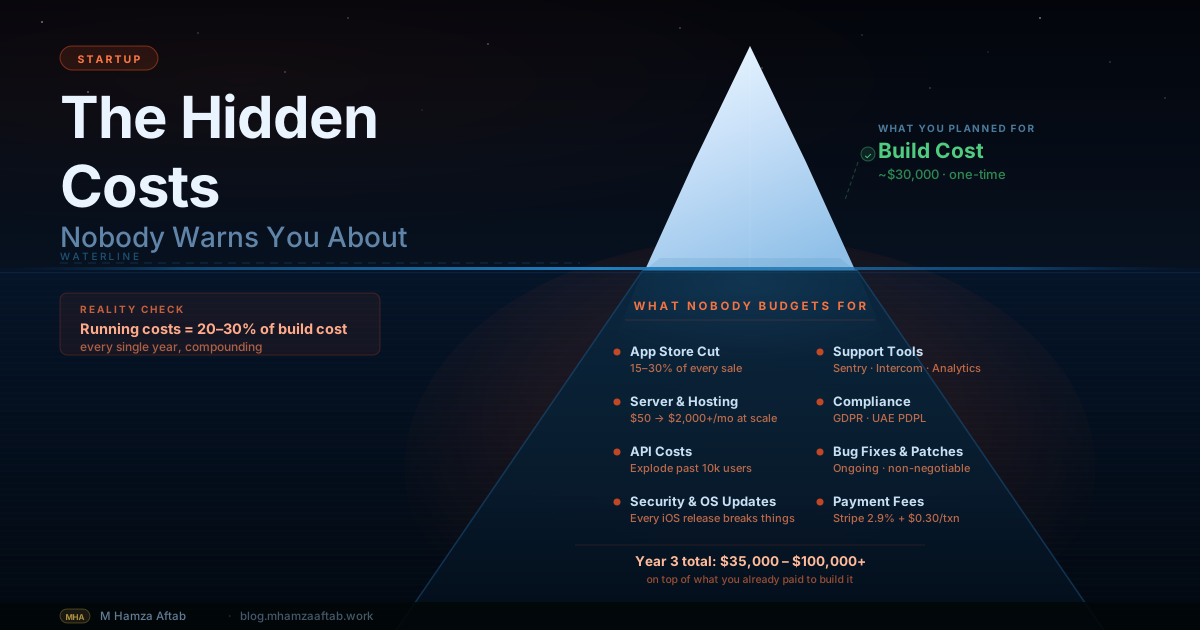
This is why the scope of your first version matters at the budget stage, not the technical one. An app scoped at $150,000 that runs out of money at 60% complete has nothing to ship. An app scoped as a lean MVP for $40,000 — see what an MVP actually costs — ships a working product in month three and has 15 months of iteration runway on the same total budget. Building the right MVP is a financial strategy as much as a technical one. The lean version gives you the optionality the over-engineered version doesn't.
A lightweight scope document — what's in, what's explicitly deferred, and who owns each decision — is usually the difference between a team that ships within runway and one that discovers the scope problem six months too late.
If you're still working out what belongs in version one and what to cut, a short pre-build conversation costs nothing and tends to prevent several times that in avoidable rework.
4. Wrong Team Structure
The most common team failure isn't skill — it's composition.
Solo technical founders often build well and distribute poorly. They ship a clean product that nobody knows exists. Solo non-technical founders often have strong market instincts but can't evaluate the quality of work their developers are producing — which creates a different kind of problem, where expensive development decisions get made without informed oversight.
Two co-founders who are both on the business side face a version of both problems: they can generate demand, but they have no internal visibility into whether what's being built is actually sound.
The team structures that survive consistently have complementary coverage: someone who can build (or credibly evaluate building), someone who can sell, and a shared understanding of the target user. This doesn't mean hiring a full team on day one. It means being honest about which critical function has no owner and addressing that before it becomes the reason for a postmortem.
Team problems are slow-motion failures. They rarely surface until a missed milestone or a difficult investor conversation makes them impossible to ignore.
5. Out of Runway Before the Pivot
Slack was a gaming company. The game, called Glitch, failed publicly. The internal messaging tool the team had built to communicate while making the game became Slack — now valued at over $25 billion.
Instagram was a location check-in app called Burbn. The check-in mechanic was going nowhere. The photo-sharing feature buried inside it was getting traction. The founders stripped everything else out and rebuilt around photos.
YouTube was a video dating site. Pinterest was a mobile commerce app for small boutique retailers. Twitter was a podcasting platform called Odeo. The pivot histories of successful apps look like a list of companies that should have died — and most of them would have, if the teams had spent all their runway on the first direction.
Most apps that fail don't fail because the pivot was impossible. They fail because there was no money left to execute it. By the time the founding team has enough data to know the initial direction isn't working, they've burned the budget proving it.
Keeping the first build lean isn't just sensible product management. It's the only way to stay alive long enough to find the version that works.
What Successful Apps Have in Common
Across the apps that beat the 90% statistic, a few patterns appear consistently:
Distribution is planned before the product is built. Founders who succeed know who their first 100 users are — by name, where possible — before the app is designed. Waitlists, community presence, SEO foundations, direct outreach to target customers: these start months before launch day.
The first version is deliberately small. Not cut-corners small — strategically small. One core use case, executed well, for a defined user. Everything else is a hypothesis for version two. This discipline is what keeps runway intact long enough to matter.
User contact is direct and regular. Not surveys or dashboard analytics — actual conversations with real users, weekly, in the early phase. Founders who build apps that survive know their users well enough to have recognised the pivot signal when it appeared.
The team covers critical functions. Build, sell, and understand the user. At minimum two of these three functions have a named owner. Ideally all three.
Runway is treated as the most valuable resource. Cash is not spent on features until the core product earns the right to be more complex. Every dollar spent on a non-essential feature is a week of iteration runway spent.
Frequently Asked Questions
What is the app failure rate?
Somewhere between 80 and 90%, depending on how you define failure — and that definition matters more than the exact number. Some studies count apps that never reach meaningful revenue; others count anything abandoned within six months. The margin shifts by methodology; the direction doesn't. Most apps launched commercially don't make it past year two.
What is the number one reason apps fail?
Distribution. Most apps are built without a concrete, costed plan for how to reach and retain users at scale. App store organic discovery is extremely competitive, and the assumption that launching equals being found has killed more funded products than any technical shortcoming. User acquisition is a product design problem — it needs to be solved before development starts, not after launch.
Why do most apps fail in the first year?
The most common causes in the first year are running out of money before reaching product-market fit, failing to acquire users at a sustainable cost, and building features that don't match what actual users need. These three problems compound each other: money burns fast on features nobody asked for, and there's nothing left for the iteration that would have fixed it.
Is a bad idea the main reason apps fail?
Rarely. Most app ideas are workable in principle. The failure is almost always in execution — specifically, in how the product reaches users and whether the team has enough time and money to iterate toward product-market fit. Genuinely bad ideas do exist, but they typically fail for the same distribution and runway reasons that would have killed a good idea too.
How do I improve my app's chances of success?
Start with validation before any development spend. Scope your first version to the smallest thing that proves your core hypothesis. Build a distribution plan — with real numbers — before you start building the product. And protect your runway: plan for at least 18 months, because product-market fit almost never arrives in six.
The apps that succeed don't succeed because of better ideas or cleaner code. They survive because the founders thought about distribution before they thought about features, kept the first version small enough to ship quickly, and preserved enough runway to adjust when the early version didn't land exactly right.
If you're in the pre-build phase — scoping, evaluating budget, deciding what to prioritise first — that's the moment where a single honest conversation saves months of expensive mistakes. I work with founders at exactly this stage, on one question: what is the leanest version of this product that tells you whether you have a business?
Reach out before you commit your budget. I'll give you a free, honest read on your scope — not a quote, not a pitch.