How Long Does It Take to Build an App in Dubai in 2026
Real app development timelines for Dubai in 2026, broken down by complexity, platform, and developer type — plus the questions to ask before you commit to anyone's estimate.

This article may contain affiliate links. See our Disclaimer for details.
Every week I speak with founders in Dubai who've already been burned once. A developer told them six weeks, the project ran to five months, and the relationship ended badly somewhere around month three. They want to know if that experience was their fault, their developer's fault, or just how this works.
The honest answer is: a bit of both, and also just how this works.
Building an app in Dubai typically takes between 6 weeks and 9 months, depending on complexity, platform, and the team building it. A simple booking or information app takes 6 to 12 weeks. A standard business app with accounts and payments takes 14 to 20 weeks. A complex platform or marketplace takes 6 to 9 months. These figures assume a competent team working consistently. Most real projects run 20 to 30 percent longer than the initial estimate.
This article breaks down where that time actually goes, what makes Dubai projects different from generic timelines you'll find elsewhere, and the eight questions you should ask any developer before you agree to their estimate.
The Short Answer: How Long Does App Development Take in Dubai?
Here's a summary of realistic timelines by complexity tier:
| App Complexity | Timeline | Best Suited For |
|---|---|---|
| Simple | 6 to 12 weeks | Info apps, booking apps, landing pages with logic |
| Medium | 14 to 20 weeks | Business apps, dashboards, payments, user accounts |
| Complex | 6 to 9 months | Marketplaces, SaaS platforms, AI-powered products |
These are development timelines only. If you're starting from scratch with no designs and no defined scope, add 2 to 4 weeks for discovery and design before any development begins. Most founders underestimate this phase and then wonder why the clock doesn't start moving the moment they sign the contract.
The ranges above assume a focused small team, a well-defined scope, and a client who can give timely feedback. All three of those conditions are harder to maintain than they look on a project kickoff call.
The Five Phases of App Development (And How Long Each Takes)
App development has a predictable structure. The timeline varies by scope, but the phases themselves don't change. Knowing what happens in each phase is the fastest way to spot an estimate that's quietly missing something.
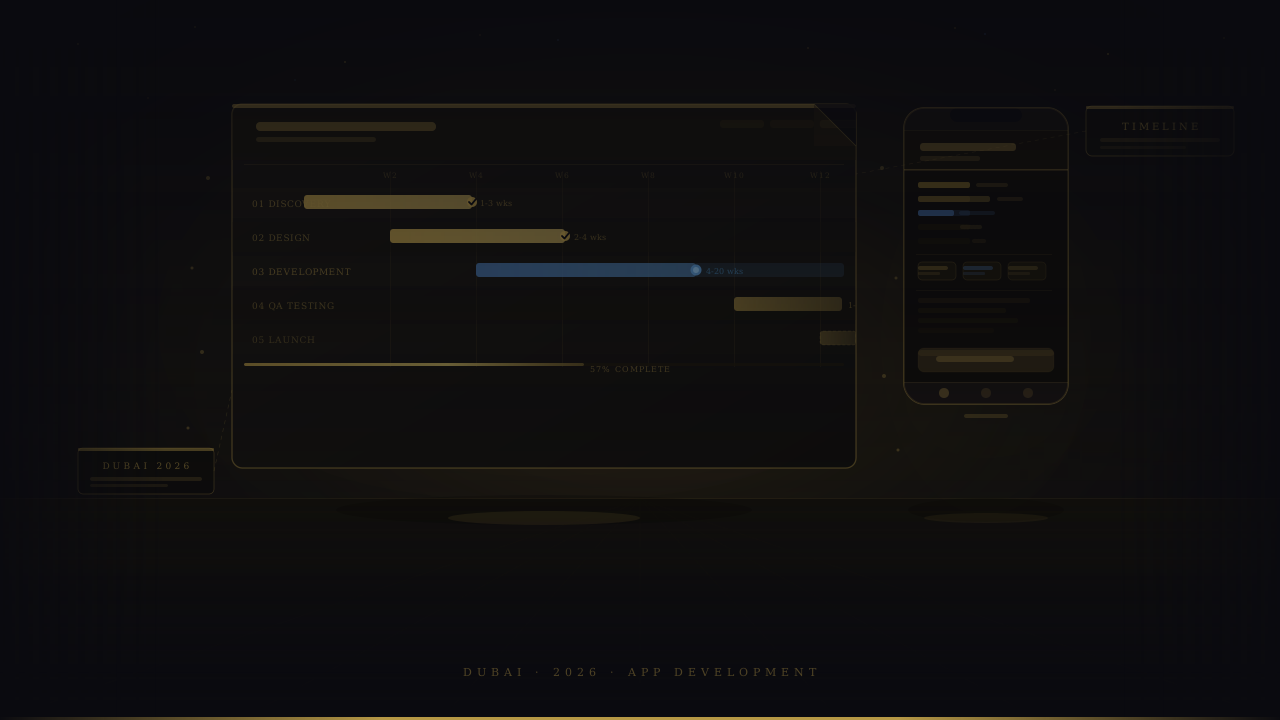
Phase 1: Discovery and Scoping (1 to 3 weeks)
This is where the project is defined: what features exist, who the users are, what integrations are needed, and what the technical architecture looks like. A strong discovery phase produces a specification document that both sides can hold each other to. A weak one produces a vague brief that gets reinterpreted at every milestone.
Skip discovery to save time and you pay for it in phase 3. I've seen a 2-week discovery investment save 6 weeks of development rework.
Phase 2: UI/UX Design and Prototyping (2 to 4 weeks)
Screens are designed, flows are mapped, and a clickable prototype is built before a single line of production code is written. This is also where most client feedback cycles happen, which is exactly right. Changing a design in Figma takes hours. Changing the same thing after it's been coded takes days.
The range varies based on how many unique screens the app has. A simple booking app might have 8 screens. A marketplace might have 40.
Phase 3: Development (4 to 20 weeks, depending on scope)
This is the largest variable in any timeline. A simple app with 8 screens, no user accounts, and a single integration might take 4 to 6 weeks to build. A medium business app with authentication, dashboards, payment processing, and push notifications takes 10 to 14 weeks. A complex platform can run 16 to 20 weeks before QA even starts.
The number that gets quoted in proposals is almost always this phase in isolation. The other four phases are often excluded.
Phase 4: Testing and QA (1 to 3 weeks)
Functional testing, device testing, edge case testing, performance testing. If the app needs to work on both iOS and Android, this phase gets longer. If the app handles payments or personal data, security testing gets added here too.
Skipping QA to ship faster is the most common mistake I see first-time founders make. The bugs that slip through are always the ones that reach users.
Phase 5: App Store Submission and Launch (1 to 4 weeks)
Apple's App Store review currently takes 1 to 3 days on average, but rejections require rework and resubmission. Google Play is faster, usually 1 to 7 days. And if your entity is new, you may need to establish a developer account first, which takes additional time (more on this below in the Dubai-specific section).
Production environment setup, DNS configuration, SSL certificates, and deployment also happen here. Not glamorous, but they take time.
Total timeline by complexity tier:
| Tier | Discovery + Design | Development | QA | Submission | Total |
|---|---|---|---|---|---|
| Simple | 2 to 4 weeks | 4 to 6 weeks | 1 week | 1 to 2 weeks | 8 to 13 weeks |
| Medium | 3 to 5 weeks | 10 to 14 weeks | 2 weeks | 1 to 2 weeks | 16 to 23 weeks |
| Complex | 4 to 6 weeks | 16 to 20 weeks | 3 weeks | 2 to 4 weeks | 25 to 33 weeks |
What Affects Your Timeline More Than Anything Else
The complexity tier gives you a ballpark. What actually determines whether you land in the lower or upper half of that range is a combination of four factors.
Platform choice. Building with a cross-platform framework like React Native or Flutter means one codebase running on both iOS and Android. That's typically 20 to 35 percent faster than building two separate native apps. For most business apps, cross-platform is the right call. Native development makes sense only when you need deep hardware access or very specific performance characteristics. If someone is quoting you dual native builds, ask whether cross-platform would work for your use case and what what each option costs in Dubai looks like in practice.
Developer type. A solo freelancer working across multiple clients will have interruptions that a dedicated small team won't. An agency adds coordination overhead that can slow delivery on smaller projects. I've covered the tradeoffs in detail in the freelance developer vs agency comparison, but the short version is: timeline predictability is one of the biggest differences between developer types, not just cost.
Feedback and decision latency. This is the most underestimated timeline killer on any project. When a design needs approval and the founder is unavailable for four days, those four days become dead time. When a technical decision gets passed up a management chain, a one-hour conversation stretches to a week. If you're the decision-maker, stay close to the project. Block time weekly for reviews and approvals. Projects with responsive clients consistently finish faster than projects where the developer spends 30 percent of their time waiting.
Third-party integrations. Every external service the app connects to adds time. Payment gateways typically add 3 to 7 days per integration. Map APIs add 2 to 4 days. CRM or ERP integrations add 5 to 10 days, sometimes more if the third-party documentation is poor or the API is undocumented. These aren't optional delays. That's just how integration work goes. An accurate estimate accounts for them explicitly.
Dubai-Specific Factors That Add Time to Any Project
Most of the Dubai-based founders I work with have been caught by at least one of these.
Ramadan scheduling. If your project overlaps with Ramadan, build in 2 to 4 extra weeks. Working hours shorten, team capacity drops by 20 to 30 percent, and review cycles slow because stakeholders are less available. This isn't a complaint about the month, just a planning reality. If you're targeting a launch in the first quarter of the year, your project almost certainly overlaps with Ramadan.
Arabic RTL support. If your app needs to work in both English and Arabic, which most apps serving the UAE market do, add 15 to 25 percent to the design and development timeline. RTL layout requires mirroring almost every UI element. Type rendering, icon direction, navigation flow, and form alignment all behave differently in Arabic. Developers who haven't done RTL work before consistently underestimate this. Ask directly: has the developer shipped a bilingual Arabic/English app before?
UAE App Store publisher account setup. If your company is a new entity and you don't yet have an Apple developer account set up under a UAE-registered business, budget 2 to 4 weeks just for that approval process. Apple's review for new accounts is manual and involves documentation. This is separate from the app review itself. Google Play is faster but also requires a verified account.
Local payment gateway integration. The UAE payment landscape is different from what most international tutorials and framework docs assume. If you're integrating Telr, PayTabs, or Network International instead of Stripe, add 5 to 10 extra days. Documentation quality varies, sandbox environments can be inconsistent, and testing requires a live merchant account in some cases.
PDPL compliance review. The UAE Personal Data Protection Law applies to any app that collects personal data of UAE residents. If your app has user accounts, contact forms, analytics, or location tracking, a basic compliance review adds 3 to 7 days. This isn't optional. It's a legal requirement. A developer who doesn't raise this when scoping a consumer app in the UAE is either uninformed or cutting corners.
Not sure how many of these Dubai-specific factors apply to your project? I can tell you which ones matter for your app type in a short conversation. No proposal, no commitment. Send me a message
Why the First Timeline You Receive Is Almost Always Optimistic
Optimistic timelines aren't always dishonest. They're often structurally inevitable.
When a developer estimates a project, they estimate it under ideal conditions: clear requirements, fast client feedback, no integration surprises, no scope changes, and everything working as documented. Real projects rarely hit all of those conditions. Requirements clarify during development. Feedback cycles take longer than expected. An integration behaves differently in production than in the sandbox. A stakeholder asks for one small change that touches seven screens.
Each of those events is individually minor. Collectively, they're how a 16-week project becomes a 22-week project.
Scope creep is the largest single contributor. Even changes the client considers trivial add days. Adding a filter to a list screen sounds minor until you realize it affects the database query, the API contract, the UI state management, and the test suite. A developer who's been honest about this will tell you upfront that any feature added after the scope is locked extends the timeline proportionally.
Revision rounds are another underestimated variable. Most developers quote one or two rounds of design revision. In practice, clients have three to five feedback cycles before they're satisfied with how something looks. That's not a criticism. It's normal. But it needs to be in the timeline, not treated as a free addition.
The practical rule I use: take any quoted timeline and add 20 to 30 percent as your planning baseline. If the project comes in on the original estimate, that's a pleasant surprise. If it doesn't, you haven't committed to a launch date that's now impossible to hit.
If you've just received a quote and want a second opinion on whether the timeline is realistic for your scope, feel free to run the numbers past me. I can usually tell within five minutes whether an estimate is credible or whether something is being excluded.
Questions to Ask Before You Start (From a Senior Developer)
These are scoping and timeline questions, not general vetting questions. They're designed to stress-test an estimate before you commit to it. A developer who's shipped real products can answer all of these without hesitation.
1. "What assumptions are you making to produce this timeline?" Every estimate is built on assumptions. A good developer can list them: assumes scope doesn't change, assumes two design revision rounds, assumes client feedback within 48 hours, assumes the payment gateway sandbox is accessible. If they can't name their assumptions, the estimate isn't grounded in anything specific.
2. "Have you built something similar before? How long did that take?" Past project experience is the only real basis for a timeline estimate. If the developer has built three booking apps and they all took 10 to 14 weeks, that's meaningful data. If this would be their first booking app, ask how they arrived at their estimate.
3. "What is not included in this timeline?" Discovery, design, QA, deployment, and App Store submission are frequently excluded from the headline number. Ask explicitly what is and isn't in scope. The answer should be immediate and specific.
4. "What is the single thing most likely to delay this project?" A developer who's shipped knows exactly what usually goes wrong on projects like yours. They might say "third-party API documentation is almost always incomplete" or "the first design round usually takes longer than planned." If the answer is "nothing should go wrong," that's not experience talking.
5. "How many revision rounds are included for design?" This needs to be in the contract, not left ambiguous. If two rounds are included and you use four, you need to know that will affect the timeline and potentially the cost. Clarifying this before signing prevents the most common mid-project friction point.
6. "What do you need from me to stay on schedule?" This is the question founders skip most often. The developer's timeline depends on your availability. If they need design approval within 48 hours at certain milestones and you're traveling, that's a problem you can plan around if you know about it in advance.
7. "What does the timeline look like if we add [specific feature] later?" Name a feature you're considering but not sure about. A developer who understands the architecture can tell you whether adding it later is a small addition or a structural change. The answer tells you how modularly they're thinking about the build.
8. "Does this timeline include time for App Store review and any rejection and resubmission cycles?" App Store rejection is common, especially for apps with payment flows, data collection, or subscription models. A first-time developer often excludes this. A resubmission after a rejection adds 3 to 7 days minimum. If you're launching around a specific date, this matters.
A developer who can answer all eight clearly and without hesitation is operating at a professional level. One who gets defensive or vague is telling you something. For questions about evaluating the developer themselves beyond timeline, the full checklist is in What to Know Before Hiring a Developer in Dubai.
A Realistic Timeline by App Type: Dubai 2026
| App Type | Complexity | Realistic Timeline | Key Variables |
|---|---|---|---|
| Landing page with waitlist | Simple | 1 to 2 weeks | Copy readiness, design rounds |
| Simple info or booking app | Simple | 6 to 10 weeks | 3rd-party booking API, payment |
| Standard business app | Medium | 12 to 18 weeks | Auth, dashboards, notifications |
| Two-sided marketplace | Medium-High | 20 to 32 weeks | Trust mechanics, payments, admin |
| Custom SaaS platform | High | 24 to 40 weeks | Multi-tenancy, billing, analytics |
| AI-powered product | High | 20 to 36 weeks | LLM integration, data pipeline, testing |
| Cross-platform (React Native) | Varies | 20% faster than dual native | Code sharing across iOS and Android |
These are development timelines only. Add 4 to 8 weeks for discovery, design, and App Store submission.
How to Use This Before Talking to a Developer
First, place your project in the right complexity tier using the tables above. Be honest about what you actually need, not what you're hoping is possible. A two-sided marketplace is a two-sided marketplace even if you're calling it an "MVP." Understanding what counts as an MVP before your first developer conversation will save you a significant amount of time and negotiating confusion.
Once you have a tier, you have a reference range. When a developer quotes you a timeline, you can compare it against that range and ask specific questions if the numbers don't align. If someone quotes you 8 weeks for a project that sits clearly in the medium tier, you're not being pessimistic by asking why.
Build the buffer in from the start. Don't treat the best-case estimate as your planning assumption and then scramble when the project runs long. If you're pitching a launch date to investors or partners, use the top of your tier range, not the bottom. Anyone who's shipped software will respect a realistic timeline more than an optimistic one that slips.
If you're working out what an MVP build should cost alongside figuring out the timeline, the breakdown in what an MVP build costs covers the budget side of the same question.
FAQ: App Development Timelines in Dubai
How long does it take to build an app in Dubai?
Building an app in Dubai takes between 6 weeks and 9 months depending on complexity. A simple app takes 6 to 12 weeks, a standard business app with payments and accounts takes 14 to 20 weeks, and a complex marketplace or platform takes 6 to 9 months. These are development timelines. Add 4 to 8 weeks for discovery, design, and App Store submission.
What is the fastest way to build an app?
Start with a cross-platform framework like React Native or Flutter rather than building separate iOS and Android apps. Narrow your scope to the smallest version of the product that delivers core value. Have designs approved before development begins. And be available for fast feedback throughout the build. The fastest projects I've worked on were the ones where the client was responsive and the scope was genuinely fixed.
Why does app development take longer than expected?
Because initial estimates are built on ideal conditions that rarely hold through a full project. Scope clarifies during development. Feedback cycles run longer than planned. Third-party integrations behave differently in production than in the sandbox. Revision rounds multiply. A realistic estimate adds 20 to 30 percent to the quoted timeline as a planning buffer.
How long does the App Store review take in the UAE?
Apple's App Store review takes 1 to 3 days on average for standard submissions. Rejections require rework and resubmission, which adds another 3 to 7 days per cycle. Google Play review is faster, typically 1 to 7 days. If your entity is new and doesn't yet have a UAE-registered Apple developer account, the account approval process can add 2 to 4 weeks before any app review begins.
Does building for iOS or Android take longer?
If you're building native apps separately, iOS and Android take roughly the same time in development but can vary in QA. If you're using a cross-platform framework like React Native or Flutter, both platforms are covered by a single codebase, which is 20 to 35 percent faster than dual native builds. For most business apps, cross-platform is the right choice on both timeline and cost grounds.
How long does an MVP take to build?
An MVP takes 6 to 16 weeks depending on how tightly the scope is defined. The timeline is almost entirely determined by how many features are included. A true MVP, the smallest thing that proves the core assumption, sits at the lower end of that range. A "minimum viable product" that has actually become a full feature list sits at the upper end. If you're unsure what should be in your MVP, that's worth resolving before you start the clock.
Most projects run long not because developers are incompetent, but because the scope wasn't validated and the estimate wasn't stress-tested before work began. That's a solvable problem at the start of a project, and an expensive one to fix halfway through.
If you're approaching a developer conversation and want to know what tier your project sits in, whether a quote you've received is realistic, or what to push back on before you sign anything, I'm glad to give you a straight read. No proposal deck, no sales process.