How to Monetize an App: 7 Revenue Models Compared (2026)
Freemium, subscription, in-app ads, or marketplace commission? The 7 proven app revenue models explained side by side — with a decision framework for founders picking the right one before they build.

This article may contain affiliate links. See our Disclaimer for details.
Most founders spend six months deciding on features and a weekend deciding how they'll charge. Then, six months after launch, they reverse the revenue model — because the one they chose no longer fits the product architecture, the payment infrastructure doesn't support what they're now selling, and they're rebuilding billing from scratch while trying to retain their first customers.
The revenue model is not a post-launch decision. It shapes which features you build, how your database is structured, what payment infrastructure you need on day one, how long your billing cycle is, and how investors read your unit economics. Get it wrong and you are not tweaking a pricing page — you are refactoring core product logic.
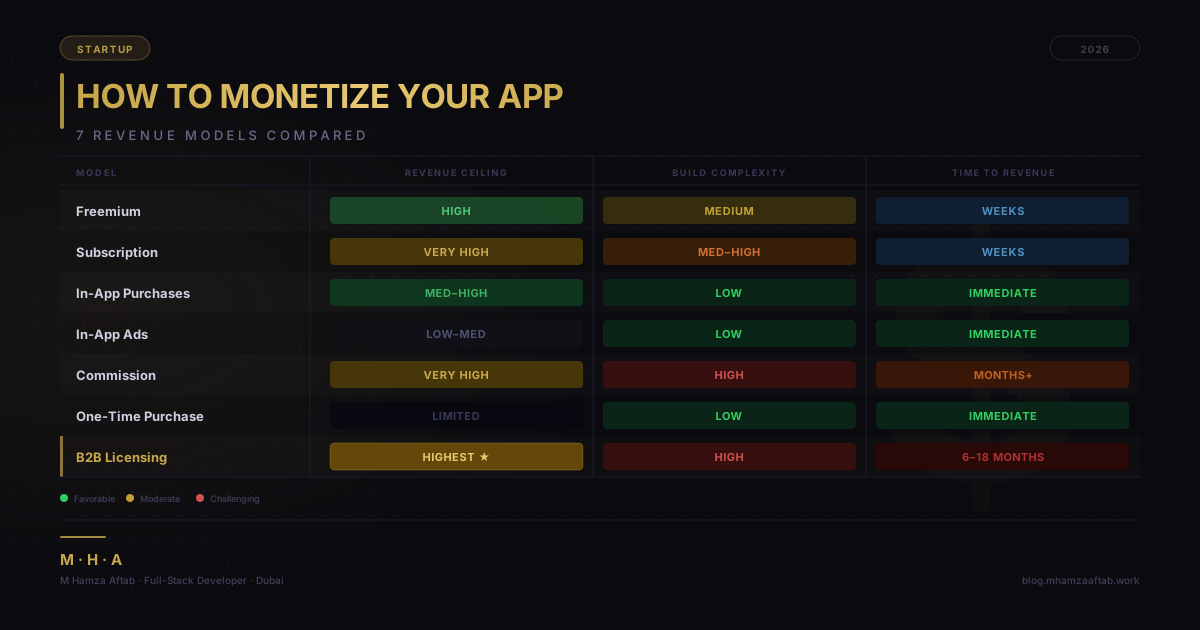
The seven ways to monetize an app are:
- Freemium — offer the core app free and charge for premium features.
- Subscription — charge a recurring monthly or annual fee for access.
- In-App Purchases — sell digital goods, credits, or permanent unlocks inside the app.
- In-App Advertising — keep the app free and earn revenue from ads shown to users.
- Transaction Commission — take a percentage of every transaction processed through your platform.
- One-Time Purchase — charge a fixed price to download or permanently unlock the app.
- B2B Licensing — sell annual contracts or white-label deals to businesses.
This guide covers how each model works, which app type it suits, what it demands from your development team, and a framework for choosing your model before you write a single line of code. I have built apps on all seven of these models, working with founders in Dubai and remotely — this guide draws from that directly, not from generic frameworks. If you are still deciding whether to build a web app or mobile app at all, start here first.
Consumer App or B2B App — Why the Answer Changes Everything
One question determines which monetisation paths are even viable: are you building for individual consumers or for businesses?
Consumer app economics are a volume game. Average revenue per user runs $2–$15 per month for subscription products, often less. Purchase decisions are emotional and fast — users compare you against the price of a coffee, not a procurement budget. You live and die by App Store ratings, organic discovery, and retention curves. Churn is high (5–10% monthly is typical for consumer apps without strong habits built in). Your development budget competes directly with games, social apps, and free tools that have already conditioned users not to pay.
B2B app economics invert almost all of that. Annual contract values (ACV) range from $500 to $500,000+ per account depending on your market. Buying decisions involve multiple stakeholders and take weeks to months. But once a business is using your software, they are genuinely sticky — switching tools means migrating data, retraining teams, and re-integrating with other systems. Monthly churn below 2% is achievable. Investors understand the revenue profile immediately.
This is your first decision gate. Determine your primary customer type before evaluating any model.
What if my app serves both? Pick one as your go-to-market anchor. Consumer self-serve and enterprise sales require completely different products at the feature level, different onboarding flows, different billing infrastructure, and different sales motions. Build for one, get to product-market fit, then add the second customer type once you know what they need.
The 7 App Revenue Models
1. Freemium
The core product is free. A subset of features — storage limits, collaboration, advanced exports, priority support, or usage thresholds — sit behind a paywall.
Best for: Broad consumer apps, productivity tools, and anything with network effects (where more users make the product more valuable for everyone). Notion, Dropbox, and Slack all built user bases on free tiers that created internal company advocates before any enterprise deal was signed.
Key trade-offs: Global freemium conversion rates sit at 2–5%. If you get 10,000 free users, expect 200–500 paying customers. That math only works if your free tier has meaningful infrastructure costs you can manage, and if the paid upgrade is clearly valuable — not just cosmetic. In 2026, subscription fatigue in crowded consumer categories is real. Free tiers are expected. Upgrades are harder to justify unless the gated features solve a genuine pain point.
Real examples: Spotify (free tier with ads and shuffle-only; full library and offline listening behind Premium), Dropbox (2GB free, storage upgrades paid), Notion (personal free plan; team collaboration blocked behind paid tier), Duolingo (streak freezes and ad removal paid).
Development complexity: Requires a feature-flag system to toggle access per account tier, paywall UI, and subscription billing (RevenueCat on mobile, Stripe Billing or Paddle on web). Add 2–3 weeks to your baseline build.
2. Subscription
Recurring billing — monthly or annual — for continued access. The user pays to keep using the product, not to unlock a one-time purchase.
Best for: B2B apps, SaaS products, productivity tools embedded in a workflow, and any product where the value compounds over time (more data, more history, more integrations). Subscription is the most investor-friendly model because it produces predictable, recurring revenue that can be modelled as MRR and ARR.
Key trade-offs: Highest lifetime value (LTV) of almost any consumer-facing model. But it demands a genuine answer to "why should I stay subscribed in month 13?" when the initial excitement has worn off. You also need robust billing infrastructure: trial periods, upgrade and downgrade paths, pause subscriptions, cancellation flows, and dunning sequences for failed payments (typically 20–30% of monthly churn is involuntary, from expired cards).
Sub-decisions matter: monthly vs annual pricing (annual subscriptions dramatically reduce churn and improve cash flow), per-seat vs flat fee vs usage-based. Usage-based pricing — pay for what you consume — is the fastest-growing variant in 2026, especially for AI tools where inference costs are variable.
Real examples: Slack (per-seat monthly/annual), Linear, HubSpot, Notion Teams, Netflix.
For a full technical breakdown of what a subscription SaaS product requires to build — from billing infrastructure to multi-tenancy and enterprise SSO — the SaaS build guide covers the scope in detail.
Development complexity: Subscription lifecycle management is non-trivial — trials, upgrades, downgrades, pauses, cancellations, dunning for failed payments. RevenueCat handles this on mobile. Stripe Billing or Paddle handle it on web. Add 3–5 weeks to baseline.
3. In-App Purchases (IAP)
One-time purchases made inside the app. Three types: consumables (coins, tokens, credits that get used up), non-consumables (permanent unlocks — remove ads, unlock a premium feature), and store-managed subscriptions (App Store or Play Store handles the billing, not your backend).
Best for: Mobile games, content apps, AI tools with per-inference costs, and tools where users want to buy usage in chunks rather than commit to a recurring fee. IAP is particularly well-suited to AI apps in 2026 — credit-based pricing (buy 500 image generations, spend down the balance, buy more) is the dominant pattern for AI image generators, voice tools, and AI writing assistants.
Key trade-offs: Apple App Store takes 30% of every non-subscription IAP transaction (15% for subscriptions after the first year). Google Play matches those rates. Factor this into your pricing from day one — it is not a fee you can negotiate. Server-side receipt validation is non-negotiable if you are selling consumables: without it, jailbroken devices can fake purchases, and you will eat the infrastructure cost without the revenue.
Real examples: Candy Crush (coin bundles), Procreate (one-time permanent purchase), ChatGPT (extra credit packs above the subscription cap), Midjourney (credit bundles), AI image generators universally.
Development complexity: App Store / Google Play Billing SDK integration, server-side receipt validation (prevents fraud), entitlement management to track what each user has purchased. Add 1–2 weeks on top of your baseline.
4. In-App Advertising
The app is free. Revenue comes from ads served to users — display banners, interstitials between screens, or rewarded video (the user watches a 30-second ad in exchange for in-game currency or a premium feature unlock).
Best for: High-volume consumer apps with daily active use at scale — utilities, mobile games, news, weather, radio. Rewarded video dramatically outperforms banner ads in both revenue and user satisfaction (users opt in, so engagement is much higher).
In-app advertising is almost never a viable primary model for an early-stage startup. You need 100,000+ daily active users to generate meaningful revenue. At $1–$3 average eCPM for global audiences (the revenue per 1,000 ad impressions), 10,000 daily users generates roughly $10–$30 per day — not a business. Advertising works as a secondary revenue layer on top of a freemium model (the free tier sees ads, premium removes them), or in gaming where rewarded video is the core mechanic.
Dubai/MENA note: UAE eCPMs run $3–$8, compared to $0.50–$2 global average. If your app is specifically targeting UAE audiences, advertising economics are meaningfully better. But the scale requirement does not change.
Real examples: Free mobile games broadly, Waze, free news and weather apps.
Development complexity: Google AdMob SDK — 3–5 days for a single network. Ad mediation (combining multiple ad networks to maximise fill rate) adds roughly a week.
5. Transaction Commission (Marketplace Model)
Your platform connects buyers and sellers. You take a percentage of every transaction that flows through it — typically 5–30% depending on the category.
Best for: Marketplace apps, delivery platforms, booking apps, and service-provider platforms where the app connects supply and demand rather than being the service itself. The platform's value is the match, not the product.
Key trade-offs: The classic chicken-and-egg problem. Zero revenue until you have both supply (sellers, drivers, service providers) and demand (buyers, customers) transacting simultaneously. Commission percentage is a competitive battleground — Uber competed on driver rates, Airbnb on host fees. Your margins must be wide enough to fund growth while keeping both sides of the market satisfied.
Commission structure options: Percentage-only (simplest), flat fee per transaction (predictable for buyers), subscription for sellers plus a percentage (common in SaaS-enabled marketplaces), or promoted listing premiums on top of base commission (Etsy, Amazon seller ads).
Dubai/MENA note: The commission/marketplace model is dominant in GCC venture funding. Talabat, Deliveroo, Careem, noon, Amazon.ae, Ureed — the landmark exits and large funding rounds in the UAE have overwhelmingly been commission-model businesses. UAE investors have a clear mental model for this structure and the unit economics they expect. For the cost and infrastructure specifics of UAE marketplace and e-commerce platform builds — including payment splitting, multi-currency, and payout architecture — the e-commerce app development cost guide for Dubai covers the technical line items.
Real examples: Talabat (restaurant commission), Airbnb (10–20% from traveler, 3% from host), Careem (driver commission), noon (seller commission by category).
Development complexity: This is the most technically demanding model on this list. Multi-party payment splitting, escrow logic, automated payout scheduling to sellers, a commission calculation engine, and refund and dispute handling. Most marketplace founders underestimate this by 50–100%. Add 4–8 weeks minimum to your baseline build — more if you are handling physical goods delivery or compliance-sensitive payments.
6. One-Time Purchase
A fixed price to download the app permanently or unlock all features, with no recurring charge. The user pays once and owns access.
Best for: Professional tools with clearly defined, complete value — desktop-first software, niche productivity apps, tools serving professionals who prefer perpetual ownership over subscriptions. Also common in the indie app market where developers prefer simplicity over subscription management overhead.
Key trade-offs: Zero churn by definition. Simple user relationship — no dunning, no renewals, no upgrade flows. But the revenue ceiling is hard. Every day after launch, every existing customer has already paid you everything they will ever pay you. Growth requires constant new customer acquisition.
The AppSumo lifetime deal variant deserves a mention: a deeply discounted lifetime license ($49–$299 one-time) to a cohort of early adopters. This generates launch cash, product reviews, and real user feedback before you pivot to a subscription model. It works as a launch tactic if you are willing to honour that cohort's lifetime access while the rest of your customers move to recurring billing.
Real examples: Final Cut Pro ($299, Mac/desktop), Pixelmator Pro ($49.99, Mac), many well-regarded indie iOS apps.
Development complexity: App Store one-time purchase or Stripe Checkout / Paddle one-time payment. No recurring billing infrastructure needed. This is the simplest model technically. Add 3–5 days.
7. B2B Licensing and Enterprise Contracts
The app is sold to businesses under annual or multi-year contracts, priced per seat, per tier, or as a negotiated flat annual fee. The customer is a company, not an individual.
Best for: Apps targeting businesses directly — HR software, compliance tools, internal productivity platforms, logistics management, fintech for businesses, government technology. Also covers the white-label variant: build the product once, license it under the client's brand. Common in fintech, real estate portals, and healthcare where the client wants the perception of proprietary software.
Key trade-offs: Highest ACV of any model — $20,000 to $500,000+ per client annually is realistic for mid-market and enterprise. Once established, it is defensible: switching vendors means migrating years of data and retraining hundreds of employees. But sales cycles run 3–18 months for enterprise deals. Procurement involves legal, IT security, finance, and often a formal RFP process. Custom features and SLAs are frequently negotiated per client.
Dubai/MENA note: Government and enterprise verticals in the UAE strongly prefer this model. ADGM and DIFC tenants, UAE government entities, and large regional enterprises all buy through procurement processes that assume annual contracts, security assessments, and local data compliance. The sales cycle is long, but deal sizes are 10–100x consumer app revenue. The current wave of UAE government digitisation initiatives (particularly in healthcare, logistics, and public services) is creating sustained demand for enterprise-grade applications.
Real examples: Salesforce (per-seat annual), Workday (enterprise HR), custom apps built for UAE banks, logistics operators, and real estate developers.
Development complexity: Multi-tenancy (each client's data is isolated), SSO/SAML integration (Okta, Azure AD, Google Workspace), per-client admin dashboards, audit logs, SLA monitoring. Add 2–4 months to your baseline — more if you are handling government procurement requirements or compliance certifications.
Side-by-Side Comparison
| Revenue Model | Best Customer Type | Revenue Ceiling | Build Complexity | Time to First Revenue |
|---|---|---|---|---|
| Freemium | Consumer | High | Medium | Weeks to months |
| Subscription | B2B / SaaS | Very High | Medium–High | Weeks to months |
| In-App Purchases | Consumer / Gaming / AI | Medium–High | Low–Medium | Immediate |
| In-App Advertising | High-volume consumer | Low–Medium | Low | Immediate |
| Transaction Commission | Marketplace / delivery | Very High (at scale) | High | Slow (chicken-and-egg) |
| One-Time Purchase | Niche / professional | Limited | Low | Immediate |
| B2B Licensing | Enterprise / government | Highest | High | Slowest (6–18 months) |
If you already know which model fits your product and want a quick sense check on whether your technical scope covers what that model demands from day one, book a free 30-minute call. I will tell you what billing infrastructure your chosen model needs, where founders typically underscope the build, and what can wait until after your first revenue milestone.
How to Choose the Right Model — A 4-Question Framework
This is the question most founders answer with a gut feeling or by copying a competitor. Neither approach holds up once you realize the revenue model shapes your payment infrastructure, your database structure, and your billing logic — choices you will live with for years. Work through these four questions in order.
Question 1: Who is your primary user — an individual consumer or a business?
- Consumer → your viable models are freemium, subscription, in-app purchases, advertising, and one-time purchase.
- Business (B2B) → your viable models are subscription (SaaS), B2B licensing, and transaction commission.
If you genuinely cannot answer this, your product definition is not tight enough yet. Read how to validate your app idea before committing to a revenue model.
Question 2: How often will they use the app — daily, weekly, or occasionally?
- Daily → freemium or subscription works because users are reminded of the value constantly. Advertising has more daily inventory to monetise.
- Weekly → subscription is viable. IAP works well for session-based value (unlock a feature for this session). One-time purchase is reasonable.
- Occasionally → subscription will have high involuntary churn because users forget they're paying. IAP or one-time purchase is more honest to the usage pattern.
Question 3: What is your realistic path to 10,000 active users within 12 months?
- Organic / self-serve → freemium, IAP, advertising (if you can hit scale). These models distribute through App Store discovery, SEO, and word-of-mouth without a sales team.
- Sales-led / direct outreach → B2B licensing and subscription with outbound sales. Revenue per account is high enough to justify the sales cost.
- Platform / marketplace → transaction commission, but only if you have the capital to fund both sides of the market before revenue follows.
Question 4: What is your year-3 revenue target, and what does that imply per customer?
- Mass market ($1–$20 ARPU) → freemium, IAP, advertising, one-time purchase. You need 10,000–100,000+ paying users to build a real business.
- Mid-market ($100–$1,000 ACV) → SaaS subscription with a direct sales motion or PLG (product-led growth) where the product sells itself.
- Enterprise ($10,000–$500,000 ACV) → B2B licensing and contracts. You can build a $10M revenue business with 20–100 clients.
Most founders building for consumers at early stage should default to freemium with a subscription upgrade path. Most founders building for businesses should default to a subscription model with an enterprise licensing tier added after the first 20 paying customers. Start with one model. Add a second only after product-market fit is confirmed.
If the framework above points you to subscription, marketplace, or B2B licensing — and you're about to brief a developer or review a quote — a free 30-minute scoping call is usually the fastest way to confirm your revenue model is actually reflected in the technical scope you've been quoted. No proposal deck, no sales process.
Hybrid Models — Layering Multiple Revenue Streams
Hybrid models are real and they work. They also have a failure mode that kills more early-stage products than any individual model does — it is the same split-attention pattern that appears in the most common reasons apps fail after launch.
Freemium + Advertising: The free tier sees ads. The paid tier removes them. Works when free tier volume makes the ad inventory worth something, and when the ad experience is good enough not to poison the upgrade perception. Risk: bad ad placement makes even a good product feel cheap — and once the free tier reads as a compromised experience, the upgrade pitch gets harder.
Freemium + IAP: The dominant mobile gaming model. Duolingo, Candy Crush, and most successful free games run this combination. Calibration is critical — pay-to-win mechanics that lock meaningful outcomes behind purchases alienate non-paying users, who provide the social proof and organic acquisition that makes the free tier worth having.
Subscription + Enterprise Licensing: The classic SaaS revenue ladder. Self-serve monthly subscription → team plan → annual enterprise contract with SSO and admin controls. This is one product with a pricing ladder on top of it, not two separate products. Linear, Notion, and Figma all run this structure. The key: the enterprise tier must genuinely add features enterprises need (SSO, audit logs, data residency, SLA) — not just charge more for the same thing.
Transaction Commission + Premium Listing: Commission on all transactions, promoted placement as an upsell to high-volume sellers. Etsy, Amazon, and Noon all run this. The upsell only makes sense once transaction volume exists — sellers pay for visibility because the platform already has buyers. Trying to sell promoted listings on a marketplace with no buyers is selling ads for a channel nobody watches.
Three revenue streams on day one means split engineering attention, unclear product focus, and pricing that confuses users. Pick one model. Add a second after 1,000 paying customers.
What Your Revenue Model Means for Development Scope
Knowing which model you want is only half the answer — the other half is what that model adds to your build. These are rough additions on top of a baseline app build; they assume payment infrastructure is not already in place.
Freemium / Subscription: Payment infrastructure from day one. RevenueCat is free up to $2.5k MRR and the default choice for mobile apps — it abstracts App Store and Play Store billing into one SDK. Stripe Billing or Paddle handles web subscriptions. Paddle is worth considering for international products because it acts as the merchant of record, handling VAT and sales tax compliance automatically. Budget 2–4 weeks on top of your baseline build. If you are evaluating whether a no-code builder can handle subscription billing at the tier your model requires, the no-code vs custom development guide maps out exactly where that ceiling appears.
IAP: App Store / Google Play Billing SDK integration. Server-side receipt validation is non-negotiable — without it, fraudulent purchases on jailbroken devices generate infrastructure costs with no corresponding revenue. Entitlement management (knowing what each user has purchased and what they can access) layers on top. Budget 1–2 weeks. If you are also deciding between React Native and Flutter for the mobile build, the React Native vs Flutter comparison for startups covers how each framework handles the billing SDK integration.
Advertising: Google AdMob SDK — 3–5 days for a single network integration. Adding ad mediation (combining AdMob, Meta Audience Network, and other networks to maximise fill rate) adds roughly a week. Rewarded video requires more careful UX design and placement logic to avoid undermining retention.
Transaction Commission: Multi-party payment splitting, escrow logic (holding funds until delivery is confirmed), payout scheduling to sellers, a commission calculation engine (which may vary by category or seller tier), and refund and dispute handling. Most marketplace founders underestimate this by 50–100%. Stripe Connect and Checkout.com both support split payments, but the implementation is non-trivial. Budget 4–8 weeks minimum — more if you are handling physical goods delivery logistics.
B2B Licensing: Multi-tenancy (each client's data in isolated schemas or databases), SSO/SAML integration (Okta, Azure AD, Google Workspace), per-client admin dashboards, audit logs, SLA monitoring. Budget 2–4 months on top of your baseline — more for government procurement requirements.
One-Time Purchase: Stripe Checkout or App Store one-time payment. No recurring billing infrastructure. 3–5 days. This is genuinely the simplest model to implement.
For the cost breakdown of full builds that include these models, the MVP development cost guide covers the component-by-component analysis.
A Note for Dubai and MENA Founders
Stripe in the UAE: Stripe is available but requires careful legal entity setup. Most early-stage UAE businesses route payments through a UK, US, or EU entity, or use a payment gateway reseller. If you have a UAE-only entity, you will likely need to set up a foreign entity or work with a UAE-native gateway before you can use Stripe's full product suite.
UAE-native payment alternatives: Checkout.com is dominant among UAE scale-ups and handles subscription billing, marketplace split payments, and multi-currency natively. PayTabs, Telr, and Tap Payments all support recurring billing and multi-currency. For marketplaces specifically, Checkout.com's Marketplace product supports automated seller payouts without requiring you to build your own escrow logic from scratch.
If you are raising for a marketplace: UAE investors have a clear mental model for commission-based businesses. The landmark exits in the GCC — Careem, Talabat's acquisition, Deliveroo's UAE expansion — have conditioned the regional investor community to understand marketplace unit economics. If you are pitching a transaction commission model, your deck will land more easily in Dubai than in markets where investors expect SaaS subscription metrics as the default.
For enterprise and government deals: B2B licensing is the only viable model in UAE government procurement. Understand the RFP process, plan for 6–12 month sales cycles, and ensure your product can meet UAE data residency requirements (relevant under the UAE Federal Data Protection Law). ADGM and DIFC entities have their own data protection regimes layered on top of the federal framework. Budget for legal review if you are targeting these verticals.
Mobile app development cost breakdown for UAE founders — including payment gateway integrations and compliance line items — is covered in detail in the Dubai mobile app development cost guide.
Frequently Asked Questions
How do free apps make money?
Free apps generate revenue through one or more of four mechanisms: advertising (showing ads to users in exchange for ad network payments), in-app purchases (selling digital goods, credits, or feature unlocks inside the app), freemium upgrades (offering a paid subscription tier that removes restrictions or adds premium features), or transaction commission (taking a percentage of transactions processed through the platform). Most successful free apps combine two of these — typically freemium with either advertising for the free tier or IAP for optional purchases.
What is freemium monetisation?
Freemium means the core app is free to download and use, with premium features, higher usage limits, or collaboration capabilities behind a paywall. The goal is to acquire a large free user base and convert a small percentage (typically 2–5%) to paying customers. Freemium works best when the free tier delivers genuine value (not just a crippled demo) and the paid tier solves a clearly identifiable pain point that users encounter as they grow. Spotify, Dropbox, and Notion are the canonical examples.
Is freemium better than a subscription model?
They are not opposites — freemium is a distribution strategy, subscription is a billing model. Most freemium apps use subscription billing for their paid tier. The real question is whether to have a free tier at all. A free tier accelerates user acquisition and reduces the barrier to trial, but it adds infrastructure costs and creates a two-tier product you need to maintain. If your target market is B2B and buyers can expense the cost, a free trial (limited time, full features) is often more effective than a permanent free tier with limited features. For founders still defining their product scope, what counts as an MVP and how to scope it is worth reading before committing to a freemium tier.
What percentage does the App Store take from in-app purchases?
Apple's App Store takes 30% of all non-subscription in-app purchases and 30% of subscription revenue in the first year. After the first year of a subscription, the rate drops to 15%. Google Play matches these rates. The Small Business Programme reduces these rates to 15% for developers earning under $1M per year on either platform. Factor these fees into your pricing before launch — they are non-negotiable and cannot be avoided for digital goods sold through App Store or Play Store distribution.
Can my app make money without showing ads to users?
Yes — the majority of revenue-generating apps do not show ads. Subscription billing, in-app purchases, transaction commission, one-time purchase, and B2B licensing all generate revenue without advertising. Advertising is one of the more intrusive monetisation approaches and tends to signal that the product cannot charge users directly for value. If your app delivers enough value for users to pay for it, a direct billing model will almost always generate higher revenue per user than advertising while delivering a better experience.
How long does it take for an app to start generating revenue?
It depends on the model. One-time purchase and IAP can generate revenue on the day of launch. Freemium and subscription models typically see the first meaningful revenue within 4–12 weeks, as it takes time to build an audience and convert free users to paid. Transaction commission models are the slowest — you need both supply and demand active before any revenue flows, which typically takes 3–9 months of market-building. B2B licensing can take 6–18 months from product launch to first signed contract, depending on sales cycle length. For a component-by-component cost breakdown that accounts for billing model complexity, the MVP development cost guide maps these timelines against build scope.
What is the best monetisation model for a B2B app?
For most B2B apps, a subscription model with a usage-based or per-seat structure is the default starting point. It produces predictable recurring revenue, is easy for investors to model, and aligns your incentives with your customers' growth (more users on their account = more revenue for you). Add an enterprise licensing tier — annual contract, SSO, dedicated support, SLA — once you have 20+ paying customers and are seeing inbound interest from larger organisations. If your B2B app processes transactions between businesses (procurement, payments, logistics bookings), a transaction commission layer on top of subscription can work well at scale. For a technical and cost breakdown of what a subscription SaaS build requires from day one, the SaaS build guide covers the infrastructure decisions in detail.
What is the marketplace commission model?
Your platform connects buyers and sellers and takes a cut of each transaction — typically 5–30% depending on the category — rather than charging either side for access. The positioning advantage is that you share in your users' success: if the platform doesn't generate transactions, you don't earn. The structural challenge is scale dependency — at low transaction volume the model generates almost nothing; at meaningful volume it outperforms most other models. Getting there requires active supply and active demand simultaneously, which is the chicken-and-egg problem every marketplace business faces before revenue flows. The payment infrastructure to support it (split payments, escrow, automated seller payouts, dispute resolution) is the most technically demanding billing system on this list — and consistently the part marketplace founders most badly underestimate. For cost and infrastructure specifics for UAE marketplace builds, the e-commerce app development cost guide for Dubai covers the payment architecture in detail.
Choosing the right revenue model takes a few hours of clear thinking. Getting the technical architecture to actually support it — billing infrastructure, payment splitting, enterprise multi-tenancy, or token-based IAP — is where wrong decisions compound into months of avoidable rework.
I have built apps on all seven of these models, working with founders across Dubai and remotely. If your current scope is based on a developer quote or a brief you drafted before working through the model-specific build complexity, book a 30-minute call — I will tell you whether the scope is accurate, what it is missing, and what can wait. One conversation is usually enough. No proposal deck, no sales process.