Upwork vs Hiring a Freelancer Directly: What Nobody Tells You
Upwork charges more than most clients realise and locks you in for two years. Here is the honest breakdown — real fees, the lock-in clause, and a trust stack for hiring a developer safely without any platform.

This article may contain affiliate links. See our Disclaimer for details.
A client I spoke with last year sent $15,000 through Upwork for a web project — perfectly reasonable, or so they thought. A few months in, they wanted to formalise a longer engagement with the same developer: pay monthly, drop the per-transaction overhead, treat it like a real working relationship. When they looked into it, Upwork would charge a conversion fee of roughly $4,500 to move the relationship off-platform. On top of that, they had already paid over $1,800 in platform fees they hadn't noticed at invoice time. They had assumed Upwork was like using a bank — a neutral pipe the money flowed through. It isn't. It's a subscription to a trust system, and the price of leaving is baked into terms most people never read.
Most articles on this topic compare Upwork to Fiverr, or Upwork to Toptal. That's the wrong comparison. The question that actually matters is simpler: should you use a platform at all?
What You Are Actually Comparing
The real decision isn't "Upwork vs other platforms." It's platform-managed risk vs self-managed risk.
Five years ago, self-managing was genuinely hard. Cross-border payments required a wire transfer through a correspondent bank. Contracts required a lawyer or a templated PDF you had to hope would hold up. Verifying a freelancer's background meant a phone call to a reference who you had no way to vet either.
That infrastructure problem is largely solved. Deel handles international contracts with IP assignment, kill clauses, and jurisdiction selection. Wise and Payoneer handle cross-border transfers at a fraction of bank rates. LinkedIn gives you employment history, mutual connections, and company affiliations you can verify in ten minutes. GitHub shows you twelve months of actual code activity.
The platform's core value proposition — "we reduce the risk of hiring someone you can't verify" — has shrunk considerably. It hasn't disappeared. But it's no longer as large as the fee structure implies.
If you have already decided to go with a freelancer rather than an agency and just need to figure out the sourcing channel, that model-level comparison is here.
The Real Cost of Hiring Through Upwork
The short answer for anyone searching: Upwork charges clients a 5% service fee on all payments, plus 2–3.5% in payment processing fees depending on the method. Total client-side overhead is typically 7–9% on top of whatever rate you agreed with the developer. But the actual cost is higher than that, because the developer's rate is already inflated to absorb their own platform fee.
Upwork's Fee Structure for Clients
The fees on the client side are:
- 5% service fee on every payment made through the platform
- 2–3.5% payment processing fee (lower for ACH/bank transfer, higher for credit card)
- Connects credits for boosting job posts or accessing certain talent tiers — minor in isolation, but they add up on active accounts
So on a $15,000 project, the client pays $750 in service fees and roughly $300 in processing. That's $1,050 before you factor in anything the developer absorbs.
What the Developer Absorbs
Upwork's developer-side fee structure is tiered per client relationship:
- 20% on the first $500 earned with a client
- 10% on earnings from $500–$10,000 with that same client
- 5% beyond $10,000 with that client
A developer who quotes $65/hr on a direct hire knows that on Upwork, their first $500 with you costs them 20%, dropping to 10% for most of the engagement. To net the same take-home, they quote $75–$80/hr on the platform. That's not them being dishonest — it's basic maths. The fee is always paid by someone. On Upwork, it's just split between both sides.
The True Cost — A Worked Example
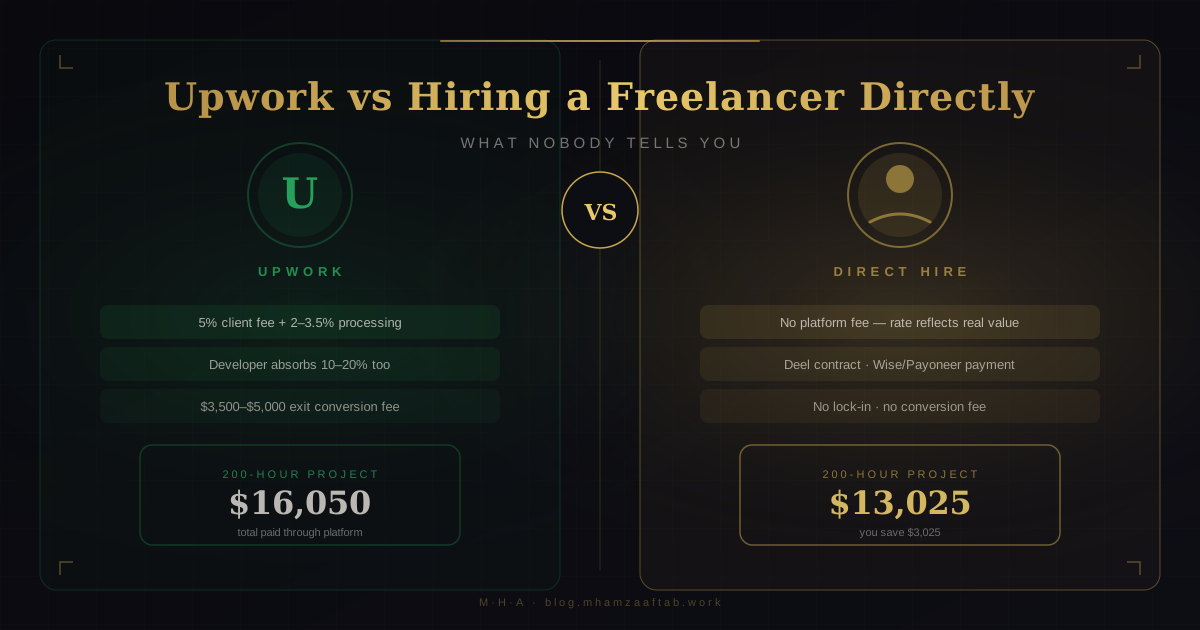
Take a 200-hour project at market rate. Here's what that actually costs on each path:
| Cost Element | Upwork | Direct Hire |
|---|---|---|
| Developer hourly rate | $75/hr | $65/hr (no platform fee to absorb) |
| Total at agreed rate | $15,000 | $13,000 |
| Client service fee (5%) | +$750 | $0 |
| Payment processing | +$300 | +$25 (Wise transfer) |
| Total paid | $16,050 | $13,025 |
| You save by going direct | — | $3,025 |
The $10/hr rate difference isn't Upwork developers being more skilled. It's the platform fee distributed across both sides of the transaction. The real cost of Upwork on a $15,000 project is over $3,000 — money that goes to the platform, not to your product.
For smaller projects the delta is proportionally similar. For longer engagements, it compounds. A six-month retainer at $5,000/month through Upwork costs roughly $18,000 more over the engagement than the same work billed direct — assuming the developer adjusts their rate at each new fee threshold.
And the compounding gets worse if you ever try to leave the platform cleanly.
The Lock-In Clause Nobody Reads
Upwork's Terms of Service include a non-circumvention clause. The premise: if you discovered a developer through Upwork, that relationship belongs to Upwork's ecosystem. If you want to move it outside — pay them directly, stop routing payments through the platform — you need to formally convert the relationship. And converting costs money.
As of 2024, the Upwork conversion fee is approximately $3,500–$5,000, or 10% of the projected annual contract value, whichever is higher. So if you plan to pay a developer $60,000 over the next year, the conversion fee is $6,000. For a relationship you discovered through a two-week trial project that cost you $800.
Most clients encounter this clause for the first time when they try to move a strong long-term contractor off-platform to simplify their billing. They've been working together for months. The relationship is solid. The overhead is annoying. They propose going direct. That's when the developer — usually reluctantly, sometimes awkwardly — has to explain that Upwork's terms prohibit it without the fee.
What this means practically: Upwork's fee structure isn't just an ongoing cost. It's a lock-in mechanism. If you find a great developer on Upwork and want to formalise a long-term working relationship, your options are:
- Keep routing payments through Upwork and keep paying their cut indefinitely
- Pay a lump-sum exit fee to convert the relationship
- Try to work around the clause — which violates the ToS and exposes you to account termination and potential legal action
This isn't a small-print surprise for edge cases. It's a financial decision that most clients make without realising it at the point of hire.
The practical advice: read the ToS before starting any engagement on Upwork. If there's any chance the relationship will extend beyond 12 months — or if you'd want the option to formalise things properly later — treat the conversion fee as part of the total platform cost and factor it into your decision from day one.
If you want to hire a developer without any of this overhead, I work on direct engagements with milestone-based contracts and no platform lock-in. Talk through your project — no pitch, no proposal deck, just an honest conversation about what you're building.
What Upwork's Trust System Actually Measures
The Job Success Score (JSS) is Upwork's primary trust signal. It looks like a quality metric. It measures something narrower.
JSS is calculated from: client satisfaction survey responses, contract completion rate, and dispute rate. What it does not measure: code quality, architectural decisions, communication depth during discovery, whether the product actually shipped, or whether the client was happy six months after delivery.
Three ways the JSS gets gamed that any business owner should know:
1. Private feedback exclusion. When a developer requests private feedback at contract close, Upwork excludes those responses from the JSS calculation if the client has also left negative public feedback. A developer with a string of dissatisfied-but-quiet clients can maintain a 95%+ score by consistently steering toward private feedback channels.
2. Milestone stacking. Disputes are more likely on long fixed-price contracts where scope shifts. Developers who understand this avoid them — stacking short milestones on short contracts instead, where each completed milestone registers as a positive signal regardless of what was actually delivered. A 100% JSS could represent twenty two-week sprints, none of which produced a working product on its own.
3. Network review inflation. Developers in the same communities and Discord servers exchange small positive-feedback jobs. A $50 completed task generates the same JSS signal as a $15,000 project. Ten mutual-review jobs with contacts, run before taking on real client work, inflates a fresh account's score quickly.
None of this means Upwork reviews are meaningless. A developer with a 95%+ JSS, 500+ hours billed, and consistent repeat clients is a meaningful positive signal. But it isn't a proxy for code quality.
What to look for instead: a portfolio with live product URLs you can actually click, a GitHub profile with consistent commit history over at least 12 months (not a spike of activity right before they pitched you), and a 15-minute call where they demonstrate problem-solving by asking better questions than you expected.
That's the signal the JSS can't give you — and it's the signal that actually predicts whether a project ships.
Building Trust Without a Platform
The objection that stops most clients from hiring directly is: "But how do I trust them without the review system?" The answer is a five-part stack that, when used together, gives you more signal than any JSS score.
Portfolio Audit
You don't need to read code to audit a portfolio. Ask: Is there a live URL? Does the product actually work on your phone right now? Is there a named client or company you can Google? Does the visual quality stay consistent across projects, or does it spike on one case study and drop on others — suggesting they're showing you work they didn't fully own?
Two deeply documented projects with live products beat ten screenshots. Any developer who can't show you something real and running has a gap worth asking about directly.
The Trial Project
A paid test task, scoped to 3–5 days, $300–$800 budget. Not free work. Not a "show us what you can do" spec exercise. A real, paid, small-scope task that produces something useful — a working API endpoint, a prototype screen, a technical review with written notes.
What you learn from a trial project that you cannot get from reviews: how they ask clarifying questions before starting (or whether they just start), how they handle one round of feedback, whether they deliver on the date they said they would, what their code structure looks like when they know you'll read it. That behavioural data is worth more than any star rating.
Before you get to hiring at all, make sure the scope is defined clearly. Ambiguous scope is the source of most freelance engagement failures — not developer dishonesty. If you haven't narrowed down what you're building, understanding what goes into an MVP and validating the idea first will save you the cost of a bad trial project.
LinkedIn Verification
Employment history consistency, mutual connections, company affiliations that match what they told you on the call. A developer with a coherent LinkedIn history going back four or five years, 500+ connections, and mutual contacts you can message is substantially lower-risk than a developer with a 100% JSS, no external web presence, and a GitHub account with three repositories created last month.
LinkedIn isn't perfect. But it's hard to fake over time, and it's verifiable in a way that a platform score isn't.
Milestone-Based Payments
Use Deel for the contract (IP assignment, kill clause, jurisdiction selection in plain English) and Wise or Payoneer for transfers. A payment schedule that protects both parties: 30% upfront (skin in the game for both sides), 40% at a defined mid-milestone, 30% on delivery and acceptance.
This structure gives you more practical protection than Upwork's escrow on a long engagement, because you control the milestone definitions and the release timing. You are not waiting for a platform dispute resolution process that can take weeks.
For context on what realistic project budgets look like before you structure payments, mobile app development costs in Dubai gives you current market rate anchors.
Contract Essentials
Three clauses that are non-negotiable regardless of platform:
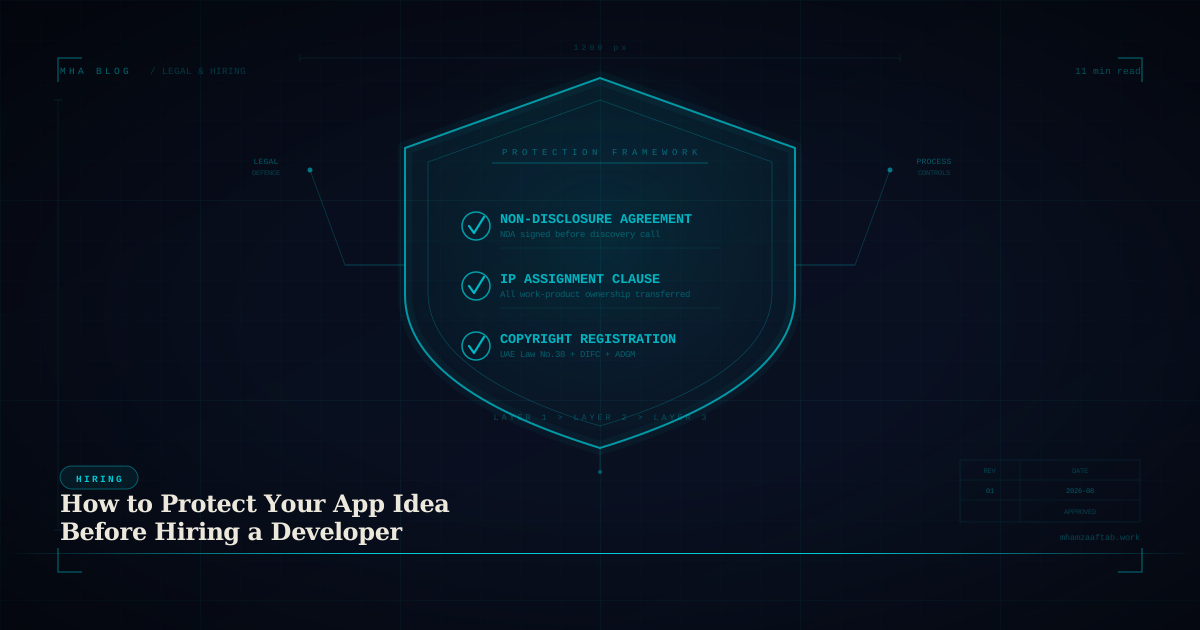
- IP assignment: All work product belongs to you on payment. No exceptions.
- Kill clause: A clear deliverable definition that lets you exit at any milestone if work is unsatisfactory, with rules for what gets paid in that scenario.
- Confidentiality: Standard NDA covering your product, data, and business context.
For a complete due diligence checklist on hiring a developer — what to ask, what documents to collect, what red flags to watch for — the hiring developer checklist covers the full process.
When Upwork Is Actually Worth It
I'm going to be direct here: the honest answer is not "Upwork is always a waste of money." There are four specific scenarios where the platform fee is a rational spend.
1. Your first ever developer hire with no vetting experience. If you have no reference point for what good code looks like, no one in your network who can evaluate a portfolio, and no intuition for what a realistic timeline or budget should be — Upwork's dispute resolution is a genuine safety net. Paying 7–9% overhead to have a third party you can escalate to if things go wrong is cheap insurance when you don't know what you're looking at. Use it, learn from the engagement, and build the judgment to hire direct next time.
2. Short projects under $3,000. The lock-in clause risk is lower on a short engagement. The escrow protection is proportionally more valuable on a small project where a non-payment dispute would otherwise cost more to resolve legally than the project is worth. The relationship is unlikely to extend to a point where the conversion fee becomes relevant. Upwork makes sense here.
3. One-off commodity tasks. Upwork and Fiverr are genuinely efficient for logo design, short copywriting passes, quick QA cycles, or a single landing page. These aren't developer relationship contexts where trust compounds over time. They're transactions, and platforms handle transactions well.
4. No referral path and no verifiable external presence. If the only available candidate has no live portfolio links, no consistent GitHub history, no mutual LinkedIn connections, and no one who can vouch for their work — the platform review system provides the only trust signal available. Use it. The fee is the price of that signal.
The Dubai and MENA Angle
A few things change when you're sourcing or paying developers from the Gulf.
Payments. AED-denominated bank accounts incur significant wire fees on USD or EUR transfers to international freelancers — typically 2–4% plus fixed charges. Wise reduces this dramatically; international transfers from a UAE account typically run 0.4–0.7%. On a $10,000 project, that's a saving of $150–$350 compared to a standard bank wire, with same-day or next-day settlement. Payoneer is also widely used in the MENA freelance market. Both are cleaner options than routing payments through Upwork just for the transfer infrastructure.
Freelancer visa context. A developer operating on a UAE freelancer visa or a UAE-registered sole establishment can issue a legal invoice. This matters for your VAT records and for contract enforceability under UAE commercial law. A developer on a visit visa cannot legally invoice you in the UAE — your contract enforceability depends entirely on informal trust, and that's a meaningful difference. Upwork provides a layer of enforceability that a visit-visa direct hire genuinely does not. If you're working with an international developer based outside the UAE and have no other mechanism for contract enforceability, the platform provides something real.
Cultural sourcing norms. In the Gulf, warm introductions carry significantly more weight than platform ratings. A direct introduction through GITEX, in5, Dubai Chamber of Commerce startup events, or a LinkedIn connection who has worked with the developer directly gives you social proof that a 98% JSS from an anonymous global marketplace cannot replicate. If you're in Dubai and you're not already using your network as a sourcing channel, you're leaving the highest-quality signal on the table.
Contract jurisdiction. For direct hires, DIFC and ADGM jurisdiction clauses in freelance contracts are enforceable and well-suited to technology service agreements. A short clause designating DIFC courts as the dispute forum gives both parties a clear path without needing a platform intermediary. Any UAE-qualified commercial lawyer can draft this in under an hour.
How to Make the Decision
Three questions that resolve most cases:
1. Is this your first developer hire and you have no independent way to evaluate candidates? Use Upwork. The dispute resolution and review system are worth 7–9% overhead when you have no other reference point. Treat the fee as the cost of a safety net you genuinely need.
2. Is the project over $5,000, or likely to extend beyond three months? The combined platform fees plus lock-in clause tip the economics clearly toward direct hire. At $5,000, you're paying roughly $400–500 in platform overhead. At six months, you're either paying that overhead indefinitely or paying a $3,500+ conversion fee to exit.
3. Do you have a referral path, a verifiable portfolio, and a trial project budget? Direct hire. You save money, avoid lock-in, and build a working relationship that compounds over time without a platform taking a cut.
Most projects answer themselves by the second question.
| Your Situation | Recommended Approach | Reason |
|---|---|---|
| First hire, no vetting experience | Upwork | Dispute protection is worth the 7–9% overhead |
| Short task under $3,000 | Upwork or Fiverr | Low lock-in risk, fast to spin up |
| Project over $5,000 or likely ongoing | Direct hire + Deel/Wise | Lock-in fee + platform fees exceed the trust cost |
| Warm referral from a trusted source | Direct hire | Social proof is already established |
| Dubai-based, active local network | Direct hire | Cultural and payment mechanics both favour direct |
| No referral path, international developer | Platform or Toptal | External trust signal is genuinely needed |
FAQ
How much does Upwork charge clients?
Upwork charges clients a 5% service fee on all payments, plus 2–3.5% in payment processing fees depending on the method (bank transfer is cheaper; credit card is more expensive). Total client-side overhead is typically 7–9% on top of the rate you agreed with the developer. This does not include the rate inflation developers build in to absorb their own platform fee, which adds another 10–15% on most of the engagement.
Is it safe to hire a freelancer outside Upwork?
Yes, when you use the right tools. A contract through Deel with an IP assignment clause and a kill clause, payments via Wise or Payoneer, a paid trial project to verify working style, and LinkedIn verification of employment history give you a trust stack that holds up as well as Upwork's review system for most engagements. The risk is higher for first-time hires with no vetting experience — in that case, a platform provides safety rails worth keeping.
Can I hire an Upwork freelancer directly?
Technically yes, but Upwork's Terms of Service prohibit it without paying a conversion fee if you originally connected through the platform. The fee is approximately $3,500–$5,000 or 10% of the projected annual contract value, whichever is higher. Attempting to work around the clause is a ToS violation and can result in account termination. The right approach is to either factor the conversion fee into your decision at the start, or hire through a separate channel from the beginning.
What is Upwork's service fee for clients?
The client service fee is 5% on all payments processed through Upwork, applied on top of whatever rate you agreed with the freelancer. Payment processing adds another 2–3.5%. So on a $5,000 payment, you pay $250 in service fees plus roughly $100–175 in processing — $350–425 above the developer's rate.
What happens if I hire a freelancer off-platform after meeting them on Upwork?
Upwork's non-circumvention clause in their Terms of Service applies. If you pay a developer outside Upwork after originally connecting through the platform, Upwork considers this a circumvention of their fee structure. They can charge you a conversion fee (currently $3,500–$5,000 minimum, or 10% of annual contract value), suspend your account, or both. The clause applies for 24 months from the last Upwork transaction with that freelancer.
How do I pay a freelancer without a platform?
Wise and Payoneer are the two most practical options for international transfers. Wise is typically cheaper for USD/EUR transfers from AED (0.4–0.7% vs 2–4% bank wire rates). Payoneer is widely used across MENA and South Asia freelance markets. For the contract, Deel handles international freelance agreements with IP assignment, milestone structures, and jurisdiction clauses. For UAE-based freelancers with a proper business registration, a standard bank transfer with a formal invoice works fine.
What is Upwork's Job Success Score?
The Job Success Score (JSS) is Upwork's measure of client satisfaction, calculated from survey responses after contract completion, contract completion rate, and dispute frequency. It does not measure code quality, architecture decisions, communication depth, or whether the product delivered actually worked. A 95%+ JSS is a positive signal about client relationships but is not a reliable proxy for technical competence. Supplement it with live portfolio links, a GitHub commit history, and a paid trial task before committing to a long engagement.
How do I protect myself when hiring a freelancer directly?
Three layers of protection: a proper contract (IP assignment clause, kill clause with deliverable definitions, confidentiality agreement — use Deel for the framework), milestone-based payments (30% upfront, 40% at mid-milestone, 30% on delivery and acceptance), and a paid trial project before the full engagement starts. The trial project is the highest-value step — a developer's behaviour on a three-to-five-day scoped task reveals more about how they work than any review system.
The Practical Next Step
If you're leaning toward direct hire, the next question is usually: "Where do I find the right developer?" That depends on what you're building. If you're evaluating a mobile app, React Native vs Flutter for startups helps you clarify what you're actually hiring for before you start interviewing. For realistic timelines before you structure a milestone payment plan, how long app development actually takes will anchor your expectations. For the full due-diligence process — how to evaluate a developer's portfolio, what to ask on a discovery call, and what contract terms you need — the hiring developer checklist covers it step by step.
If you are ready to hire without a platform: I'm a senior full-stack developer based in Dubai. No conversion clause, no service fee, no lock-in. Direct engagement, milestone-based contracts, paid trial project to start. Let's talk — first call is free, no pitch, no proposal deck.