What Investors Check in Your Tech Stack Before Writing a Cheque
Investors audit your tech stack before every Series A and B. Here is exactly what they check, which issues kill deals, and a 4–8 week preparation playbook for non-technical founders.

This article may contain affiliate links. See our Disclaimer for details.
Most founders I speak with in the weeks before their Series A are not panicking about the financial model or the market slide. They are panicking about the technical due diligence.
They should not — not because the review is unimportant, but because the thing investors are actually measuring is not the quality of the code. It is whether the founder understands what they have built, what the risks are, and whether the team is capable of addressing them. A clean codebase owned by a founder who cannot explain a single architectural decision is a worse signal than a messy codebase owned by a founder with a written remediation plan and a clear-eyed view of the work ahead.
That distinction changes everything about how you prepare.
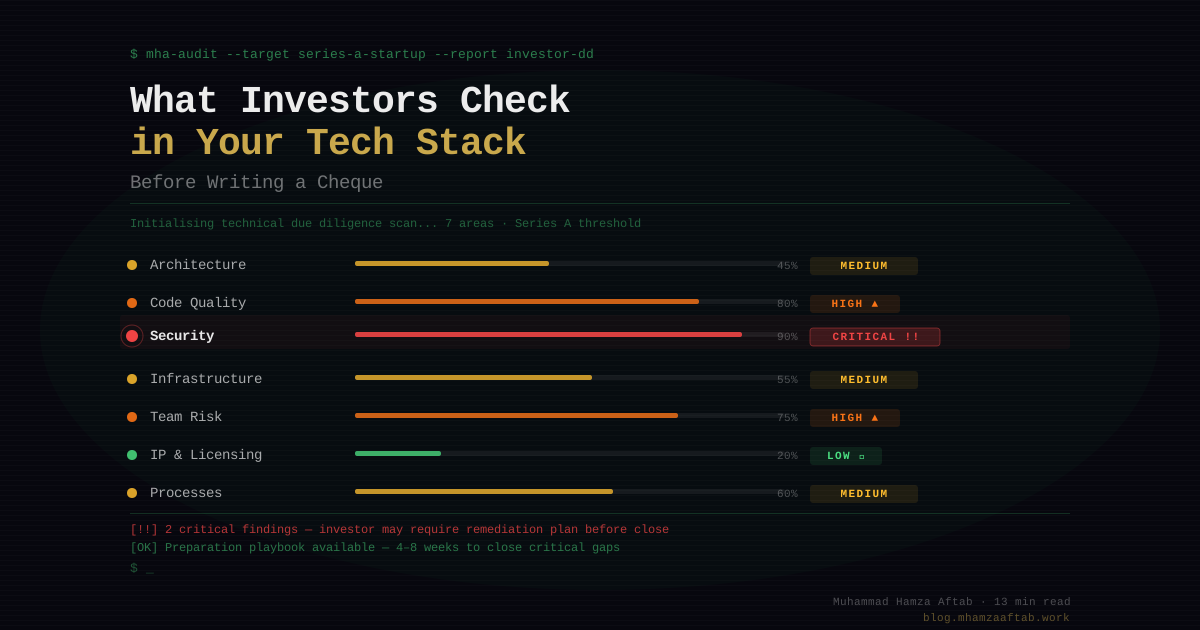
This guide covers what a technical review actually involves, the seven areas every investor examines, what genuinely kills deals versus what is manageable, and a realistic 4–8 week preparation plan for founders who are not engineers.
What Technical Due Diligence Actually Is (And When It Happens)
The difference between financial DD and technical DD
Financial due diligence examines your numbers — revenue, burn rate, cap table, contracts. Technical due diligence examines your product's underlying infrastructure. Think of it as an audit of one question: can what you have built actually support the growth trajectory your pitch deck describes?
The two processes run in parallel, but technical DD often determines whether financial DD continues at all. An investor who is excited about your commercial traction will stop the clock if the technical review reveals the product cannot scale without a full rebuild.
At what stage investors commission a technical review
At pre-seed and seed, most investors rely on founder conversations and a look at the live product. Formal technical reviews are uncommon at this stage.
At Series A — typically $3M–$15M — a technical review is standard practice for any fund putting meaningful capital in. The product is live, there are real users, and the investor needs confidence that the architecture can support 10x growth from here.
At Series B and beyond, the review is more intensive. Investors are evaluating whether the codebase is a productive asset or a liability that will consume engineering resource for years. They want evidence of engineering maturity: test coverage, CI/CD pipelines, documented architecture, and a team with genuine depth.
Who conducts it — and what their incentives are
Technical due diligence is typically conducted by one of three parties: an in-house technical partner at the fund, an external consultancy the investor regularly works with, or an independent senior engineer contracted specifically for the review.
Their job is not to kill your deal. It is to give the investment committee an honest risk picture. A reviewer who finds nothing wrong is not doing their job well — in my experience, every serious review surfaces findings. The question is whether the risks they find are manageable at the investment price. Understanding that framing changes how you engage with the process.
The Seven Areas Investors Evaluate
1. Architecture and Scalability — Can this system handle 10x growth?
Reviewers want to understand how your system is structured: is it a monolith (one large application), a collection of microservices, or a hybrid? Neither is automatically a red flag at Series A. A well-structured monolith is often the correct choice at this stage — the problem arises when the monolith is structured in a way that makes it impossible to extract individual components later without rewriting everything.
The core question is capacity for growth. If your product currently serves 500 users and your pitch describes 50,000 users within 18 months, reviewers will look at your database design, API architecture, and caching approach to assess whether that trajectory is realistic without a major rebuild.
If you are building a SaaS product, the decisions described in how to build a SaaS product — particularly multi-tenancy structure and database isolation — receive close scrutiny at this point. Getting those wrong early is expensive to correct under growth pressure.
Reviewers also consider your technology stack choices. A React Native vs Flutter decision made for the wrong reasons, or a mobile product built with tooling the founding team does not fully understand, can introduce structural constraints that only surface when the product comes under load.
2. Code Quality and Technical Debt — How much cleanup is baked into the buy?
Technical debt is not a red flag. Every live product has it. The question is whether the debt is acknowledged, tracked, and proportionate to the product's stage.
Reviewers look at code structure, naming conventions, inline comments, and the degree to which the codebase is navigable by someone new. A codebase that only the original developer can understand without a guided tour is a risk multiplier — it slows every future hire, every bug fix, and every new feature.
They also look at test coverage. A product with no automated tests is not necessarily broken, but it means every deployment is a manual gamble. At Series A this is a yellow flag. At Series B it becomes a deal condition.
3. Security and Compliance — Are your users and their data at risk?
Security has moved from a secondary concern to one of the slower parts of a technical review over the past three years. A breach post-investment can undo commercial progress overnight — investors have seen it happen often enough that they now examine it carefully. Four specific areas:
Dependency vulnerabilities — whether the third-party libraries your product relies on are reasonably current. An application running on packages with documented critical CVEs is a liability the investor inherits at close.
Authentication and authorisation — how the system verifies who users are and what they can access. Weak session handling, missing HTTPS enforcement, or broken access controls are serious findings — the kind that go into the report with a requirement for remediation before funds are released, not after.
Secrets management — whether API keys, database credentials, and service tokens are stored securely or hardcoded directly into the codebase. Hardcoded secrets in a Git repository, even a private one, are a finding that can pause a deal. If those secrets were ever in a public repository, even briefly, the finding escalates.
Data handling — for products storing personal data, GDPR compliance and (for UAE-based products) PDPL compliance. A product with no privacy policy, no data retention controls, and no deletion mechanism will not pass compliance review for European or Gulf enterprise customers.
4. Infrastructure and Reliability — What does the uptime story actually look like?
Investors want to see infrastructure appropriate to the product's stage. For most Series A products, cloud-hosted infrastructure on AWS, GCP, or Azure with standard managed services is the expected baseline.
What reviewers look for specifically: Is there monitoring in place? When something breaks at 2am, does anyone know before users do? A product with no error tracking and no uptime monitoring means the first signal of an outage is a support inbox full of complaints.
They also examine the deployment process. Is there a staging environment? Can you deploy without taking the product offline? Can you roll back a problematic release quickly? The absence of these does not kill a deal at Series A, but they are documented as findings with remediation expectations attached.
5. Team and Bus Factor Risk — What happens if one person leaves?
"Bus factor" is one of the questions I find founders least prepared for in a technical review: how many people would need to leave before the product becomes unmaintainable? A bus factor of one — a single developer who built and understands every part of the system — is a serious risk flag.
This surfaces frequently in startups where a solo CTO or a single outsourced developer built the entire product. If that person is not staying post-investment, or if they are staying but there is genuinely no one else who can work on the codebase independently, the investor is acquiring a product that is one resignation away from a crisis.
The decision between freelance developer vs agency for your initial build matters here: products built entirely by an individual freelancer, with no documentation and no knowledge transfer, often score poorly on bus factor review. It is a commercial risk, not just a technical one.
6. Development Processes and Tooling — Is this team professional or improvised?
This area often surprises non-technical founders — the review is not just about the product, it is about how the team works. What reviewers look at:
Version control — all code in a Git repository, with a branching strategy and code review before changes reach production. Without it, a reviewer cannot establish a reliable audit history — or verify that what is deployed matches what was reviewed.
CI/CD pipeline — whether deployment is automated or whether it means one developer running a script from their laptop. At Series A this is a yellow flag if absent; at Series B it is a cost assumption baked into the post-investment engineering roadmap.
Documentation — can a new engineer get the development environment running without a full day of hand-holding? That single question tells you more about documentation quality than any README word count.
Delivery cadence — evidence of regular, incremental shipping rather than long gaps followed by large batches of unreviewed changes. The commit history is a proxy for how the team actually works under normal conditions.
None of this requires enterprise-grade engineering process. But it does require evidence of intentional practice, not accidental outcomes.
7. Intellectual Property and Licence Risk — Do you actually own what you built?
IP ownership surprises more non-technical founders than any other area of a technical review — not because it is obscure, but because nobody raises it until the reviewer does.
Open-source licence risk is the most common form. If your product includes code published under a copyleft licence such as the GPL, you may be obligated to open-source your own code as well. Most products use permissive licences (MIT, Apache 2.0) without issue, but reviewers check specifically for GPL contamination in the dependency tree.
Contractor IP assignment is a frequent gap. If a developer built part of your product as a freelancer and there is no IP assignment clause in the contract, there is a legitimate legal argument that they retain ownership of that code. Investors want to see that all past contributors have signed IP assignment agreements before any funds change hands.
AI-generated code introduces emerging questions that reviewers are increasingly flagging. If significant portions of the codebase were built using AI coding tools, the intellectual property situation is more complex than most founders realise — training data provenance, copyright status of generated output, and Copilot's subscriber licence terms are all active legal questions. This is documented as a finding more often than it used to be.
Deal-Breakers vs. Minor Flags — The Tier That Matters
Not all technical findings are equal. Investors categorise issues by severity, and understanding which tier a problem sits in changes how you should approach your preparation.
| Issue | Severity | Why investors care |
|---|---|---|
| No version control | Critical | Cannot audit change history; no baseline for code review or collaboration |
| Hardcoded API keys or secrets in repository | Critical | Active security exposure; any contributor with repository access has production credentials |
| Single-developer bus factor with departure risk | Critical | Product becomes unmaintainable the moment that individual is unavailable |
| Missing IP assignment agreements from contractors | High | Legal uncertainty over asset ownership; may require retroactive contracts or renegotiation |
| Outdated dependencies with known critical CVEs | High | Known vulnerabilities in a live production system; inherited liability at close |
| No automated tests (Series B) | High | Every deployment is a gamble; technical debt compounds without a safety net |
| No monitoring or error tracking | Medium | Outages are invisible until users complain; undermines any reliability claims in the pitch |
| No CI/CD pipeline | Medium | Slows post-investment iteration velocity; adds engineering cost from day one |
| Limited test coverage (Series A) | Medium | Yellow flag, not a blocker; expect a remediation condition in term sheet |
| Monolith architecture (early stage) | Low / context-dependent | Acceptable at Series A if well-structured; flagged at Series B if scale has started |
| Mixed tech stack without documented rationale | Low | Signals engineering immaturity if unexplained; acceptable if a rationale exists |
The distinction between "deal-breaker" and "deal condition" matters. Investors who find critical issues do not automatically walk away — they adjust on price, on escrow arrangements, or on conditions that must be satisfied before funds are released. What can end a conversation is a combination of critical findings that were not disclosed and a founder who appears unaware of them.
Read why apps fail for the product-level counterpart to this conversation — many of the structural problems that surface in technical DD are the same ones that eventually end live products.
If you are looking at that table and recognise critical or high-severity items in your own product, it is worth getting an independent read before your review calendar is booked. Request a pre-due-diligence technical review →
The Honest Answer — What Happens If Issues Are Found
Scenarios: deal proceeds with conditions, price adjustment, delay and re-review
When a technical review finds significant issues, the most common outcome is a conditional deal. The investment proceeds, but part of the capital is held in escrow pending resolution of specific findings — alternatively, the investor adjusts the valuation to reflect the remediation cost they expect to carry post-close.
A delay for re-review — typically 6–12 weeks — happens when findings are significant enough that the investor wants to see meaningful remediation before committing. A pause, not a rejection.
Outright rejection based solely on technical findings is uncommon unless the issues were not disclosed, the product has no viable path to scale without a rebuild from scratch, or there is a fundamental IP ownership problem that cannot be resolved through contracts.
What investors tolerate at Series A vs. Series B
At Series A, investors generally accept technical debt proportionate to the product's age and team size. A two-year-old product built by a small founding team will have rough edges. What they want is evidence that the team knows where those edges are.
At Series B, the standard is higher. A product raising $20M+ is expected to have engineering maturity: documented architecture, test coverage, more than one person who understands the full system, and an active process for managing technical health. The question shifts from "can we work with this?" to "is this team ready to scale an engineering organisation?"
When to disclose proactively vs. wait for them to find it
Disclose proactively. Every time.
If you are aware of a significant technical issue — a database design that cannot handle horizontal scaling beyond current load, a developer who built 80% of the product and has recently handed in notice, a dependency with an unpatched critical vulnerability — name it before the review begins. Not because it removes the problem, but because finding it yourself and framing it before their reviewer does is a clear signal of self-awareness. Investors fund founders as much as they fund codebases.
How to Prepare in 4–8 Weeks
Week 1–2: Triage — run the audit yourself before they do
Before a technical reviewer is given access to your systems, you need an honest picture of what you have. You do not need to be an engineer to do this — you need to know which questions to ask your developer and which free tools to run.
GitHub Security Advisories — if your code is hosted on GitHub, the Security tab under your repository surfaces known vulnerabilities in your dependency tree. No additional tooling required.
Snyk free tier — connects to your repository and produces a dependency vulnerability report in plain English. The free tier covers one project, which is sufficient for most startups at this stage.
OWASP ZAP — a free web application security scanner you can run against your production URL. It identifies common issues including missing security headers, exposed admin paths, and HTTP/HTTPS misconfigurations.
Sentry free tier — if you do not currently have error tracking in production, add it now. Beyond its operational value, having error tracking in place is a signal to reviewers that you maintain basic production observability.
Make a list of everything you find. Do not attempt to hide findings you discover during this phase — document them, categorise them by the severity tiers from the table above, and prepare a plain-English summary of what you found and what the remediation plan is.
Week 3–6: Fix the critical and document the rest
With your triage list in hand, work with your developer to prioritise by severity.
Fast fixes — completable in days: Rotating any exposed API keys and revoking the originals. Adding error tracking if absent. Enforcing HTTPS everywhere. Patching or updating dependencies with critical CVEs. Adding a README that explains what the product does, how to run it locally, and where the key architectural decisions live.
Medium-term work — 1–3 weeks: Writing a concise architecture overview document. Creating a staging environment if one does not exist. Setting up a basic CI/CD pipeline — GitHub Actions has a generous free tier and covers most Series A needs. Reviewing contractor agreements and getting IP assignment clauses signed by anyone who contributed code without one.
Deep work — not realistic in 4–8 weeks: Restructuring a core database architecture. Refactoring a deeply entangled codebase. Adding comprehensive test coverage to a product that has none. Do not attempt any of these under time pressure before a funding round. Document them instead.
The documentation step for deep-work items is the most valuable preparation most founders skip. A one-page note that reads: "We know our current database schema does not support horizontal sharding beyond approximately 80,000 concurrent sessions. Our plan for this is a phased migration to [specific approach] in Q3 following the Series A close, budgeted at approximately $X and requiring Y weeks of engineering time" — that document is worth more to an investor than a rushed architectural change that introduces new instability.
Some of these fixes are fast — rotating exposed credentials takes an afternoon; adding basic error tracking, an hour. Others require a developer who understands not just what needs fixing, but how a technical reviewer will probe it and how to frame the remediation conversation with the investor. Knowing which category each item sits in before you start is half the work.
The conversation your developer needs to have with you before they walk in the room
The single most important preparation step for a non-technical founder is a direct, honest conversation with whoever built the product.
Ask them these five questions:
- If a senior engineer who had never seen this codebase wanted to understand it from scratch, what would take them longest?
- What are the three things you are most concerned about if the product had to support ten times the current load?
- Are there any parts of the codebase where you would be uncomfortable with another engineer reading the code?
- Is everything committed to version control? Are there any local-only changes or unreleased branches?
- Are there any open-source licences or contractor agreements we should review before an investor looks at IP ownership?
Their answers tell you exactly where to spend the remaining preparation time. If they cannot answer question one clearly, you have a documentation problem. If they hesitate on question four, you have a more immediate issue that needs attention before the review calendar is booked.
If the answers to those questions reveal more than you expected, or if you want someone to run that conversation and translate the findings into investor-ready language, let's talk before your review is on the calendar.
A Note for Founders Building in Dubai and the MENA Region
If your product is targeting the UAE or broader GCC market, a standard technical checklist misses several review points that MENA-domiciled investors — particularly those based in DIFC or ADGM — will raise.
UAE data residency requirements are growing in practical relevance. Certain categories of data — particularly those governed by the UAE Personal Data Protection Law (PDPL, Federal Decree-Law No. 45 of 2021) — carry restrictions on cross-border transfer. A product that stores UAE resident personal data exclusively on infrastructure in European or US regions may have a compliance gap that DIFC or ADGM-domiciled investors will flag during legal review.
DIFC and ADGM fintech compliance applies if your product falls within the scope of regulated financial services. Both free zones operate independent data protection regimes — the DIFC Data Protection Law 5 of 2020 and the ADGM Data Protection Regulations 2021. A fintech product under either jurisdiction will face data-handling questions that extend well beyond a standard technical checklist.
VARA requirements for digital assets are now in effect in Dubai. If your product involves tokens, digital assets, or any mechanism a regulator could classify as a virtual asset service, VARA registration is not optional. Investors in this space will look specifically for either active VARA registration or a written legal opinion confirming the product falls outside regulatory scope. "We think we are fine" does not close this question.
Arabic localisation and RTL support is asked about by an increasing number of MENA-focused investors. A startup claiming UAE or broader GCC market fit with no Arabic-language support and no evidence of RTL engineering in the codebase raises a credibility question. It signals either that the product is not ready for the market it claims to address, or that the distribution strategy has not been fully thought through.
For any of these areas, if your compliance position is uncertain, do not guess when the investor asks. "We have taken legal advice on this and the position is documented" is a strong answer. "I think we are fine" is not.
Frequently Asked Questions
What is technical due diligence for a startup?
Technical due diligence is an audit of a startup's technology, infrastructure, and engineering processes conducted by or on behalf of a potential investor. It evaluates whether the codebase is sound, whether the architecture can support projected growth, whether the team has the capability to maintain and develop the product, and whether there are hidden liabilities — security vulnerabilities, IP ownership gaps, or compliance failures — that would materially affect the investment's risk profile. It is standard practice at Series A and later, though some funds conduct abbreviated reviews at seed stage.
How long does investor technical due diligence take?
A standard technical due diligence process runs 2–4 weeks from the point when the reviewer receives access to the repository and infrastructure. The review itself — code reading, architecture interviews, security analysis — typically takes 3–7 days of active work. The additional time accounts for questions back and forth, documentation gathering, and the final written report. More complex products, or those with multiple codebases and legacy services, can extend to 6 weeks.
What are the most common technical due diligence red flags at Series A?
The findings that most often result in deal conditions or valuation adjustments at Series A are: a single developer who built the entire product and has no successor or written documentation; hardcoded secrets or API keys present in the repository history; no error tracking or monitoring running in production; critical dependency vulnerabilities left unpatched; and missing IP assignment agreements from past contractors. None of these automatically end a deal, but all of them will be documented as findings that require a named remediation plan before or shortly after close.
Can a non-technical founder pass technical due diligence without a CTO?
Yes — but the founder needs to be able to speak credibly about the product's technical state, even without having built it. What investors are measuring is self-awareness: do you know where the risks are, have you thought about them, and is there a plan? Bringing a trusted technical voice into the process — a fractional CTO, a technical advisor, or the lead developer who built the product — is standard practice and entirely acceptable. What damages a round is a founder who cannot answer basic architectural questions and has no one present who can.
What happens if investors find technical problems during due diligence?
The most common outcome is a conditional investment: the deal proceeds but part of the funds are held in escrow pending remediation of specific findings, or the valuation is adjusted to reflect the estimated remediation cost. A delay for re-review — where the investor asks for critical issues to be addressed before they commit — is less common but not unusual. Outright rejection based solely on technical findings is rare unless the issues were not disclosed, the product cannot function at meaningful scale, or there is a fundamental IP ownership problem with no clear resolution path. Proactive disclosure before the review begins is always the better strategy.
Before Your Technical Review
The most common reason a technical due diligence process goes badly for a founder is not a bad codebase. It is a founder walking into a technical interview with no trusted technical voice in the room and no clear map of their own product's risks.
A technical reviewer will ask your lead developer detailed questions — about architecture, about trade-offs made under time pressure, about the parts of the system that are fragile. If you have never had an honest conversation with that developer about what is solid and what is held together with compromises, that interview will surface things you are not prepared for.
The week before a review is too late to fix major structural issues. Four weeks is enough time to fix the critical ones, document the rest, and walk in with a position that signals self-awareness and seriousness rather than panic.
If you want a senior technical perspective before your investor call — a clear-eyed read of what you have built, where the actual risks sit, and what a credible remediation roadmap looks like — that conversation is worth having before the review is booked, not while it is in progress. Let's talk →