React Native vs Flutter: Which Should Your Startup Pick in 2026?
React Native or Flutter? A plain-English guide for startup founders — covering cost, hiring, build speed, and a clear 2026 recommendation. No jargon.

This article may contain affiliate links. See our Disclaimer for details.
I've had this exact conversation more times than I can count. A founder comes in with two developer proposals — one for React Native, one for Flutter. Both developers sounded authoritative. Both used words like "performance," "ecosystem," and "long-term maintainability." Now there are two quotes on the table and no obvious way to evaluate them.
Most articles about React Native vs Flutter for startups make this worse by refusing to commit to an answer. They list factors on both sides and end with "it depends on your needs." That's not advice — that's hedging.
This article gives you a clear recommendation. By the end, you will know which framework makes sense for your situation, what questions to ask your developer, and what red flags to watch for.
One quick prerequisite check before we go further: if you haven't decided whether you're building a mobile app or a web app at all, read whether to build a web app or mobile app first before continuing here. And if your app idea isn't validated yet, how to validate your app idea is where to start — the framework question is premature until you know people actually want the thing.
If you're past both of those decisions, keep reading.
The Short Answer (Before We Get Into It)
The default choice for most startups in 2026 is React Native with Expo.
Flutter (flutter.dev) wins under specific conditions: your app needs pixel-perfect UI consistency across iOS and Android as a core product requirement, on-device machine learning is central to what you're building (not just an add-on), or you already have a dedicated Flutter developer who has shipped apps to both stores in the last 12 months.
The one-line decision rule: if your developer has a web background and you're building an MVP, start with React Native and Expo. Switch to Flutter only if pixel-perfect UI or on-device AI is a core product requirement.
Everything below explains why, and when to break the rule.
What Are React Native and Flutter, Actually?
No code in this section. Just what each framework is, in plain English.
React Native — Built by Meta, Runs on JavaScript
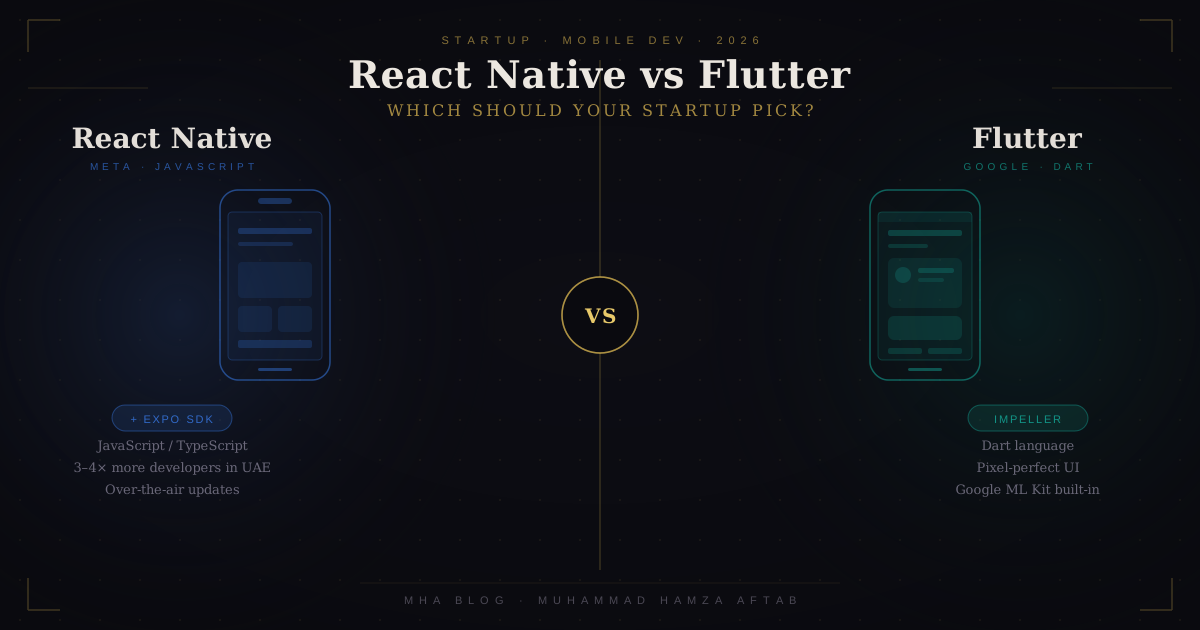
React Native is a framework created by Meta (Facebook) that lets you build mobile apps using JavaScript and TypeScript — the same languages used to build websites. A tool called Expo sits on top of React Native and handles most of the painful configuration work for you.
The practical implication: any developer who builds web apps with React can pick up React Native relatively quickly. Your existing web developer might already be able to build your mobile app without hiring someone new. And when you do hire, you're drawing from one of the largest developer talent pools on the internet — there are far more JavaScript developers than specialists in any other mobile language.
Flutter — Built by Google, Runs on Dart
Flutter is Google's cross-platform framework. Unlike React Native, Flutter uses a language called Dart, which Google created specifically for Flutter. Dart is not widely used outside of Flutter — which means Flutter developers are a distinct talent pool. They're not cross-trained web developers.
What makes Flutter technically interesting is its custom rendering engine, called Impeller. Instead of relying on each platform's native UI components, Flutter draws every pixel itself. Your app looks and behaves identically on iOS and Android — pixel-for-pixel — rather than adapting to each platform's native style. Google Pay and the BMW app are built with Flutter, which tells you it scales to production requirements without issue.
What They Both Promise
Both frameworks let you write one codebase that runs on iOS and Android — in practice, you get 70–90% code reuse, meaning most of your logic and UI only gets written once. Significantly faster and cheaper than building two separate native apps.
Both are proven at real scale. React Native powers parts of Facebook, Shopify's mobile app, and the Bloomberg app. Flutter powers Google Pay, the eBay Motors app, and dozens of enterprise tools. Neither choice is a gamble on unproven technology.
The 5 Factors That Actually Matter for Founders
No benchmarks. No synthetic tests. Every comparison below translates into a business consequence.
1. How Fast Can You Get to a Working App?
Expo's toolchain makes React Native unusually fast to prototype with — especially if your developer has any web background. Something testable on a real device within days, not weeks. The Expo Go app lets you scan a QR code and see your app live on your phone with no build pipeline involved. For an MVP, that speed matters a lot.
Flutter requires Dart proficiency before any of this starts. If you're hiring a developer who doesn't already know Dart, add 3–6 weeks of ramp time to your timeline. With a dedicated Flutter developer who knows the ecosystem well, build speed becomes roughly equivalent — but that's the constraint. React Native's speed advantage over Flutter comes entirely from developer background, not from the framework itself.
For a more detailed breakdown of how long each phase of a mobile build actually takes, see how long it takes to build an app in Dubai.
2. How Easy Is It to Find (and Keep) a Developer?
This is the most underrated factor for non-technical founders, and it almost never appears in technical comparisons.
React Native developers are roughly 3–4x more available globally than Flutter developers. In the UAE and MENA region specifically, the pool is large — web developers who work with React regularly make the transition to React Native via Expo in a matter of weeks. If your first developer doesn't work out, you can find a replacement without waiting months. More supply also means more pricing leverage.
Flutter developers in the UAE are a smaller cohort, and that gap is not closing as quickly as global Flutter adoption statistics suggest. The developers who can genuinely build a production-quality Flutter app — not tutorials, but a shipped product in the App Store — are in demand and command a premium. If your first Flutter developer leaves mid-project, finding a replacement at short notice in the UAE is a real operational risk, not a theoretical one.
Before you sign anyone, read the full developer vetting checklist — framework aside, the vetting process is the same and the red flags are identical.
3. What Does It Cost?
The framework itself doesn't have a license fee. Cost differences come from two places: developer day rates and long-term maintenance.
On day rates: React Native developers in the UAE generally cost less than Flutter specialists, purely because supply is higher. The premium for a strong Flutter developer in Dubai runs roughly 10–20% above a comparable React Native developer. On a 3–6 month project, that gap is real.
Here is what that looks like in practice:
| Developer Type | Day Rate (USD) | 3-Month Estimate (USD) |
|---|---|---|
| React Native + Expo (UAE, mid-senior) | $490 – $760 | $30,000 – $46,000 |
| Flutter (UAE, mid-senior) | $545 – $870 | $34,000 – $53,000 |
| React Native (remote, global) | $245 – $435 | $15,000 – $27,000 |
| Flutter (remote, global) | $300 – $520 | $18,000 – $31,000 |
On maintenance: Flutter's custom renderer means iOS and Android system updates almost never break your app. The rendering engine is self-contained — Apple releasing iOS 19 doesn't change how Flutter draws your UI. React Native's native modules (camera, biometrics, push notifications) rely on third-party packages that can lag behind major OS updates by weeks or months. This is manageable with experienced React Native developers, but it is a genuine maintenance consideration the Flutter camp correctly points out.
For full budget breakdowns, the mobile app cost in Dubai guide covers every cost tier in AED and USD.
4. Will It Perform Well Enough?
For 95% of startup use cases: yes, both are indistinguishable from native apps for real users.
Both frameworks have closed the performance gap with native iOS and Android significantly since 2022. Flutter's Impeller renderer handles animations smoothly without the CPU spikes that older Flutter versions were known for. React Native's New Architecture (JSI — JavaScript Interface) eliminates the old asynchronous bridge that caused jank in complex UIs.
The exceptions where performance is a genuine concern: real-time video processing, complex 3D rendering, heavy gaming, and AR/VR with sub-20ms frame budgets. If your app is a booking platform, marketplace, fintech tool, SaaS mobile companion, or content platform, performance is not your problem.
Flutter has a slight edge in animation consistency — because it draws its own UI, you don't get subtle differences between iOS and Android in how transitions and gestures feel. For design-led consumer apps where animation is central to the brand experience, this edge is real. For everything else, it doesn't move the needle.
5. What If You Need AI Features?
This is where 2025 and 2026 starts to shift the calculus slightly.
Flutter integrates tightly with Google's ML Kit, which provides on-device capabilities: text recognition, face detection, image labelling, barcode scanning, object detection, and language translation — all running locally without an API call. If your product's core value proposition involves real-time on-device vision or language processing (a scanning app, a translation tool, a document parser), Flutter's ML Kit integration is genuinely better and simpler to build with.
React Native handles API-based AI features — chatbots, content generation, recommendations, semantic search — cleanly and simply. The Vercel AI SDK and direct OpenAI/Anthropic API integrations work well in a React Native JavaScript environment. If your AI feature is "a chatbot that answers questions about my product," React Native handles it without any disadvantage.
The decision split: on-device ML as a core product feature (camera-based, real-time, no connectivity required) leans Flutter. API-based AI that calls a cloud model leans React Native.
For broader AI integration strategy, the AI integration guide for businesses covers the full cost and approach by tier.
React Native vs Flutter — Side by Side
| Factor | React Native (with Expo) | Flutter |
|---|---|---|
| Language | JavaScript / TypeScript | Dart |
| Learning curve (new team) | Lower (if web background) | Higher (new language) |
| Developer availability (global) | High | Medium |
| Developer availability (UAE/MENA) | High | Low–Medium |
| Time to MVP | Faster (web-leaning team) | Similar (dedicated Flutter dev) |
| Performance | Excellent (New Architecture) | Excellent (Impeller) |
| Animation / UI consistency | Good | Very good |
| OS update risk | Moderate (native modules) | Low (custom renderer) |
| On-device AI / ML | Good (third-party SDKs) | Excellent (Google ML Kit) |
| Package ecosystem | Very large (npm) | Large (pub.dev, growing) |
| Over-the-air updates | Yes (Expo EAS Update) | Limited (workarounds needed) |
| Best team fit | Full-stack / web-leaning devs | Dedicated mobile specialists |
| Best for | Most startup MVPs | Pixel-perfect UI, on-device ML |
If you're already in conversations with a developer and want a quick sanity check on what they're proposing before you sign anything — book a free 30-minute call. No pitch, just clarity on whether their recommendation fits your specific situation.
When Flutter Is the Right Call
Flutter is the correct choice in four specific situations. Not "might be better" — actually the right call:
1. Pixel-perfect UI is a core product requirement. You're building a design-led consumer app where iOS and Android must look and feel identical — same animations, same spacing, same font rendering. Fashion, luxury retail, or interactive media apps where the visual experience is the product.
2. On-device ML is central to what you're building. Not "we might add a chatbot later." The primary value proposition requires the camera to recognise something in real time, or text needs to be extracted from a document without a network request. If this describes your app, Flutter's ML Kit integration is worth the Dart learning curve.
3. You already have a dedicated Flutter developer with shipped apps. This condition overrides everything else. If someone on your team or in your network knows Flutter deeply and has apps in both stores right now, the hiring risk disappears. Use Flutter.
4. Complex custom animations are the product. Interactive maps, AR-style UI layers, frame-perfect motion that must behave identically across platforms. Impeller's consistent rendering makes Flutter the stronger choice here.
One path worth knowing about: FlutterFlow is a no-code builder that generates Flutter code. If you want Flutter output without a full Flutter specialist, FlutterFlow can get you to a prototype quickly. The trade-offs of no-code apply — see no-code vs custom development for when that's sensible and when it creates problems.
When React Native with Expo Is the Right Call
React Native with Expo is the default for most startups. Here's when to pick it:
You're building an MVP and need to validate quickly. Expo's toolchain lets you iterate fast — OTA updates mean you can ship a fix to users without waiting for App Store review, which matters when you're still learning what users actually want.
Your developer or agency has a JavaScript/web background. The most common situation. A strong React developer can build a solid React Native app with Expo. A strong Flutter developer is a different hire entirely.
You need over-the-air updates. Expo EAS Update lets you push bug fixes and content changes to users without going through App Store or Google Play review. Flutter has no equivalent out of the box — teams work around this with update packages, but it's not the same. If "fix a bug and get it to users today" is a real operational need, React Native wins clearly.
Your budget is under $25,000 and developer cost is a variable. Higher supply means more pricing options. Strong React Native + Expo developers exist in the UAE and remotely at a range of rates. Flutter specialist rates are compressed at the upper end because supply is tighter.
Your app is a marketplace, SaaS companion, booking tool, fintech product, or content platform. These are the most common startup app types. None of them need pixel-perfect cross-platform UI consistency or on-device ML. React Native handles all of them well.
You want maximum optionality if your first developer doesn't work out. Hiring a React Native replacement mid-project is far easier than finding a Flutter replacement at short notice, especially in the UAE.
For more on scoping your MVP correctly before you pick any framework, what is an MVP and how to build one and the full MVP cost breakdown are the next reads.
The Part Most Articles Skip — Expo
Here's something nobody says clearly enough early on: most of the horror stories about React Native — the broken Android builds, the Xcode nightmares, the Gradle configuration hellscapes — are stories about bare React Native from several years ago. They're not wrong, exactly. They're just describing a workflow that almost no startup uses anymore.
In 2026, React Native for a startup means React Native with Expo. Here is what Expo actually provides:
Expo Go — a free app on iOS and Android that lets your developer send you a QR code and you see the live app on your phone in seconds. No build pipeline, no provisioning profiles, no Xcode required on your end. This is how you review progress during development.
EAS Build — Expo's managed build service that handles App Store and Google Play submission without your developer needing a Mac for iOS builds. It substantially reduces the "it works on my machine" class of deployment problems.
EAS Update — Over-the-air update delivery. A JavaScript fix goes directly to all users, bypassing app store review. Not usable for native module changes, but invaluable for bug fixes, copy changes, and UI tweaks that would otherwise sit in review for 48–72 hours.
A curated set of pre-built native modules — Camera, location, notifications, biometrics, and filesystem access, all maintained by the Expo team and tested against iOS and Android updates. The "native module breaks on iOS update" problem is largely an issue with bare React Native using unmaintained third-party packages. Expo's maintained modules reduce this considerably — which is a more honest picture than the "React Native is fragile" narrative suggests.
Teams that need bare React Native for full native code access typically use Codemagic or Fastlane for CI/CD, but for most startups, EAS handles everything without that complexity.
Questions to Ask Your Developer (Whatever They Recommend)
Before you sign a contract with a developer or agency that's recommending one of these frameworks, ask these questions directly:
If they're recommending React Native:
- Do you use Expo or bare React Native? Why?
- Have you submitted apps to both the App Store and Google Play using EAS Build in the last 12 months?
- How do you handle native module compatibility issues when a major iOS or Android update ships?
- Can you show me a React Native app you've shipped that's live in the stores right now?
If they're recommending Flutter:
- Are you on the stable release channel or beta?
- How do you handle pub.dev package deprecations mid-project?
- Have you implemented Impeller-based custom animations in a shipped app?
- Can you show me a Flutter app in the App Store that you built in the last 12 months?
Red flags regardless of framework:
The developer insists on one framework without asking about your team's background, your timeline, or whether you need on-device AI. A strong opinion that isn't grounded in your specific project requirements usually means they're recommending what they know — not what you need.
"We use Flutter because it's better" — better at what, for which use case, with which team? The inability to complete that sentence is a problem.
No experience with EAS Build, Codemagic, or Fastlane for CI/CD pipelines. App store submissions are a real skill. If they've never deployed to both stores, that gap becomes your problem during launch week.
Cannot show shipped apps in that framework in the last 12 months. Tutorials and portfolio projects are not the same as a published, live app with real users. Insist on seeing something in the App Store or Play Store you can actually download.
The hiring developer checklist has a full vetting framework — the framework question is just one part of a complete evaluation. For context on whether to hire an individual or an agency, freelance developer vs agency walks through the trade-offs.
The Bottom Line
For most startups building a mobile app in 2026, React Native with Expo is the right starting point. Faster to staff, cheaper to hire for in the UAE, and Expo's toolchain solves most of the operational problems that gave React Native a difficult reputation. The one-line rule holds: web background, MVP stage, start with React Native.
Flutter is a strong framework with real advantages — but those advantages are specific. Pixel-perfect cross-platform UI. On-device ML as a core product feature. A dedicated Flutter developer already on your team. Outside those conditions, you're paying a hiring premium and accepting a smaller talent pool for benefits you probably won't use.
The framework itself is rarely what determines whether your app succeeds. The developer's quality, the clarity of your product spec, and how well you manage the feedback loop between building and testing — those are what matter. Pick the framework that gets you the best developer for the shortest ramp time at a cost you can defend.
FAQ
What is the difference between React Native and Flutter?
React Native uses JavaScript and TypeScript to build cross-platform mobile apps, rendering through native platform components. Flutter uses Google's Dart language and draws every UI element itself through a custom rendering engine called Impeller. Both produce apps that run on iOS and Android from one codebase — but the language, rendering approach, and developer talent pool are completely different. React Native has a much larger pool of available developers globally and in the UAE, which is the most practical difference for a founder who isn't writing the code themselves.
Is Flutter better than React Native in 2026?
Neither is objectively better — they're better at different things. Flutter has the edge for pixel-perfect UI consistency and on-device ML integration. React Native wins on developer availability, hiring cost, Expo's toolchain, and OTA update capability. For most startup MVPs, React Native with Expo is the stronger practical choice in 2026. Flutter is the right call when design consistency or on-device AI is a core product requirement, and when you have a dedicated Flutter developer already.
Is Expo the same as React Native?
No. Expo is a framework and toolset built on top of React Native. Think of React Native as the engine and Expo as the car — you can drive the engine directly (bare React Native), but most people are better off with the car. Expo adds managed build services (EAS Build), over-the-air updates (EAS Update), a library of pre-built native modules, and the Expo Go app for instant device testing. In 2026, almost all new React Native projects for startups use Expo rather than bare React Native.
Which is cheaper to develop with, React Native or Flutter?
React Native with Expo is typically cheaper for two reasons: more developers are available globally (lower day rates due to higher supply), and the Expo toolchain reduces build pipeline complexity (fewer billable hours on DevOps). Expect Flutter specialists to cost roughly 10–20% more than comparable React Native developers. On a 3-month project, that gap is meaningful — $4,000–$8,000 depending on seniority and location. Long-term, Flutter's OS update resilience can reduce maintenance costs, but that's a year-2 benefit, not a year-1 concern.
Can I switch from React Native to Flutter later?
Yes, but it's not a migration — it's a full rewrite. The two frameworks share no code (different languages entirely). If you build in React Native and later decide you need Flutter, you are rebuilding the app from scratch. The business logic transfers in concept but not in code. This isn't a strong reason to pick Flutter from the start unless you genuinely need its advantages today — rewrites are expensive and almost always avoidable with the right initial choice.
Which framework do most developers in Dubai use?
React Native has significantly more adoption in the UAE developer community, largely because the web developer base (React, Next.js, TypeScript) cross-trains into React Native via Expo relatively easily. Flutter's Dubai community is growing — active meetups, a growing cohort of specialists — but the talent pool is materially smaller. If you're hiring locally or through UAE-based agencies, React Native developers are far easier to find at competitive rates.
Should I use Flutter or React Native for an e-commerce app?
React Native with Expo. E-commerce apps — product listings, cart, checkout, user accounts, order tracking — are not cases where Flutter's pixel-perfect UI or on-device ML advantages apply. What matters for e-commerce is payment gateway integration (Checkout.com, PayTabs, Telr in the UAE), push notification reliability, and fast iteration on UI based on user feedback. Expo handles all of this well. The larger React Native talent pool also means more prior-art examples of e-commerce apps you can reference during development.
How long does it take to build an app with React Native vs Flutter?
With React Native and Expo, a web-experienced developer can typically get to a working MVP in 6–10 weeks for a standard-complexity app. Flutter with a dedicated Flutter developer is roughly equivalent — 8–12 weeks for the same scope. The difference isn't the framework; it's the developer's familiarity with it. A React Native developer using Expo for the first time is slower than an experienced Flutter developer. The app build timeline guide breaks down each phase in detail.
Not Sure Which Framework Your Developer Is Recommending?
If a developer or agency has proposed a tech stack and something about the recommendation doesn't sit right — or you just want a second opinion before you commit — I do free 30-minute tech stack reviews for founders at any stage. You don't need to be ready to build. The review is useful precisely when you're still deciding: it tells you whether the framework choice fits your project, whether the scope is realistic, and whether you're looking at the right kind of developer for what you're actually trying to build.
Most of the time it takes one conversation to identify whether you're looking at a sound recommendation — or over-engineering, unnecessary lock-in, or someone pushing what they know rather than what you need.
Get a free tech stack review — no pitch, just clarity
If you're still working out total project cost before making any decisions, the mobile app development cost guide for Dubai gives you full budget ranges in AED and USD across every complexity tier.